In the space of eight days in late October, four of the largest U.S. companies told investors how much they plan to spend this year, and most of it is going into buildings full of computers. Amazon chief executive Andy Jassy said the company still expects to spend about $220 billion this year, largely to build AI data centers. Alphabet kept its range at $195 billion to $205 billion, Microsoft put its figure at about $170 billion and Meta narrowed its range to $135 billion to $145 billion.
The phrase “data center” now turns up in earnings calls, utility forecasts and local zoning fights, usually with no explanation attached. This piece is that explanation: what a data center is, what goes on inside one, why AI changed the economics, and why the market watches every dollar these companies put into them.
A Building Full of Computers
In its simplest form, the Congressional Research Service writes, a data center is a physical facility that houses and runs large computer systems. Federal law uses a similar definition: a facility that primarily contains electronic equipment used to process, store and transmit digital information.
Almost everything people do online passes through one. A streaming show, a bank transfer, a search query and a chatbot answer are all handled by computers sitting in a data center somewhere, often hundreds of miles from the person using them. “The cloud” is the industry’s name for renting that computing power over the internet instead of owning the machines, and CRS describes the facilities that provide it as cloud data centers. There is no cloud without the building.
What’s Actually Inside
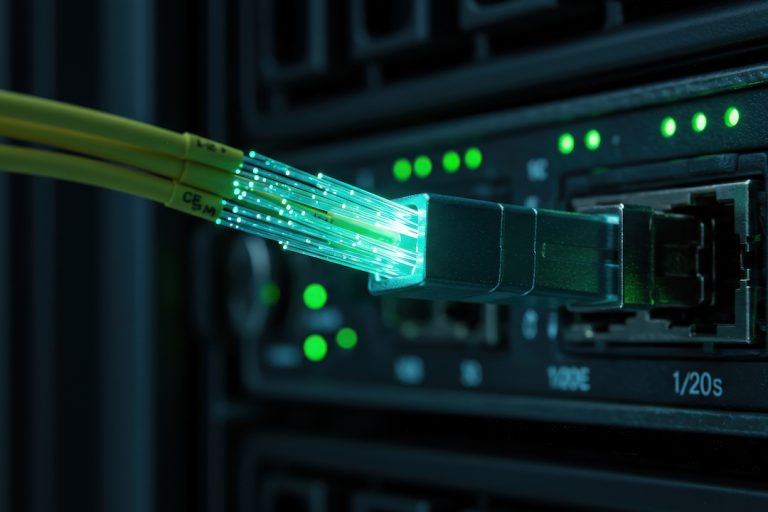
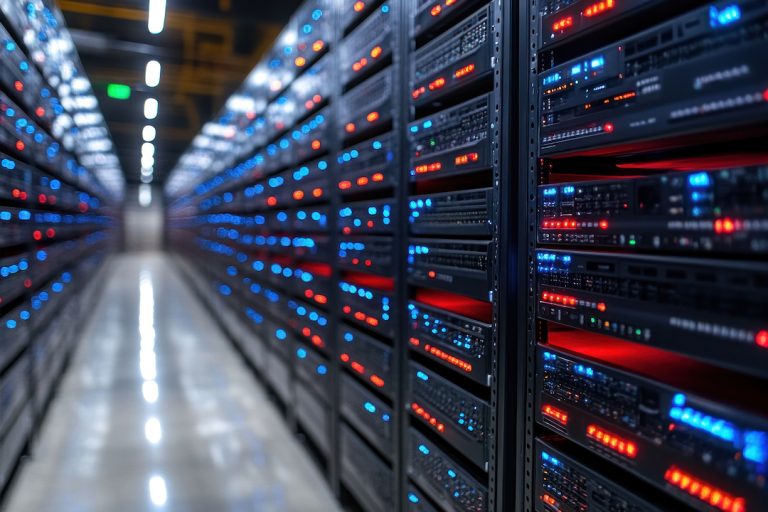
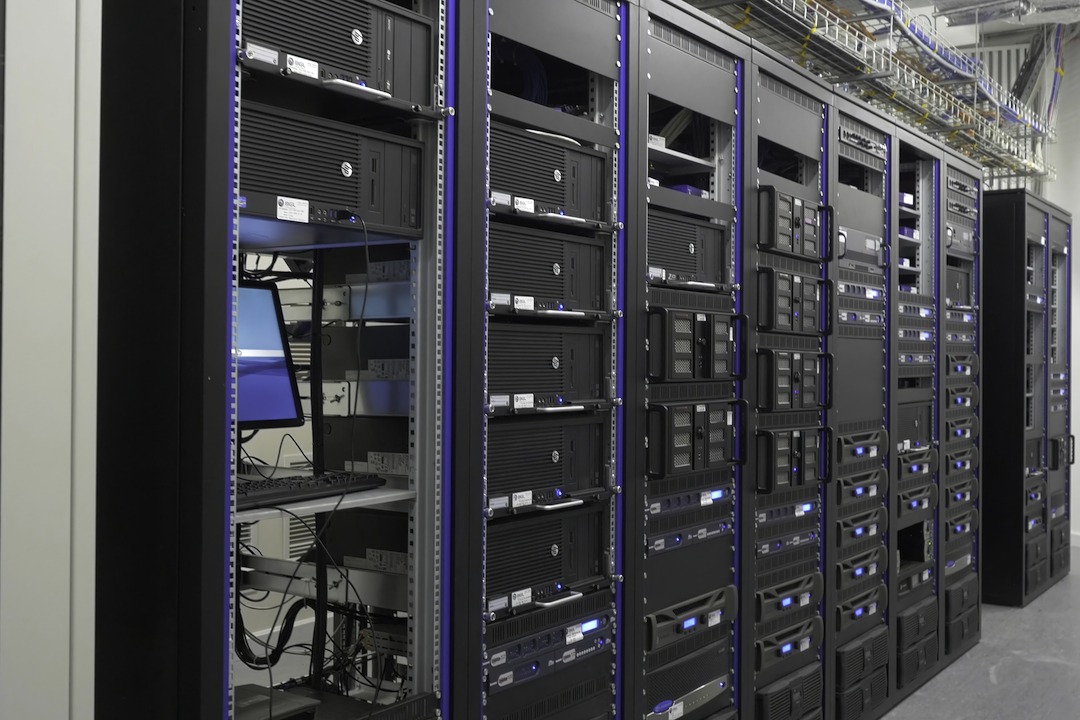
Walk into one and you would see long rows of metal racks, each stacked with servers, the computers that do the actual work. Alongside them sit storage systems that hold the data and networking gear that moves it in and out. CRS lists those three, servers, storage and network equipment, as the core of a typical facility.
The rest of the building exists to keep those machines running. Uninterruptible power supplies bridge short outages, and diesel or natural gas generators stand by for longer ones. Cooling is the other big job, because chips turn electricity into heat. Figures from Deloitte cited by CRS put computing and servers at about 40% of a data center’s electricity use, cooling at another 38% to 40%, and storage and networking at about 10%.
The industry tracks that overhead with a ratio called power usage effectiveness, or PUE: total facility energy divided by the energy the computing equipment uses. A PUE of 2 means half the power goes to the computers and half to cooling and power systems. Uptime Institute’s 2026 survey put the industry-wide average at 1.52, falling to 1.36 when larger facilities are given proportional weight, because big new sites tend to be the most efficient.
From Server Closet to Small City
The word covers a huge range of buildings. An enterprise data center is owned and run by one organization for its own computing needs. A colocation facility rents space and services in a shared building to many outside customers. Edge data centers are small sites placed close to users to cut delays. At the top end are hyperscale facilities, built by the largest cloud operators, which one common industry yardstick cited by CRS defines as at least 5,000 servers and 10,000 square feet. Hyperscale and colocation centers together held 74% of U.S. servers in 2023, according to Lawrence Berkeley National Laboratory figures cited by CRS.
Power is the clearest way to compare them. Traditional data centers use between 10 and 25 megawatts, according to the International Energy Agency, while hyperscale AI centers can exceed 100 megawatts, about the annual electricity use of 100,000 households. The largest under construction, the IEA says, could use as much electricity as 2 million households.
Why AI Changed the Math
Data centers existed long before the current AI boom. What AI changed is how much power each rack of equipment draws. A conventional server processor is rated at roughly 150 to 350 watts, while a data center graphics processor, the chip type most used for AI, runs at 350 to 700 watts, according to manufacturer figures cited by CRS.
The IEA estimates that the power density of AI servers rose elevenfold between 2020 and 2025 and is set to grow about fourfold more by 2027, when a single advanced rack could draw peak power equal to 65 households. The heat coming off one of those racks equals about 30 natural gas boilers, the IEA says, which is why cooling design keeps changing. CRS lists direct liquid cooling, already used for high-performance computing, alongside the air and chilled-water systems found in older halls. Uptime Institute’s survey found a growing number of operators reporting peak rack densities of 30 kilowatts or more.
The Electricity Bill
Globally, data centers used about 485 terawatt-hours of electricity in 2025, around 1.5% of the world’s demand, after growing 17% in the year. Consumption at AI-focused sites grew 50%. In the IEA’s central case, total use roughly doubles to 950 terawatt-hours by 2030, about 3% of global demand, with AI-focused consumption tripling.
The United States is where the numbers move fastest. Lawrence Berkeley National Laboratory’s June 2026 update for the Department of Energy estimates that U.S. data centers used 192 terawatt-hours in 2024, 4.7% of national electricity. Its reference case reaches 649 terawatt-hours, or 11.8%, by 2030, but the scenario range runs from 521 to 843 terawatt-hours, or 9.5% to 15.3%. In that reference case, AI servers account for 55% of all data center energy use by 2030.
The width of that range is the honest answer to “how much power will data centers need?” It depends on how many chips get installed, how long they stay in service and how hard they run.
Where They Cluster
Data centers bunch together. Northern Virginia is the world’s largest market, holding 13% of reported global operational capacity and about a quarter of capacity in the Americas, according to the state’s Joint Legislative Audit and Review Commission (JLARC). The commission credits a strong fiber network, reliable and cheap power, available land, nearness to major customers and a state tax incentive. An independent forecast commissioned by the commission found unconstrained power demand in Virginia would double within 10 years, with data centers the main driver.
Ireland shows what that concentration looks like at national scale. Data centers used 23% of the country’s metered electricity in 2025, up from 5% in 2015, according to the Central Statistics Office. All Irish homes combined used 28%.
Water, Power Bills and Pushback
The growth has brought local opposition. Large tech companies face backlash from politicians and residents over data center expansion, the Associated Press reported, and Amazon said in October it would invest more than $1 billion over five years in communities where it runs data centers.
Water is one concern. The IEA estimates that a 100-megawatt U.S. data center uses about 2 million liters of water a day on average, with about 725,000 liters, a little under 40%, consumed at the site itself, according to CRS. In The Dalles, Oregon, Google data centers accounted for nearly 30% of the city’s water use, CRS notes, citing local reporting.
Power bills are the other. Here the evidence is more mixed than the debate suggests. CRS, citing Berkeley Lab research covering 2019 to 2025, says the main drivers of retail electricity prices were grid investment, natural gas prices, disaster recovery and state policies, and that data centers were not major price influencers in most areas. States with the largest growth in data center demand generally saw prices fall, though some saw increases.
The concern is about what comes next. JLARC found that a substantial amount of new generation and transmission would be needed to meet Virginia’s forecast demand, even half of it. It estimated that a typical Dominion Energy residential customer could see generation- and transmission-related costs rise by $14 to $37 a month by 2040, in constant dollars, and warned that existing customers could carry stranded costs if the forecast demand never arrives.
Efficiency is improving, though not fast enough to offset demand. The IEA says the energy needed per AI task has fallen by at least an order of magnitude a year recently, but video, reasoning and agent-style tasks can use hundreds or thousands of times more energy per query than simple text answers.
Follow the Money
This is why data centers dominate market coverage. The IEA says spending by the largest cloud operators exceeded $400 billion in 2025 and is expected to rise about 75% in 2026, and that five technology companies now spend more than global investment in oil and gas production. The four 2026 plans in the lede add up to roughly $720 billion to $740 billion, an AktieGo calculation. Not all of it is data centers; AP notes Amazon’s figure also covers robots, semiconductors and satellites.
The spending is showing up in revenue. In the September quarter, Google Cloud revenue rose 103% to $30.7 billion, Amazon Web Services grew 39% to $46.0 billion, and Microsoft said demand for its AI infrastructure is outpacing available capacity. Jassy said Amazon is installing an AI chip about every 14 seconds.
It is also showing up in cash flow. Alphabet spent $51.4 billion on capital projects in the quarter, more than double a year earlier, and free cash flow was negative $9.1 billion. Meta’s capital spending of $34.91 billion left its free cash flow at negative $2.12 billion. Amazon shares fell 7% in after-hours trading as investors focused on its cash burn, AP reported.
Building is not always going to plan, either. Microsoft spent $45.2 billion in the quarter, below its own forecast of more than $50 billion, because some capacity that third parties were supposed to deliver was delayed. The IEA flags other choke points: orders for gas turbines rose 70% in 2025, and a shortage of high-bandwidth memory chips is expected to last through at least the end of 2027.
Five Things to Watch
FAQ
Not quite. The cloud is a way of renting computing power, storage and software over the internet. Data centers are the physical buildings where that computing happens. Every cloud service runs on servers sitting in a data center somewhere.
No. They run streaming, banking, email and websites, and they existed long before the AI boom: Ireland’s data centers already used 5% of the country’s electricity in 2015. AI is the fastest-growing part, though. AI-focused sites grew their electricity use 50% in 2025, and Berkeley Lab’s reference case has AI servers using 55% of U.S. data center energy by 2030.
About 1.5% of global electricity in 2025, according to the IEA, rising to about 3% by 2030 in its central case. The share is much higher in some places: 4.7% in the United States in 2024 and 23% in Ireland in 2025.
Not in most areas so far, according to Berkeley Lab research cited by CRS, which found grid investment, gas prices, disaster recovery and state policies were the main price drivers from 2019 to 2025. The open question is the future: Virginia’s JLARC estimated that a typical Dominion Energy residential customer could see related costs rise by $14 to $37 a month by 2040 if demand grows as forecast.
Because demand is still growing faster than supply. Google Cloud revenue rose 103% and AWS 39% in the September quarter, and Microsoft said AI demand is outpacing its capacity. Investors are weighing that growth against negative free cash flow at Alphabet and Meta, and against construction delays like the ones Microsoft reported.
Sources
- Associated Press via NY1: Amazon’s 3Q Results Miss Analysts’ Estimates but Posts Solid Sales Gains in Cloud Computing Unit, October 29, 2026
- 24/7 Wall St.: Alphabet Raised $41 Billion in One Quarter to Pay for AI, October 29, 2026
- Analytics India Magazine: Microsoft’s Azure Revenue Grows 48% in September Quarter, October 29, 2026
- Meta Platforms: Meta Reports Third Quarter 2026 Results (Form 8-K, Exhibit 99.1), October 21, 2026
- Alphabet: Alphabet Announces Third Quarter 2026 Results (Form 8-K, Exhibit 99.1), October 28, 2026
- Amazon.com: Amazon.com Announces Third Quarter Results (Form 8-K, Exhibit 99.1), October 29, 2026
- Congressional Research Service: Data Centers and Their Energy Consumption: Frequently Asked Questions (R48646), updated May 12, 2026
- Uptime Institute: The Growing PUE Advantage of Larger Data Centers, August 2026
- Uptime Institute via Business Wire: 16th Annual Global Data Center Survey Results, July 28, 2026
- International Energy Agency: Artificial Intelligence (topic page)
- International Energy Agency: Key Questions on Energy and AI, Executive Summary, April 16, 2026
- U.S. Department of Energy / Lawrence Berkeley National Laboratory: United States Data Center Energy Usage Report: 2025 Update, June 2026
- Lawrence Berkeley National Laboratory: United States Data Center Energy Usage Report: 2025 Update (publication page and abstract), June 2026
- Virginia Joint Legislative Audit and Review Commission: Data Centers in Virginia (Report 598, Summary), December 9, 2024
- Central Statistics Office (Ireland): Data Centres Metered Electricity Consumption 2025, July 7, 2026
Disclaimer
Sources: International Energy Agency, Lawrence Berkeley National Laboratory and the U.S. Department of Energy, Congressional Research Service, Virginia Joint Legislative Audit and Review Commission, Ireland’s Central Statistics Office, Uptime Institute, company regulatory filings, and wire and financial press as cited. Forecasts from the IEA and Berkeley Lab are projections and are revised between editions. The combined 2026 spending range is an AktieGo calculation from company guidance. AktieGo doesn’t independently verify third-party data, so figures should be checked at the time you’re reading this.
These are speculative investments carrying significant risk including potential total loss of capital. Coverage on aktiego.com is provided for informational and educational purposes only. aktiego.com is not a registered investment advisor. Nothing in this article constitutes financial, investment, or professional advice. Readers are encouraged to conduct their own due diligence and consult a qualified financial advisor before making any investment decisions. For more information please see our full DISCLAIMER.