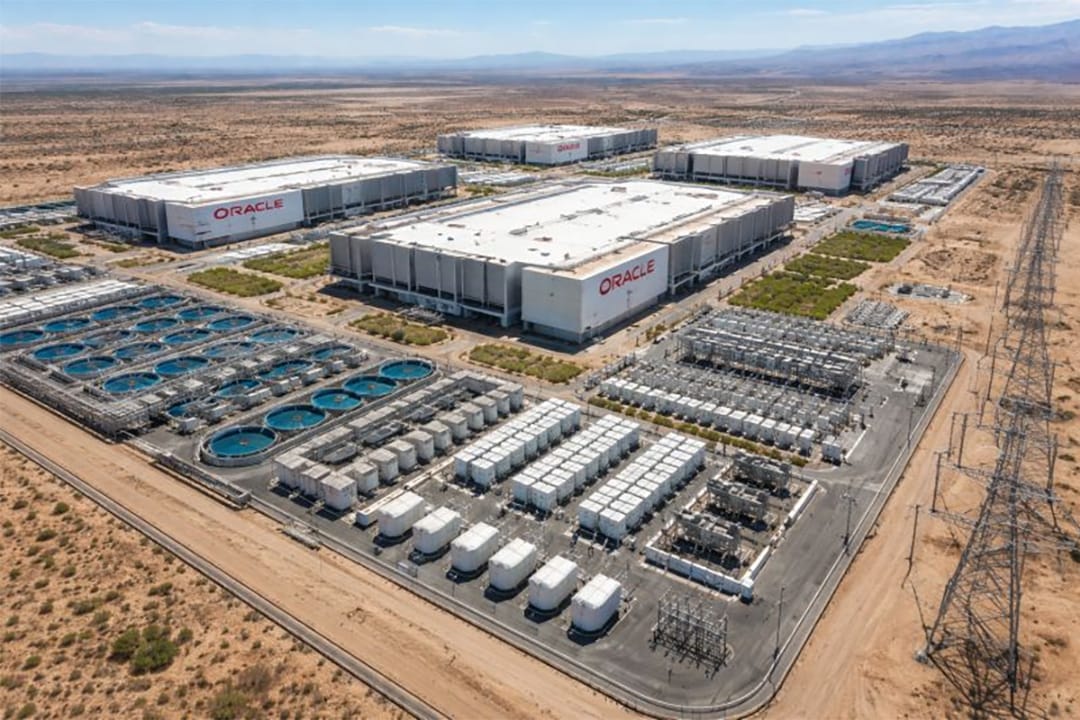
The AI data center energy problem has been solved on paper many times. Project Jupiter in New Mexico is trying to solve it in the ground.
Oracle (NYSE: ORCL) and BorderPlex Digital Assets announced on April 27, 2026 that Project Jupiter, an AI data center campus in Doña Ana County, New Mexico, will be fully powered by Bloom Energy fuel cells. The installed capacity: up to 2.45 gigawatts. The switch: away from previously planned gas turbines and diesel generators, consolidating the entire facility into a single microgrid campus.
At completion, this is expected to be one of the largest data center microgrids operating in the United States.
Why fuel cells rather than gas turbines
Gas turbines generate electricity through combustion. Fuel cells do not. Bloom Energy’s solid oxide fuel cells produce electricity through an electrochemical reaction, generating power without burning anything. The physics matter practically. No combustion means dramatically lower nitrogen oxide emissions. The new design reduces NOₓ emissions by approximately 92% compared to the gas turbines it replaces.
Water use is the second major advantage. Conventional gas turbine power generation and traditional data center cooling both consume significant quantities of water. In Doña Ana County, a high desert region where water scarcity is not theoretical, that is not an abstract environmental concern. Project Jupiter’s fuel cell microgrid uses a negligible amount of water. Combined with closed-loop, non-evaporative cooling systems designed to minimize day-to-day water use, the campus is designed to be a minimal draw on regional water resources.
A third advantage is grid independence. Fuel cell microgrids generate power on-site. Oracle has committed to bearing all energy costs for Project Jupiter, ensuring the campus places no additional load on the local electricity grid and does not affect residential electricity rates. For a county in southern New Mexico with limited grid infrastructure, a 2.45 gigawatt data center that is self-powered rather than grid-dependent is a fundamentally different proposition from what most large facilities represent to local utilities.
The scale of Project Jupiter
2.45 gigawatts is a substantial number. For context, a large nuclear power plant produces approximately 1 gigawatt. The data center campus Oracle and BorderPlex are building in Doña Ana County would, at full capacity, have installed power equivalent to more than two nuclear plants, generated entirely on-site through fuel cells.
Data center power demand has been one of the fastest-growing segments of US electricity consumption. The Lawrence Berkeley National Laboratory’s data center energy report estimated that US data centers consumed approximately 200 terawatt-hours of electricity in 2023, with AI-driven hyperscale facilities expected to drive demand significantly higher through the decade. The challenge for utilities across the country is how to serve that demand without destabilizing grid infrastructure or imposing costs on residential ratepayers.
Project Jupiter’s model, full on-site generation through fuel cells with zero grid draw, is one answer to that challenge. Bloom Energy’s CCO Aman Joshi described it directly as a model that can be replicated across America.
The community investment alongside the infrastructure
Project Jupiter has committed $50 million to repair, upgrade, and improve local water systems, $360 million in direct support for schools, infrastructure, and local services, and $6.9 million for workforce development, the Boys and Girls Club of Las Cruces, clean drinking water, community college, and habitat restoration. The project expects to create 4,000 construction jobs and support 1,500 ongoing positions, with explicit priority on local hiring, New Mexico’s skilled trades and union workforce, local suppliers, and contractors.
Doña Ana County and the broader Las Cruces metropolitan area have historically had limited access to large-scale industrial investment. The combination of advanced computing infrastructure, cleaner power generation, and substantial community investment is the specific value proposition BorderPlex chairman Lanham Napier described when discussing a vision for the region as a tier-one industrial engine.
Bloom Energy’s positioning in the data center market
Bloom Energy has been moving aggressively into data center power supply. Its partnership with Oracle, first announced in 2025 and now expanded to cover Project Jupiter’s full power load, represents one of its largest single deployments. Bloom’s solid oxide fuel cells run on natural gas or hydrogen, with the flexibility to shift toward green hydrogen as that supply chain develops.
According to BloombergNEF’s energy storage and fuel cell market analysis, on-site fuel cell generation for data centers is growing faster than any other fuel cell application segment, driven by the combination of reliability requirements that grid-dependent power cannot consistently meet and the environmental commitments that major technology companies have made to their investors and stakeholders.
A 2.45-gigawatt campus powered entirely by Bloom fuel cells, operating as a self-contained microgrid, is the most concrete proof of concept that model has yet produced.
Sources
- Lawrence Berkeley National Laboratory — US Data Center Energy
- BloombergNEF — Fuel Cell Market Analysis
- Bloom Energy — Official Website
- Oracle — Investor Relations
Editorial disclosure
This article is based on a press release issued by Oracle Corporation and has been independently rewritten and editorially expanded. It covers the announcement that Project Jupiter in Doña Ana County, New Mexico will be fully powered by Bloom Energy fuel cells. Oracle trades on NYSE under the ticker ORCL. Bloom Energy trades on NYSE under the ticker BE. Project Jupiter capacity figures and community investment commitments are as reported by Oracle and have not been independently verified. Market context is sourced from Lawrence Berkeley National Laboratory and BloombergNEF. Commentary reflects the author’s own assessment. The information provided on this website is for informational and educational purposes only. Our content is derived strictly from verified online sources to ensure accuracy and objectivity. This analysis does not constitute financial, investment, or professional advice. Readers are encouraged to consult with qualified professionals before making decisions based on this information. For more information, please see our full DISCLAIMER.