PAID PROMOTIONAL CONTENT: This article has been prepared and paid for by Radiant Uranium Corp. (CSE: RUC; OTC: RUCCF; FSE: V0O0) and should not be considered independent editorial content. Full disclosure follows the Sources section below.
The scientific and technical information in this article has been reviewed and approved by Tim Henneberry, P.Geo., a Qualified Person as defined by National Instrument 43-101, Standards of Disclosure for Mineral Projects. Mr. Henneberry is a director and consultant to Radiant Uranium Corp. and is not independent of the Company for the purposes of NI 43-101.
On October 27, the US Department of Energy offered Constellation Energy a conditional loan commitment of up to $5 billion to get more power out of reactors it already runs. Energy Secretary Chris Wright announced it at Constellation’s Byron Generating Station in Illinois, POWER magazine reported.
The money targets uprates, upgrades that raise the output of existing nuclear plants. Eight plants are on the list: Braidwood, Byron, Clinton, Dresden, LaSalle and Quad Cities in Illinois, Calvert Cliffs in Maryland, and Limerick in Pennsylvania. Together they could add nearly 1.1 gigawatts, enough to power more than 930,000 homes, according to the Department of Energy. The commitment is conditional. Constellation still has to meet technical, legal, environmental and financial conditions before any money moves, and the company says it is not a final investment decision on any individual project. Constellation is not affiliated with Radiant.
It was the second offer of its kind this month. Vistra was offered up to $4.2 billion on October 5, taking the two commitments to as much as $9.2 billion, POWER noted. Private buyers are pushing in the same direction. Constellation says 20-year agreements with Google and Amazon have already driven more than $7 billion of its own investment for about 1,080 MW of added nuclear capacity. Google’s share alone is an 890 MW uprate program in Illinois, Pennsylvania and New Jersey, announced October 6.
Every one of those extra megawatts runs on uranium. A reactor pushed to higher output burns through fuel faster over its life, and uprates across a fleet add up. That demand lands on a US fuel market that buys most of its uranium abroad, at a moment when the price utilities pay for long-term supply has just hit a record.
For Radiant Uranium Corp. (CSE: RUC; OTC: RUCCF; FSE: V0O0), a Canadian explorer with three uranium projects in Saskatchewan’s Athabasca Basin, that backdrop matters. Canada was the single largest origin of the uranium US reactor operators took delivery of in 2025. Radiant has no resource and no production. Its projects sit at the permitting and early-exploration stage. What it does have is ground in the jurisdiction the US already leans on most.
Why Utilities Are Paying More for 2030 Than for Today
Utilities rarely buy uranium on the spot market. They lock in supply years ahead through term contracts, so the term price is the number that shows what reactor owners expect to pay for fuel they need later.
That number reached US$96 per pound in August 2026, an all-time high, according to Sprott Asset Management’s September 24 uranium report. Sprott noted it cleared the prior cycle high set nearly two decades earlier. Cameco’s published month-end data shows the long-term indicator at US$96.50 at the end of September, up from US$89.00 at the end of January.
Spot has moved the other way for much of the year. It closed January at US$94.28, slid to US$84.18 by the end of May, then climbed back to US$89.63 by September 30, per the same Cameco series. Spot remains well short of its US$107 peak from early 2024 and the US$136 high of 2007, NucNet reported.
A term price sitting above spot says something about what buyers fear. Reactor owners appear more focused on locking in pounds for 2030 than on next month’s deliveries.
One Pound in Fourteen Comes From Home
The US Energy Information Administration’s 2025 Uranium Marketing Annual Report, released July 29, 2026, puts the scale of the problem on one page. Owners and operators of US civilian reactors bought 46.9 million pounds of U₃O₈ equivalent in 2025 at a weighted average of US$58.46 per pound. US-origin material made up 7% of deliveries.
Canada led at 32%. Kazakhstan followed at 28%, then Australia at 15% and Uzbekistan at 7%.
The forward book looks thinner still. The EIA counts 186 million pounds of unfilled requirements through 2035 against 174 million pounds of maximum deliveries already under contract for 2026 to 2035. Sprott’s coverage analysis shows US utilities’ contracted supply dropping from about 60% of needs in 2030 to 9% by 2033.
Domestic output is rising off a very low base. US mills and in-situ operations produced about 2.1 million pounds in 2025, more than triple 2024 and the most since 2017, per the EIA. The first quarter of 2026 added 1,039,075 pounds from six facilities across Wyoming, Texas and Utah, ANS Nuclear Newswire reported. Sprott estimates US commercial reactors need roughly 49 million pounds a year.
A 2028 Deadline and a $2.7 Billion Head Start
Policy has been stacking up since 2024. The Prohibiting Russian Uranium Imports Act was signed in May 2024, and the Department of Energy can grant waivers for Russian enriched uranium only until January 1, 2028. Russia supplied 26% of the foreign-origin enrichment services bought by US operators in 2025, per the EIA. The waivers covering that supply run out in about 14 months.
In May 2025, four executive orders set a goal of quadrupling US nuclear capacity to 400 gigawatts by 2050 and having 10 new large reactors under construction by 2030. The Department of Energy followed in January 2026 with US$2.7 billion in awards to rebuild domestic enrichment.
Then came trade. On January 15, 2026, Proclamation 11001 concluded a Section 232 investigation into processed critical minerals, a category that includes uranium. No tariffs were imposed at that stage. Commerce and the US Trade Representative were directed to negotiate supply agreements and to consider price floors, with further action possible if talks fail, according to Covington & Burling’s summary.
Federal buyers are also lining up. Sprott reports the National Nuclear Security Administration is assessing purchases of about 4 million pounds a year of US-origin U₃O₈ over 10 years, beginning as early as 2030. That volume roughly matches all of current US production, and imported material generally cannot satisfy it.
Restarts Bought Time. Discoveries Come Next.
The 2026 edition of the OECD Nuclear Energy Agency and IAEA Red Book, released in September, says uranium projects typically take 15 to 20 years from discovery to production. It projects world reactor requirements of roughly 84,800 to 143,900 tonnes of uranium a year by 2050, up from about 64,500 tonnes at the start of 2025. Exploration and development spending topped US$1.78 billion in 2023 and 2024, yet the report described drilling for new projects as relatively stagnant, ANS Nuclear Newswire noted.
Prices have roughly tripled since 2020, and annual mine output has risen by about 60 million pounds over that span, mostly from restarted operations, according to Sprott. Restarts are finite. Sooner or later, new discoveries have to fill the pipeline, which is where explorers come in.
Three Projects, Three Next Steps
Radiant explores where the US already buys the most. Its three projects sit in Saskatchewan’s Athabasca Basin, one of the highest-grade uranium districts in the world, and each one has a defined next step in the field. Cross Lake has a Phase 1 and 2 program the Company describes as fully funded. Key Lake Road has permit applications filed for an IP survey and up to 30 drill holes. Gorilla Lake has up to 7,000 metres of diamond drilling in permitting.
The Red Book’s 15 to 20 year lead time makes the case for early-stage ground. Utilities short of contracted supply after 2030 will eventually need pounds from deposits that have not been drilled out yet. Explorers holding ground in proven districts are where that pipeline starts.
Cross Lake has moved fastest. Radiant announced its option on September 22, laid out a roughly $325,000 Phase 1 and 2 program on October 1, and completed the first option payment and share issuance on October 6. Phase 1 covers ground radiometrics and selective short-hole drilling to test for extensions and confirm grade. Phase 2 adds a high-definition IP survey to map the shape of the mineralization. Diamond drilling is planned for the first half of 2027. CEO Clive Massey said the goal is “to systematically build on the historical work at Cross Lake.”
Radiant holds Cross Lake under an option to earn 100% from Bromell Mining LLP, subject to a 1% net smelter return royalty, and does not yet own it outright. With $20,000 paid and 4,000,000 shares issued, the remaining terms are $40,000 by the first anniversary, then $140,000 and $250,000 in exploration spending by the third. Missing a milestone could end the option.
The draw is the Narrows Zone, which carries a 1979 historical estimate of approximately 371,038 lbs U₃O₈ to a depth of about 75 metres. Management describes the zone as open to depth.
Cross Lake historical estimate disclosure. Source and date: “Bralorne Resources Limited, 1979 Winter Drilling of the Narrows Zone ML 5255 (Formerly CBS 1074), Foster River Area, Saskatchewan,” by Rene Bissonnette, dated May 12, 1979, as cited by the Company, and documented in Saskatchewan Mineral Deposits Index record SMDI #0941, which records approximately 330,000 tonnes at 0.51 kg U₃O₈ per tonne (roughly 1.12 lbs/tonne) to about 75 metres depth. Relevance and reliability: the Company considers the estimate relevant because it attests to the potential of the property; its reliability is limited by the drill density, sampling and quality-control practices of 1979, and the original author noted the drilling was not detailed enough to prove the structure. Key assumptions and methods: blocks were drawn around the better drill intersections using true thickness, a strike length of half the distance between mineralized intersections on the 50-metre plan plus 5 metres beyond the last significant intersection, and a vertical depth of 75 metres. Categories: the 1979 author described the figure as “possible reserves,” a category not used under NI 43-101; the Company states it would be comparable to an inferred resource but was prepared before current classifications existed. More recent data: the Company is not aware of a more recent estimate; a 2008 drill program by Uracan Resources Ltd. confirmed the presence of uranium in the area. Work required: twinning a number of the historic holes and completing infill drilling would be needed to upgrade or verify the historical estimate as a current mineral resource. A qualified person has not done sufficient work to classify this historical estimate as a current mineral resource or mineral reserve, and Radiant Uranium Corp. is not treating the historical estimate as a current mineral resource or mineral reserve.
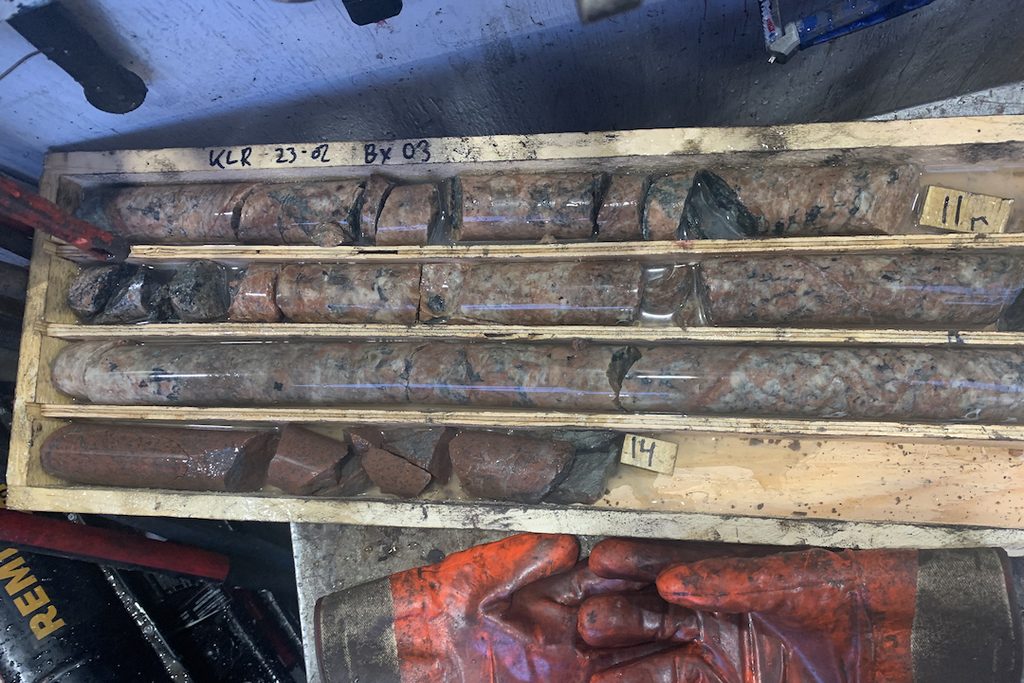
Key Lake Road has the road. Provincial Highway 914 runs through the roughly 5,521-hectare property, about 90 kilometres south of Cameco’s Key Lake mine, which is not affiliated with Radiant. The Company says road access allows drilling without a fly-in camp, and permit applications are filed for a 6.2-kilometre IP survey and up to 30 drill holes across the DD and Highway zones.
The highest historic grade on the property sits at the Highway Zone, where man-portable drilling in 2015 returned 1.9% U₃O₈ over 0.29 metres near surface. The Company’s working model, informed by NexGen’s Arrow deposit (not on Radiant’s property and not affiliated with Radiant), is that a feeder structure may sit beneath the shallow mineralization, at depths historic drilling never reached.
Historical drill result disclosure. The 1.9% U₃O₈ over 0.29 metres result is from historical man-portable drilling at the Highway Zone in 2015, as cited in the Company’s September 2026 corporate presentation, which lists its Key Lake Road historical sources as Tan & Wheatley (2008), Harrington (2016) and a 2023 KLR drill program summary. The interval is a downhole length, and its true width has not been determined. The original laboratory, analytical method and QA/QC details have not been confirmed. The Company has not verified this result. It is a single selective interval, is not necessarily representative of grade, width or continuity on the property, and is not a mineral resource estimate. The Arrow deposit is referenced for geological context only, and mineralization there is not indicative of mineralization on Radiant’s property.
Gorilla Lake is the largest block, 6,949.90 hectares inside the Carswell structure, near the decommissioned Cluff Lake Mine. Cluff Lake produced more than 62 million pounds of U₃O₈ between 1979 and 2002.
Adjacent property disclosure. Source: Orano Canada, “Cluff Lake Project Concludes Mining Life Cycle,” May 11, 2023. Cluff Lake was operated by Orano Canada and is not affiliated with Radiant Uranium Corp. Historical production from a nearby property is not necessarily indicative of mineralization on Radiant’s Gorilla Lake property.
On Radiant’s own ground, historic holes CLU-01 and CLU-07 intersected uranium mineralization associated with a structure extending more than 700 metres that remains virtually untested, according to the Company. Historic work concentrated on the western portion of the claim group, leaving most of the property with little modern exploration. Radiant is permitting up to 7,000 metres of diamond drilling, to follow an airborne EM survey and ground truthing, with the Cluff Lake airstrip supporting access.
Historical drill result disclosure. The CLU-01 and CLU-07 intersections and the 700-metre structure are historical information as cited in the Company’s September 2026 corporate presentation, which lists its sources as Beckett, R.J. (2006), ESO Uranium Corporation drilling (2006), and Logan Resources Ltd. option records for Disposition S-107580. The work was completed by previous operators. The Company has not verified these results, and they are not necessarily representative of mineralization on the property. No mineral resource estimate exists for Gorilla Lake.
Radiant Uranium Corp. is not affiliated with Radiant Industries, the US microreactor developer named in Department of Energy announcements, or with Radiant World, a Singapore iron-ore trader.
The Risks Investors Need to Understand
Junior exploration is the riskiest end of the mining market. Most exploration projects never become mines, and the companies exploring them usually have no revenue to fall back on. They fund their work by selling shares, which dilutes existing holders, and their stock can swing hard on a single drill result or a move in the commodity price.
Radiant fits that profile. It has no NI 43-101 resource and has not yet drilled any of its properties. As of October 28, 2026, Simply Wall St, drawing on S&P Global Market Intelligence data, reported cash of about CA$2.25 million against debt of about CA$725,000, and flagged less than a year of cash runway based on the Company’s free cash flow trend, along with substantial shareholder dilution over the past year. Further financing will likely be needed. The Cross Lake option can be lost if a remaining milestone is missed. Permits, First Nations and community consultation, contractors and short northern field seasons can each delay planned work.
The market backdrop can turn as well. Uranium prices are volatile, and spot fell roughly 11% between January and May of this year before recovering. Federal policy can change with an administration, the Section 232 outcome is still open, and several of the federal purchase programs described above favour US-origin uranium, which Canadian supply would not qualify for.
Investing in early-stage exploration is high risk, and you could lose your entire investment.
What to Watch Into 2027
Washington is now offering billions to get more output from existing reactors while it tries to rebuild a fuel supply chain it let shrink for decades, on a deadline set by its own Russian import ban. Contract prices are reflecting that pressure. Canada already supplies the largest share of what US reactors buy, and Radiant holds early-stage ground in Saskatchewan with historic clues it has yet to test. Field programs planned for late 2026 and 2027 will show whether those clues lead anywhere.
Sources
- Energy Department Announces $5 Billion Loan to Boost Nuclear Power, U.S. Department of Energy, October 27, 2026
- Constellation Secures Conditional DOE Loan Commitment of up to $5 Billion to Expand Nuclear Output, Constellation Energy, October 27, 2026
- DOE Offers Constellation up to $5B Loan for 1.1 GW of Nuclear Uprates at Eight Plants, POWER Magazine, October 27, 2026
- Record Term Prices Mark a New Phase for Uranium, Sprott Asset Management, September 24, 2026
- Uranium Price, month-end spot and long-term indicators, Cameco Corporation, accessed October 28, 2026
- Long-Term Uranium Price Hit All-Time High in August, Says Sprott, NucNet, October 1, 2026
- 2025 Uranium Marketing Annual Report, U.S. Energy Information Administration, July 29, 2026
- U.S. Uranium Production More Than Tripled in 2025, U.S. Energy Information Administration
- Domestic Uranium Production Report, quarterly table, U.S. Energy Information Administration
- Domestic Uranium Production Is Up; Prices Hold Steady, ANS Nuclear Newswire, July 7, 2026
- EIA Details 2025 Gains in U.S. Uranium Production, ANS Nuclear Newswire, September 1, 2026
- DOE Unveils Process for Russian LEU Import Waivers, World Nuclear News, May 23, 2024
- Reinvigorating the Nuclear Industrial Base, Executive Order, The White House, May 23, 2025
- One Year After Executive Orders, U.S. Nuclear Energy Renaissance Is in Full Swing, U.S. Department of Energy, May 2026
- Trump Administration Announces Results of Critical Minerals Investigation Under Section 232, Covington & Burling LLP, January 2026
- Constellation Signs 20-Year Deal with Google to Unlock 890 MW of New Nuclear Capacity, ESG Today, October 6, 2026
- Uranium 2026: Resources, Production and Demand, OECD Nuclear Energy Agency and IAEA, September 2026
- Newest Red Book Notes the Need for More U Investment, ANS Nuclear Newswire, September 15, 2026
- Radiant Uranium Corp. company website
- Canadian Securities Exchange Welcomes Listing of Radiant Uranium Corp., Newsfile Corp., August 6, 2026
- Radiant Uranium Provides Corporate Update, TheNewswire, September 24, 2026
- Radiant Uranium Outlines Fully Funded Phase 1 & 2 Exploration Program at Cross Lake, IRW-Press, October 1, 2026
- Radiant Uranium Completes Cross Lake Property Transaction, TheNewswire, October 6, 2026
- Kirkstone Metals Updates Gorilla Lake and Key Lake Road Permitting, TheNewswire, June 10, 2026
- Saskatchewan Mineral Deposits Index, SMDI #0941, Government of Saskatchewan
- Cluff Lake Project Concludes Mining Life Cycle, Orano Canada Inc., May 11, 2023
- Radiant Uranium Corp. (RUC) Company Information, Simply Wall St, accessed October 28, 2026
- Kirkstone Metals Engages a Pan-European Marketing Firm, Junior Mining Network, May 22, 2026
Disclosure
Paid Promotional Content
This page is a paid advertisement intended for informational and marketing purposes only. It should not be considered independent editorial content and does not constitute investment advice, a recommendation, or an offer or solicitation to buy or sell any security.
Radiant Uranium Corp. is a client of Bai Media Group Ltd., operating under its brand AktieGo. Radiant Uranium Corp. has agreed to pay Bai Media Group Ltd. €32,500 per month, for the creation and distribution of content under a four-month promotional program beginning September 2026. Bai Media Group Ltd. has not been granted stock options of Radiant Uranium Corp. as part of this arrangement. The cash compensation creates a financial interest in the Company and a potential conflict of interest. AktieGo and Bai Media Group Ltd. may buy or sell shares of companies profiled on this page before, during, or after publication.
Qualified Person
The scientific and technical information contained in this article has been reviewed and approved by Tim Henneberry, P.Geo., a Qualified Person as defined by National Instrument 43-101 — Standards of Disclosure for Mineral Projects. Mr. Henneberry is a director of Radiant Uranium Corp. and is not independent of the Company for the purposes of NI 43-101.
Data Verification and Historical Information
Tim Henneberry, P.Geo., has reviewed and approved the scientific and technical information presented in this article. The information is based on the Company’s public disclosure, available technical and assessment reports, historical exploration records and other supporting information available to the Company.
Certain scientific and technical information concerning the Company’s properties was generated by previous operators and is historical in nature. Verification of historical results is limited by the availability and completeness of original drill logs, sampling records, assay certificates, analytical documentation, quality assurance/quality control information and other supporting data. Review and approval of the inclusion of historical information in this article does not constitute independent confirmation of every underlying historical result. Specific sources and material verification limitations should be identified alongside the applicable information.
Any historical estimate discussed in this article is not a current mineral resource or mineral reserve. A Qualified Person has not completed sufficient work to classify the historical estimate as a current mineral resource or mineral reserve, and Radiant Uranium Corp. is not treating it as such. Historical estimates should not be relied upon as current estimates of mineral resources, mineral reserves or economic viability.
Historical drill results, radiometric measurements, gamma-probe readings and selective samples may not represent mineralization across a property and do not establish grade continuity or economic viability. Counts per second, or CPS, are measurements of detected radioactivity and do not directly establish uranium grade. Laboratory assays and additional geological work are required to determine uranium grades and the nature and continuity of mineralization.
Exploration Risk
Radiant Uranium Corp. is an early-stage exploration company. The Company’s properties, including the Key Lake Road, Gorilla Lake and Cross Lake uranium projects, do not contain a current mineral resource or mineral reserve as defined by NI 43-101. Historical exploration results, geological interpretations, geophysical anomalies, radiometric measurements and prospective exploration targets do not establish the existence of an economically viable uranium deposit.
The location of a property within the Athabasca Basin, or its proximity to uranium deposits, mines, processing infrastructure or discoveries on adjoining or nearby properties, does not establish that comparable mineralization exists on Radiant Uranium Corp.’s properties. Mineralization on adjacent or nearby properties is not necessarily indicative of mineralization on the Company’s properties.
Exploration may fail to identify economically significant mineralization. Planned exploration activities may be modified, postponed or cancelled and may require additional financing, regulatory approvals, consultation, property access, suitable weather and seasonal conditions, and the availability of contractors, equipment and personnel. Additional financing may not be available on acceptable terms and could result in dilution to existing shareholders.
Forward-Looking Information
This article contains forward-looking information, including statements concerning proposed exploration programs, geophysical surveys, permitting activities, drill targeting, planned drilling, anticipated exploration expenditures, the timing and interpretation of exploration results, potential discoveries, property acquisitions or advancement, future financing, uranium-market conditions and the Company’s future plans and objectives.
Forward-looking information contained in this content is based on assumptions and expectations believed to be reasonable as at the date of this content, including that required financing, permits and approvals will be available; consultation and access requirements will be satisfied; contractors, equipment and personnel will be available as planned; and exploration activities and laboratory analysis will be completed on anticipated timelines. Although these assumptions and expectations are considered reasonable, they are inherently subject to significant business, economic, geological, environmental, market, regulatory and competitive uncertainties and contingencies, many of which are beyond the control of Radiant Uranium Corp. There can be no assurance that these assumptions will prove correct or that the outcomes contemplated by the forward-looking information will occur.
Such risks and uncertainties include, among others, the speculative nature of mineral exploration; the absence of current mineral resources or mineral reserves; the possibility that historical results cannot be verified or reproduced; failure to identify economically significant mineralization; differences between exploration results and geological interpretations; failure to obtain necessary financing, permits, approvals, access or consultation outcomes; operational, laboratory or seasonal delays; contractor and equipment availability; changes in exploration plans; and uranium-price and capital-market volatility.
Securities Discussed and Context
Securities discussed: Radiant Uranium Corp. (CSE: RUC; OTC: RUCCF; FSE: V0O0). Companies, mines and properties referenced, including Cameco, the Key Lake mine, Orano Canada, the Cluff Lake Mine, Constellation Energy, Vistra, Google, Amazon, Sprott Asset Management and Radiant Industries, are named for market or geological context only, are not affiliated with Radiant Uranium Corp., and are not clients unless otherwise stated. References to US federal policy, executive orders, trade actions, Department of Energy loan commitments and NNSA programs are provided for market and regulatory context only and do not imply any relationship, contract, or endorsement between Radiant Uranium Corp. and the US government or any of its agencies. Figures should be reverified against live quotes at time of publication.
Information Sources and Investment Risk
The information presented here has been obtained from sources believed to be reliable, including Radiant Uranium Corp.’s public disclosures, website and available technical and historical records. AktieGo and Bai Media Group Ltd. make no representation or warranty, express or implied, as to its accuracy or completeness. Market prices, valuations, capital-structure figures, commodity prices and market statistics reflect the dates identified in the article and are subject to change.
Investing in early-stage exploration and junior mining companies involves a high degree of risk, including the potential loss of your entire investment. Readers should conduct their own independent research and consult a licensed financial advisor before making an investment decision. Neither AktieGo nor Bai Media Group Ltd. is a registered broker-dealer, investment advisor or financial planner.
Securities discussed: Radiant Uranium Corp. (CSE: RUC; OTC: RUCCF; FSE: V0O0). Share and market data are sourced from Canadian Securities Exchange company listing and public market-data providers as of the dates cited in the article. Figures should be reverified at the time of publication.
Coverage on aktiego.com is provided for informational and educational purposes only. aktiego.com is not a registered investment advisor. Nothing in this article constitutes financial, investment or professional advice. Readers are encouraged to conduct their own due diligence and consult a qualified financial advisor before making any investment decisions. For further information, please see our full DISCLAIMER.