
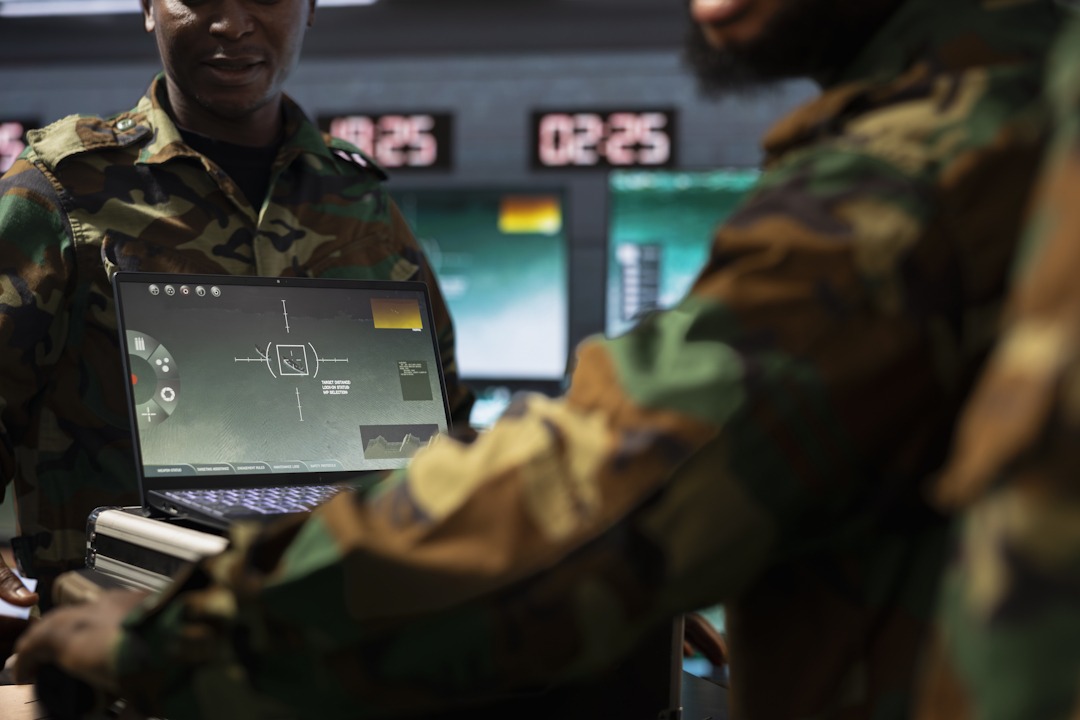
The Pentagon’s fiscal 2027 budget request carries close to 75 billion dollars for unmanned systems and counter-drone defense. Iran has shut down the Strait of Hormuz twice since February. Both numbers point at the same small group of companies.
AeroVironment and Kratos already trade at prices that reflect that demand. A smaller group of counter-drone and unmanned-systems companies, less picked over and considerably more volatile, does not.
Why Counter-Drone Spending Is Outrunning the Rest of the Defense Budget
The war in Ukraine settled an argument the Pentagon had been having with itself for a decade. Loitering munitions and small unmanned aircraft are no longer support equipment. They are now treated as a primary requirement for modern land forces, and the FY2027 defense budget reflects that shift directly: unmanned systems and counter-UAS combined make up a growing share of a defense budget that has itself climbed past 1.1 trillion dollars.
Section 1709 of the most recent National Defense Authorization Act bans Chinese-made components from military drone supply chains. That single provision reshaped procurement more than any new spending line, since it forced every prime and every subcontractor to requalify parts sourcing, and it handed a structural advantage to companies that already build or assemble domestically.
The counter-drone side of the market, jamming, detection, and interceptor systems built to stop someone else’s drone, is growing at roughly the same pace as the drone market itself. Industry estimates put the global counter-UAS market above 20 billion dollars by 2030, up from a fraction of that today, and the near-term driver is not a five-year forecast. It is a live conflict putting a dollar figure on what happens when critical infrastructure has no answer for a swarm of cheap aircraft.
The Strait of Hormuz Keeps Reopening the Case for Unmanned Systems
Roughly 27 percent of the world’s seaborne crude oil passes through the Strait of Hormuz. A ceasefire between the US and Iran took effect on April 8, 2026, mediated by Pakistan, and it has been violated by both sides more or less continuously since. By mid-July, Iran’s Revolutionary Guard Corps had shut down the strait entirely and attacked shipping in it, and the US carried out strikes on Iranian targets along the same waterway. President Trump has twice declared the ceasefire over and twice walked the statement back within days.
None of this is resolved. It is a live, recurring flashpoint that has already produced two separate Strait of Hormuz shutdowns in 2026, and every shutdown produces the same pattern: an oil price spike, a defense-stock rally, and a fresh round of Pentagon and allied government interest in exactly the kind of systems the four companies below build, from loitering munition defense to naval unmanned surveillance.
Draganfly (CSE: DPRO / Nasdaq: DPRO): Two Department of War Units Ordered the Same Drone in the Same Week
Draganfly’s first-quarter 2026 revenue rose 49.8 percent year over year to 2.3 million Canadian dollars, with adjusted gross profit up 67 percent and margin improving 210 basis points. Cash climbed to 147 million Canadian dollars from 90.2 million at the end of 2025. The company is guiding to 13.48 million Canadian dollars in revenue for full-year 2026 and 25.89 million for 2027, driven largely by military contracts rather than its older public-safety and agriculture business.
In May, two separate US Department of War units selected Draganfly’s Flex FPV systems within the same week, described by the company as reflecting continued demand for mission-ready FPV platforms across multiple defense applications. In June, Draganfly acquired a manufacturer of ultra-low-cost, mass-producible fixed-wing drones, adding that capability to a defense portfolio that already includes a next-generation counter-UAS platform combining tethered aerial intelligence, targeting, and coordinated ground-and-air drone defeat systems. H.C. Wainwright assumed coverage with a Buy rating and a 14 dollar price target; the broader analyst consensus is Strong Buy at a 13 dollar average target, implying substantial upside from a stock that traded in a 3.07 to 20.29 dollar range over the past year.
Draganfly is dual-listed on the CSE and Nasdaq, which gives it a liquidity profile the purely TSXV and CSE-listed names on this list do not share, and a revenue base, small as it still is, that most of its peers do not have yet.
Volatus Aerospace (TSX: FLT): A Counter-UAS Software Platform Launched Into a Market With No Incumbent
Volatus posted a record first-quarter gross margin of 35 percent in 2026, its highest Q1 margin on record, on revenue of 5.6 million Canadian dollars and working capital of 36.4 million. Full-year 2025 revenue was 34.2 million Canadian dollars, up 26 percent, though losses widened to 21.36 million as the company invested ahead of revenue. The stock trades around 0.46 to 0.48 Canadian dollars with a market capitalization near 335 to 350 million, and Canaccord Genuity initiated coverage with a Speculative Buy rating and a 1 dollar price target, implying roughly double the current share price.
In March, Volatus launched SKYDRA, its first Software-as-a-Service platform, built specifically for counter-UAS operational planning and simulation, aimed at armed forces, public safety agencies, and operators of airports, ports, and energy infrastructure. The same month, it moved to acquire the remaining 41.53 percent of Synergy Aviation it did not already own. A new manufacturing plant and the Condor XL, a long-range surveillance drone, were both expected to reach production before summer 2026.
The most recent addition to the story is personnel rather than product: Major General (Ret’d) Peter M. Fesler, a 27-year US Air Force veteran who served as Deputy Director of Operations at NORAD and contributed to INTERPOL’s global counter-UAS evaluation guidelines, joined Volatus’s advisory board in the past week. His background running roughly 35 million dollars of UAS and counter-UAS programs and 40 million euros of EU-funded defense and AI work gives Volatus a credibility marker that a company of this size would otherwise take years to build organically.
Swarmer (Nasdaq: SWMR): 100,000 Combat Missions in Ukraine, a New CEO Search, and a Stock That Has Ranged From $5 to $83
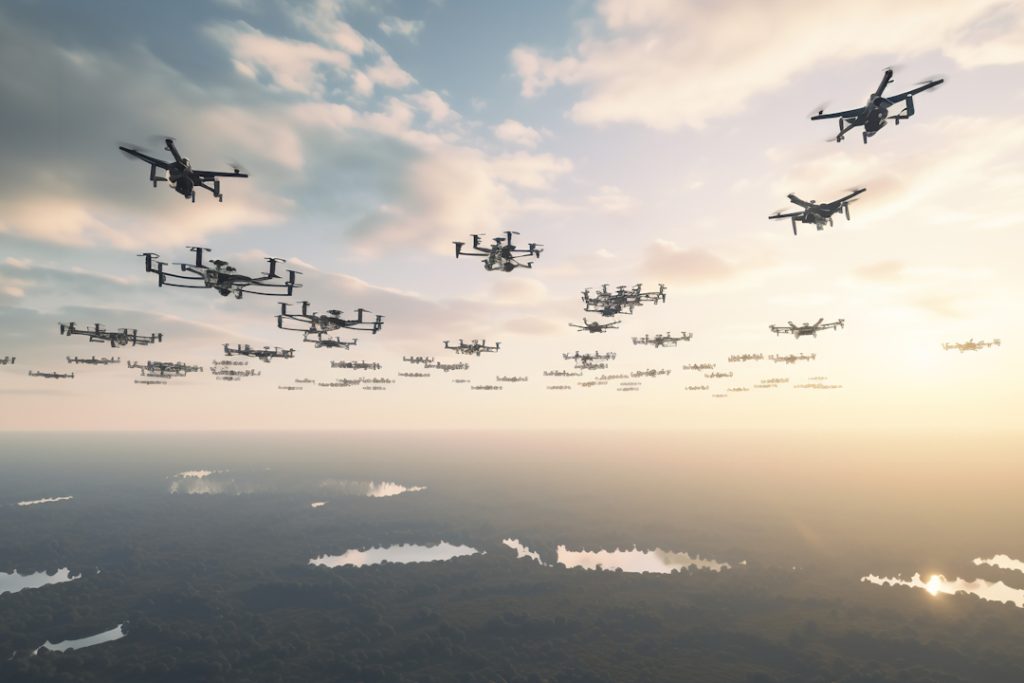
Swarmer does not build drones. It builds the software layer that lets one operator coordinate hundreds of them, autonomous swarm coordination and command-and-control software that has supported more than 100,000 real-world combat missions in Ukraine since April 2024. That distinction matters for how the stock trades: Swarmer is a pure bet on the intelligence layer of unmanned warfare rather than on any single hardware platform, supplier, or airframe.
The news flow through late July was dense. On July 30, Swarmer announced a custom compute platform collaboration with Lantronix. On July 27, it signed a data and drone memorandum of understanding with Brightline Interactive, a subsidiary of The Glimpse Group. On July 24, the company promoted Garrett Kasper to Chief Communications Officer as part of a broader executive realignment. In June, a contract update with SkyKnight added roughly 1 million dollars in revenue and expanded the software’s reach into the Czech Republic, and Swarmer signed a separate agreement with the US Department of War in early July.
Set against that is a governance change worth taking seriously: Serhii Kupriienko, Swarmer’s co-founder and Global CEO, resigned effective July 26, 2026, days before several of the announcements above. The company has not yet named a permanent successor, and Swarmer’s Q2 2026 earnings call on August 13 will be the first opportunity for management to address the transition directly. The stock’s 52-week range, from roughly 5 dollars to 83.30 dollars, already reflects how sharply the market reprices this name on news, good or bad. Swarmer’s chairman, Erik Prince, published a letter outlining company strategy in June, a detail some investors will read as a positive signal of engaged leadership and others as a reason for added scrutiny given his public profile.
Kraken Robotics (TSXV: PNG): What It Looks Like When a Small Cap Actually Graduates
Kraken does not belong on a list of overlooked names anymore. Two years ago this was a small, thinly-covered marine technology company. On July 2, 2026, it closed the acquisition of the Covelya Group, bringing together Sonardyne, EIVA, Forcys, Voyis, and Chelsea Technologies under one roof, and its market capitalization has since climbed to somewhere between 1.7 and 2.28 billion Canadian dollars. Scotiabank and Canaccord Genuity both carry Buy ratings; ATB Cormark carries a Sell. That is institutional coverage on both sides of the trade.
Kraken supplies sonar, navigation, and underwater robotics for defense, offshore energy, and ocean science, and Arctic sovereignty and naval surveillance contracts have driven first-quarter 2026 revenue growth of 35 percent year over year, with 2026 guidance reiterated at the time of the Covelya close. That is the trajectory a Draganfly, a Volatus, or a Swarmer would need to follow to stop being a small-cap story and start being a Kraken-sized one: consistent revenue growth, a transformative acquisition executed cleanly, and analyst coverage that argues about valuation rather than about whether the company will still exist in two years.
One analyst’s caution on Kraken doubles as a caution for the whole sector: technology differentiation across subsea and counter-drone systems is genuinely hard to verify from the outside, competition is real, and paying a premium multiple for any of these companies assumes the differentiation holds up under margin pressure. Kraken’s all-time high of 10.72 Canadian dollars, set on March 11, 2026, has not been revisited since, even after the Covelya acquisition closed.
Key Risks: A Volatile Conflict, a Vacant CEO Seat, and Multiples Built on Momentum
Draganfly, Volatus, Swarmer, and Kraken are all geared, directly or indirectly, to a defense budget cycle and a live conflict that could de-escalate as quickly as it has re-escalated twice already in 2026. A genuine, durable ceasefire between the US and Iran would remove the most immediate catalyst behind the recent rally in unmanned-systems names, even if the longer-run Pentagon budget trend toward drone dominance continues regardless.
Swarmer is operating without a permanent Global CEO as of this writing, following Serhii Kupriienko’s July 26 resignation, at the same time it is closing new contracts and preparing for an earnings call. Leadership transitions at small, founder-shaped companies carry execution risk that a strategy letter from the chairman does not fully offset.
Valuation has already run ahead of fundamentals at more than one of these names. Swarmer’s 52-week range spans more than 16-fold, from 5 dollars to 83.30 dollars, which is not the range of a company the market has settled on a price for. Kraken’s own analysts are split between Buy and Sell on the same stock at the same time, which is itself a signal that the premium multiple is a live debate rather than a settled conclusion.
Draganfly and Volatus both still carry meaningful losses despite improving margins, and both remain dependent on a small number of government contracts renewing or expanding on schedule. A single delayed Department of War order or a stalled NDAA-related procurement decision would show up quickly in either company’s guidance.
Two of the four names, Volatus and Kraken, sit on the TSX Venture and CSE respectively at market capitalizations and share prices that make them genuinely thin, easily moved by modest volume, and vulnerable to sharp reversals on relatively small news. Position sizing should account for that liquidity profile specifically, not just for sector risk generally.
The NDAA Section 1709 component ban that benefits domestic manufacturers today is a policy choice that could be modified, delayed, or narrowed in a future defense authorization cycle, and none of the four companies here would be immune to that kind of reversal.
Forward-Looking FAQ
Not one the company has disclosed. Serhii Kupriienko’s resignation left the role vacant with no announced replacement process, and the August 13 earnings call will be the first chance for management to address the transition directly rather than through a press release.
A named follow-on order is the missing piece. Draganfly’s June acquisition of a fixed-wing drone manufacturer and its next-generation counter-UAS platform were both built to widen that customer base, but neither has yet produced a disclosed order beyond the original two units.
Both remain open. SKYDRA launched in March without a disclosed anchor customer, and the Condor XL was targeted for production before summer 2026, a window that has effectively already closed without a confirmed delivery announcement.
The next quarterly report, due around August 20, 2026, is the first real test. That report should show whether the acquisition is accretive on the timeline management indicated, and it should help settle the disagreement between Kraken’s Buy-rated and Sell-rated analysts.
No one covering this conflict is currently forecasting a durable resolution. The ceasefire has already been declared over and revived multiple times since April, and the pattern so far suggests another shutdown is at least as likely as a lasting peace.
Sources
- StockTitan: Draganfly Q1 2026 earnings coverage and CSE/Nasdaq dual listing details
- Investing.com: Draganfly Inc Q1 2026 results, cash position, and revenue guidance
- GlobeNewswire via StockAnalysis: Draganfly selected by two Department of War units for Flex FPV drone systems
- Simply Wall St: Volatus Aerospace SKYDRA counter-UAS platform launch and Synergy Aviation acquisition
- StockAnalysis: Volatus Aerospace Q1 2026 results, Canaccord Genuity coverage initiation
- Yahoo Finance: Volatus Aerospace market capitalization and analyst price target
- GlobeNewswire: Swarmer announces date for second quarter 2026 results and business updates
- Investing.com: Swarmer Inc news feed, CEO resignation, and recent partnership announcements
- CNN Markets: Swarmer stock news timeline, Lantronix and Brightline Interactive announcements
- Stockopedia: Kraken Robotics share price, market capitalization, and analyst consensus target
- The Globe and Mail: Kraken Robotics closes Covelya Group acquisition and updates 2026 guidance
- StockChase: Kraken Robotics analyst commentary, Buy and Sell ratings
- Al Jazeera: March to July, what’s different as US-Iran fighting escalates again
- Christian Science Monitor: Ceasefire gone, the question rises, will Iran war ever end
Editorial Disclosure
This article is based entirely on publicly available information including company disclosures, government publications, industry research, and named financial and news publications. Publicly traded securities discussed include Draganfly Inc (CSE: DPRO; Nasdaq: DPRO), Volatus Aerospace Inc (TSX: FLT; OTCQB: TAKOF), Swarmer, Inc (Nasdaq: SWMR), and Kraken Robotics Inc (TSXV: PNG; OTCQB: KRKNF). AeroVironment, Inc (Nasdaq: AVAV) and Kratos Defense & Security Solutions (Nasdaq: KTOS) are referenced for comparative context only and are not the investment subjects of this article. aktiego.com has not received any compensation from any company mentioned, their management, investor relations representatives, or any third party in connection with this article. No staff member or principal of aktiego.com holds a position in any security mentioned at the time of publication. Financial figures, share prices, and market capitalizations are sourced from named company disclosures and financial data providers as cited in the sources section above and reflect data available as of approximately August 3, 2026; figures are subject to change and should be independently verified before any investment decision. Kraken Robotics is presented in this article as a comparative and instructive example given its current market capitalization and analyst coverage, which place it outside the small and microcap range that otherwise defines this article’s roster. Investing in small and micro-capitalization defense and technology equities involves operational, financing, contract, geopolitical, and liquidity risk, including the risk of total loss of capital. aktiego.com is not a registered investment advisor. Nothing in this article constitutes financial, investment, or professional advice. Readers are encouraged to conduct their own due diligence and consult a qualified financial advisor before making any investment decisions. For more information please see our full DISCLAIMER.