
Nvidia’s $500 Billion AI Financing Bet
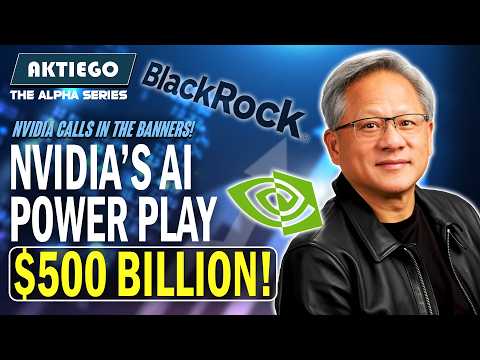
Nvidia CEO Jensen Huang wants investors to stop thinking of GPUs as depreciating hardware and start thinking of them as infrastructure. On August 10, Nvidia announced memoranda of understanding with six of the world’s largest capital providers, Apollo, BlackRock, Blackstone, Brookfield, Goldman Sachs, and KKR, aimed at mobilizing more than $500 billion in third-party capital for AI data center buildout. Nvidia has described its compute as an investable asset offering the lowest token cost, highest revenue and longest life of any hardware in the ecosystem, a framing meant to put GPUs in the same financial category as a toll road or a power plant rather than a server that ages out in three years.
The mechanics matter as much as the headline number. These are MOUs, not signed agreements, and the $500 billion figure represents capital the platforms aim to mobilize over time rather than money already committed. Nvidia will backstop up to 25 percent of qualifying deals through a residual value guarantee tied to individual projects, evaluated case by case. The remaining exposure sits with the six-firm consortium, which is the point: the structure is built to move financing risk off Nvidia’s own balance sheet and onto Wall Street’s.
Why Nvidia’s Toll-Road Thesis Could Pay Off

BlackRock CEO Larry Fink has spent much of 2026 arguing against the idea that AI spending is a bubble, telling audiences at Davos and the Milken Global Conference that the AI bubble thesis is wrong and that the real constraint is a supply crunch in power and computing capacity, not speculative excess. That framing is the entire premise of the new platforms: if institutions like BlackRock are willing to underwrite Nvidia compute the way they underwrite a toll road or a pipeline, the asset-class argument stops being marketing and starts being priced into how AI infrastructure gets financed everywhere.
The scale of demand behind the bet is real on its own terms. Morgan Stanley projects $3.5 trillion in hyperscaler AI spending between 2026 and 2028, and Apollo estimates total AI infrastructure needs above $8 trillion, a gap current corporate balance sheets cannot close without exactly the kind of outside capital this consortium exists to supply. One Bank of America analysis found the new structure could remove close to 15 percent, or roughly $470 billion, of free cash flow drag that vendor-financing circularity was projected to create across 2026 and 2027, freeing that cash for buybacks and research instead of balance sheet guarantees.
Nvidia’s own position improves on two fronts at once. Hardware and software revenue land up front regardless of financing structure, and every dollar routed through the new platforms deepens customer lock-in to Nvidia’s CUDA software ecosystem. Apollo Global President Jim Zelter, appearing alongside Nvidia and the other five partners in a joint interview announcing the deal, acknowledged that “there will be excesses, there will be pullbacks,” but argued the number of participants in the platform spreads out concentration risk that has worried critics of Nvidia-only financing arrangements. Fink, discussing BlackRock’s role in the same interview, compared the moment to the earliest days of the mortgage-backed securities market he entered decades ago, a category that took years to mature into a mainstream asset class before it became one.
Credit and supply-chain markets have already shown appetite for this kind of exposure. A Nevada data center project expected to be leased by Nvidia sold $3.8 billion in junk bonds in February, drawing roughly $14 billion in investor orders, evidence lenders were willing to fund AI buildout even before these platforms existed. The demand guarantee extends down the supply chain too. Taiwan Semiconductor, the only manufacturer capable of producing Nvidia’s most advanced chips at scale, has seen its shares climb 68 percent over the past year, and the new financing platforms are widely read as extending that runway further.
China’s Chip Glut and Nvidia’s Depreciation Risk
The case against rests on a single assumption buried inside Huang’s pitch: that Nvidia GPUs hold their value over a decade the way a toll road does. Short seller Michael Burry has spent months arguing the opposite, that hyperscalers depreciating GPUs over five to six years understate the real economic life of chips that Nvidia effectively replaces every two to three years, an accounting gap he estimates could understate industry-wide depreciation by roughly $176 billion between 2026 and 2028. When Nvidia unveiled the financing platforms, Burry was blunt about what he saw underneath the structure: “Meet the new Boss. Same as the old Boss.”
China is the mechanism that could force that scenario into the open. Huawei is targeting roughly 600,000 units of its Ascend 910C chip in 2026, nearly doubling 2025 output, with total Ascend revenue projected to grow 60 percent to $12 billion, closing much of the gap with Nvidia’s own fading China business. China’s domestic chip self-sufficiency has climbed from 16 percent to 28 percent in a single year, backed by an estimated $150 billion in state subsidies, with SMIC doubling its 7nm capacity to support the ramp. Yields on Chinese-made chips still lag Nvidia and TSMC’s 90-plus percent, running between 20 and 40 percent, but a flood of cheaper, good-enough domestic silicon is exactly the kind of price pressure that could compress global GPU values faster than any financing model has priced in.
Skepticism is not confined to outside critics. At the same event where Zelter defended the platform’s structure, Goldman Sachs CEO David Solomon offered a more pointed caveat, telling the room plainly that some of the companies at the center of the AI boom will turn out to be not what people expected. Nvidia’s own credit markets are pricing in more caution too. Nvidia’s five-year credit default swaps hit a record 82 basis points in late July as the scale of its total AI commitments, since grown past $750 billion including guarantee talks tied to OpenAI’s Ohio data center capacity, became clearer to bond investors. Société Générale strategist Manish Kabra summed up the shift bluntly: for hyperscale computing companies, it’s CDS, not EPS, that matters now.
That concern has reached the Federal Reserve. Kansas City Fed President Jeff Schmid recently asked whether AI is becoming another too big to fail, pointing to the leveraged contractual chain linking data centers, energy providers, and the communities that serve them. San Francisco Fed President Mary Daly called the scale and growth rate of AI investment very worrisome, though she noted most announced projects have not yet become physical assets, which limits near-term risk. No official has proposed any bailout mechanism, and the distinction matters: this is a conversation about systemic interconnection, not evidence a rescue plan exists. A member of Congress disclosed a purchase of Taiwan Semiconductor shares on July 10, days before the platforms were announced, a reminder of how closely Washington already tracks this ecosystem.
Signals That Could Tip the Nvidia Financing Bet
The MOUs still need to become signed agreements, and how much of the 25 percent backstop Nvidia actually draws on in practice will say more than the $500 billion headline ever will. Huawei’s real 2026 shipment numbers against its 600,000-unit target, and whether its yields climb past the current 20 to 40 percent range, will show whether China’s chip glut is a near-term threat or a longer runway away. Fed rhetoric shifting from bears watching toward something more concrete would mark a real change in tone, and Nvidia’s CDS spread remains a live, daily read on how nervous lenders actually are.
Sources
- NVIDIA Newsroom, financing platform announcement
- CNBC, “Nvidia lines up $500 billion in financing…” (Aug. 10, 2026)
- CNBC, “Wall Street just endorsed Jensen Huang’s ‘big concept’ for AI” (Aug. 11, 2026)
- The Cryptonomist, Morgan Stanley / Apollo infrastructure demand estimates
- Bloomingbit, Fink remarks at Milken Global Conference
- Bloomberg, Nvidia-linked junk bond sale (Feb. 12, 2026)
- Investing.com, TSMC outlook and congressional TSM purchase disclosure
- The Decoder, Nvidia residual-value guarantee mechanics and Burry critique
- TradingView/Stocktwits, Michael Burry statement on the $500B structure
- Value Add VC, China chip self-sufficiency and Huawei/SMIC data
- Yahoo Finance, Nvidia CDS record and Kabra commentary
- GV Wire / Reuters, Fed officials on AI systemic risk (Schmid, Daly)
Editorial Disclosure
This piece is neutral scenario analysis and does not recommend either the Holds or Gives Way branch as more likely. Securities discussed: NVDA (Nasdaq), TSM (NYSE). No positions in the above securities are held by aktiego.com staff at time of publication. No compensation has been received from any company, IR firm, or third party in connection with this coverage. Price data is sourced and timestamped per the citations above. Analyst price targets and estimates are attributed to the named firms. Forward-looking commentary in each branch is a scenario outcome, not a prediction. All securities discussed carry investment risk, including total loss of capital. Coverage on aktiego.com is provided for informational and educational purposes only. aktiego.com is not a registered investment advisor. Nothing in this article constitutes financial, investment, or professional advice. Readers are encouraged to conduct their own due diligence and consult a qualified financial advisor before making any investment decisions. For more information please see our full DISCLAIMER