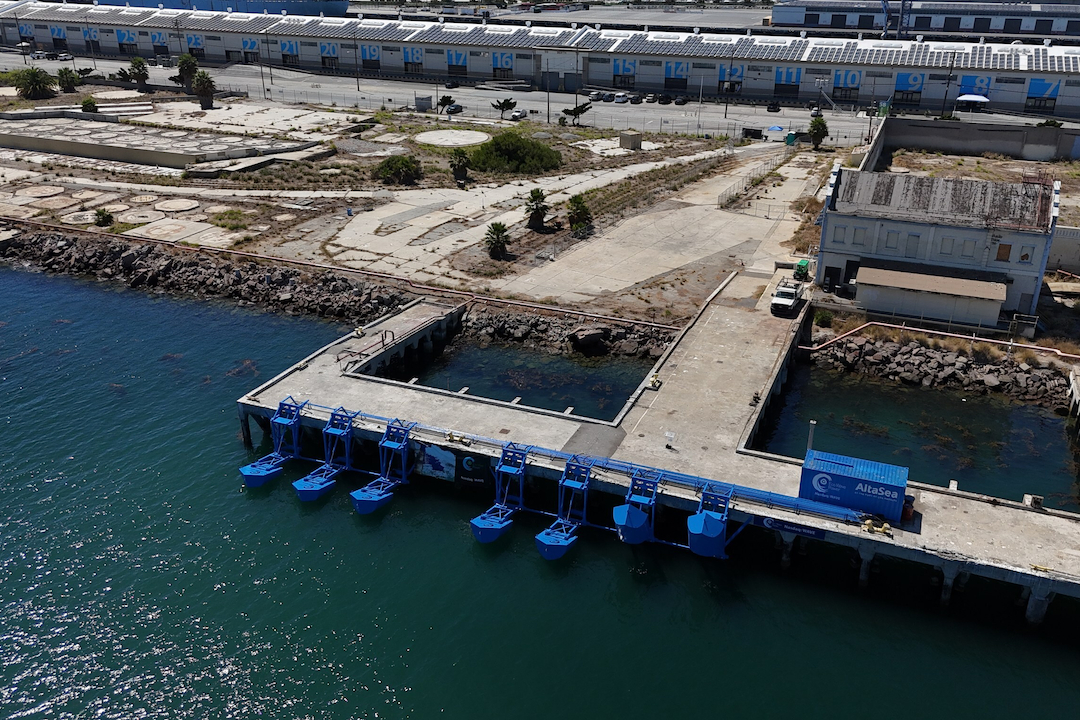
Wave energy has been theoretically promising for decades. Converting the relentless motion of ocean waves into electricity sounds logical, but making it work reliably, affordably, and without complex offshore infrastructure has defeated most attempts. Eco Wave Power Global AB (NASDAQ: WAVE) just changed that conversation. On April 1, 2026, the company announced the successful completion of its wave energy pilot at the Port of Los Angeles, conducted in collaboration with Shell. Every milestone under the 2024 Pilot Test Agreement has been achieved. Total capital expenditure came in below $1 million. The system ran under real marine conditions with no significant environmental impact and required no seabed anchoring or offshore construction.
That last point is what makes this different from every previous wave energy attempt that failed to scale.
Why every previous wave energy project struggled and what Eco Wave Power does differently
Offshore wave energy devices face a brutal engineering reality. They must survive constant exposure to saltwater, storms, biofouling, and the mechanical stress of continuous wave motion, all while being expensive to install, maintain, and connect to shore-based power grids. The costs of underwater cabling, specialized installation vessels, and offshore maintenance have consistently made offshore wave energy uneconomical compared to wind and solar.
Eco Wave Power’s approach is fundamentally different. Instead of building devices in the open ocean, the company attaches its wave-actuated floats to existing coastal infrastructure, breakwaters, jetties, piers, and port structures that are already built, already permitted, and already maintained. The mechanical systems sit above the waterline where they are accessible. There is no seabed anchoring. No offshore construction vessels. No submarine cables.
The Port of Los Angeles installation is the proof that this model works in practice. A pilot that completed its full lifecycle from feasibility through real-world operation, with CapEx below $1 million and full permitting achieved with no significant environmental impact, is not a science project. It is a commercial template.
What the Shell collaboration actually demonstrates
Shell’s involvement in this pilot is significant beyond the technical validation. Shell conducted the initial large-scale feasibility study that identified 77 potential US coastal sites suitable for wave energy deployment. That study preceded the pilot agreement and represents a systematic assessment of the commercial opportunity across American coastlines.
The transition from feasibility analysis to real-world implementation with a major energy company as the partner establishes Eco Wave Power’s ability to execute projects with industrial-scale counterparties. For a small-cap NASDAQ-listed company, successfully completing a contracted pilot with a global energy major and submitting a final completion report confirming all milestones achieved is the kind of institutional credibility that accelerates subsequent commercial discussions.
According to the International Energy Agency, ocean energy technologies including wave and tidal power represent one of the most significant untapped renewable resources globally, with theoretical potential vastly exceeding current deployment. The barrier has always been cost and installation complexity. Eco Wave Power’s onshore approach directly targets both.
The AI energy angle is real, not just marketing
Eco Wave Power’s technology was featured in NVIDIA CEO Jensen Huang’s keynote at the GTC conference via a digital twin demonstration. That placement is not incidental. The company is deliberately positioning wave energy as a solution for powering coastal AI infrastructure, and the logic holds up.
Data centers require enormous, continuous power. Many of the largest AI infrastructure buildouts are located near coastlines, either for cooling water access, fiber connectivity, or proximity to urban power grids. A wave energy system that can generate power directly from coastal infrastructure, at the point of consumption, addresses the grid connection challenge that is already delaying data center construction across Northern Virginia, Texas, and parts of Europe.
The US Department of Energy’s Water Power Technologies Office has identified marine energy as a strategic priority for coastal energy security, particularly for island communities, ports, and coastal industrial facilities that face grid reliability challenges. Wave energy that can be deployed on existing port infrastructure without permits for new seabed works represents a meaningfully faster path to power for exactly those applications.
The commercial roadmap from here
The Port of Los Angeles installation now serves as a reference project, giving potential customers, regulators, and partners a working system to evaluate rather than a theoretical proposal. The site will continue operating as a demonstration and educational facility.
Eco Wave Power’s project pipeline stands at 404.7 megawatts across planned projects in Portugal, Taiwan, and India, in addition to its operating installation in Israel. The company already operates Israel’s first grid-connected wave energy power station, recognized as a pioneering technology by the Israeli Ministry of Energy. That combination of operating history in Israel, completed pilot in the United States, and a pipeline spanning three continents represents a commercial trajectory that the Los Angeles pilot has materially strengthened.
The company has received support from the European Union Regional Development Fund, Innovate UK, the EU Horizon 2020 program, and the United Nations Global Climate Action Award. Those institutional endorsements reflect recognition that onshore wave energy solves real problems rather than simply adding another renewable option to an already crowded market.
Sources
- International Energy Agency — Ocean Energy
- US Department of Energy — Water Power Technologies Office
- Eco Wave Power — Investor Relations
Editorial disclosure
This article is based on a press release issued by Eco Wave Power Global AB and has been independently rewritten and editorially expanded. It covers the completion of a wave energy pilot at the Port of Los Angeles conducted in collaboration with Shell. Eco Wave Power Global AB trades on NASDAQ under the ticker WAVE. The company is a small-cap early-stage commercial company with a limited operating history and carries significant execution and commercial risk. Market context is sourced from the International Energy Agency and the US Department of Energy. Commentary reflects the author’s own assessment. The information provided on this website is for informational and educational purposes only. Our content is derived strictly from verified online sources to ensure accuracy and objectivity. This analysis does not constitute financial, investment, or professional advice. Readers are encouraged to consult with qualified professionals before making decisions based on this information. For more information, please see our full DISCLAIMER.