
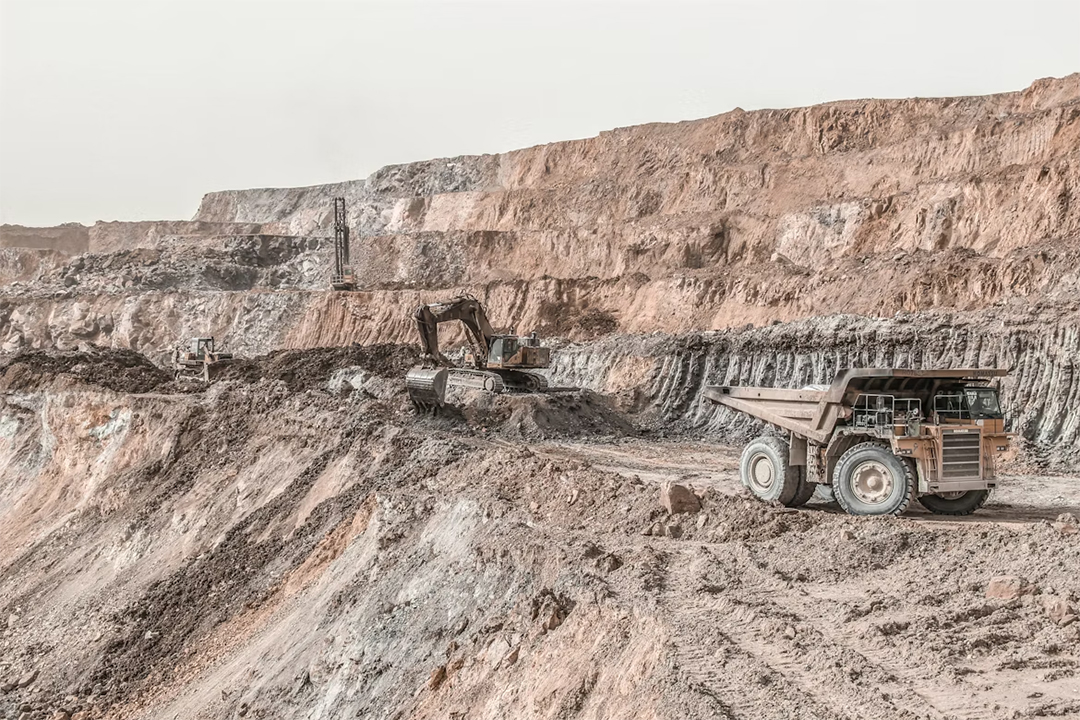
Copper held above $5.94 per pound on Monday, up 27.8% from this time last year and up 6.4% in just the past month. Gold sat near $4,600 per ounce, down roughly 12% since the Middle East conflict began in late February but structurally supported by central bank buying. Cobalt traded flat at $56,290 per metric ton as of May 1, still 67% higher year-over-year. The macro read is complicated. Demand signals for copper are strong. Data center build-outs are locking in long-term supply agreements at pace. But the supply side is deteriorating. China announced it will halt sulfuric acid exports beginning this month, a direct hit to Chilean refining operations that account for roughly half of that country’s copper output. Geopolitics is no longer a backdrop. It is the market itself.
Washington is responding. Congress handed the administration a new opening in northern Minnesota. A Greenland-focused PGM developer accelerated its technical buildout. An AI-driven minerals startup decided the problem was the labs and moved to fix it. And a Quebec niobium explorer posted drillhole results that ranked among the widest pegmatite intersections ever recorded. Here is what moved the needle this week.
1. Trump Signs Boundary Waters Mining Resolution
Congress used the Congressional Review Act to overturn the Biden administration’s 20-year mineral withdrawal protecting the Boundary Waters watershed in northern Minnesota. The Senate passed H.J. Res. 140 on a 50-49 vote in mid-April. President Trump signed it. The resolution strikes Public Land Order 7917, which had barred federal mineral leasing across 225,504 acres of the Superior National Forest. It is the first time in history the CRA has been used to nullify a mineral withdrawal.
The stakes are not abstract. The deposits underlying this area hold an estimated 95% of US nickel reserves, 88% of US cobalt reserves, and roughly one-third of domestic copper reserves. Twin Metals Minnesota, a wholly-owned subsidiary of Chilean conglomerate Antofagasta, now has a substantially clearer path to pursuing the permits it needs for a sulfide-ore copper mine on Birch Lake. The CRA passage also means no future administration can implement a substantially similar protection through rulemaking alone.
The legal and political fight is not over. The Minnesota Legislature is advancing a bill that would permanently ban copper mining in the Boundary Waters watershed at the state level, a protection no future CRA resolution could reach. The Minnesota Pollution Control Agency has separately flagged concerns that recent EPA Clean Water Act rule changes would leave the state unable to address water quality impacts from upstream mining. The state-level battle is now where this goes.
2. China Cuts Sulfuric Acid Exports. Copper Supply Feels It Immediately.
China announced it will halt sulfuric acid exports beginning in May 2026. J.P. Morgan estimates that roughly 15% of global copper production is directly reliant on sulfuric acid availability. Chile is the most exposed. Approximately half of Chilean copper refining depends on Chinese sulfuric acid supplies. For context, Chile produces more than a quarter of the world’s copper output. This is not a marginal disruption.
The timing compounds existing supply-side stress. The Grasberg mine in Indonesia, one of the world’s largest copper deposits, is currently operating below capacity following a fatal mudslide that triggered a force majeure event. Spot treatment charges at Chinese smelters had already fallen to around negative $70 per metric ton by late March, a signal of extreme concentrate tightness. China built roughly four times more smelting capacity than global concentrate supply growth over the past three years. The infrastructure is there. The feed is not.
Copper futures remained above $5.95 throughout the week, supported by the AI infrastructure build continuing at speed. Commerzbank flagged that elevated prices are beginning to act as a constraint on further upside. The J.P. Morgan EMEA Mining team has noted that copper historically troughs roughly 25% below peak during major macro shocks. That downside has not materialized yet. The question is whether the sulfuric acid disruption is fully priced.
3. Greenland Mines Builds Out Technical Platform on $68B Skaergaard Deposit

Greenland Mines Ltd (Nasdaq: GRML) assembled a notable technical stack around its Skaergaard Project this week. On April 27, the company appointed SLR Consulting as Geological Consultant and Qualified Person, the same firm that prepared the 2022 NI 43-101 Technical Report on the project. That followed a framework agreement with GTK Mintec, the mineral processing pilot plant of the Geological Survey of Finland, executed on April 23.
The 2022 NI 43-101 resource stands at 25.4 million ounces of palladium-equivalent and 23.5 million ounces of gold-equivalent, with a gross undiscounted in-situ value of approximately $68 billion at February 2026 metal prices. GTK Mintec’s scope explicitly extends beyond the primary PGM-gold deposit to evaluate critical metal optionality including vanadium, gallium, germanium, titanium, and iron recovery from vanadium-bearing titanomagnetite zones. That range of optionality is notable given the current policy environment around all of those metals.
The backdrop matters here. The Export-Import Bank has issued $14.8 billion in Letters of Interest for critical minerals projects under the current administration, including the $10 billion Project Vault domestic strategic reserve announced at February’s Critical Minerals Ministerial. Government equity stakes have been taken in MP Materials, USA Rare Earth, Lithium Americas, Trilogy Metals, and others. A Western-aligned, multi-metal deposit in Greenland with a world-class technical team and three consultants on board in five weeks is exactly what that capital flow is looking for.
4. Earth AI Goes Vertical. Lab Backlogs Are the New Bottleneck.
Earth AI, the Australian-focused AI-driven exploration startup, is building its own in-house sample processing laboratories. The reason is simple. Lab backlogs that used to run around two months have more than doubled. Interest in developing new critical minerals sources has surged and the processing infrastructure has not kept up.
CEO Roman Teslyuk has been using AI models to identify copper, platinum, and palladium prospects in parts of Australia where conventional exploration had not looked. The models have delivered promising targets. But the bottleneck has shifted downstream, to the labs that confirm whether what was drilled is what was expected. Vertical integration into sample processing is a direct response to that constraint.
The broader signal here is supply-chain thinking being applied to exploration itself. The minerals sector has spent years identifying geological risk as the primary bottleneck. Processing and logistics are emerging as equally significant constraints. A startup with drilling capacity and no lab capacity is not efficient. Earth AI is not waiting for the market to catch up.
5. North American Niobium Hits 211 Metres of Pegmatite in Quebec

North American Niobium and Critical Minerals Corp. (CSE: NIOB) (OTCQB: NIOMF) reported drillhole SGN-2026-007 at its Seigneurie project in Quebec on April 29. The intersection returned 211.25 metres of cumulative pegmatite, anchored by a continuous 105.45-metre core interval. By the company’s accounting, this ranks fourth among the widest pegmatite drillhole intersections ever publicly disclosed.
The pegmatite displayed elevated radiometric response and qualitative portable XRF indicators the company considers encouraging for niobium and rare earth element-bearing minerals. A light-brown mineral associated with magnetite returned elevated niobium, yttrium, and phosphorus on portable XRF screening. Laboratory assays and mineralogical confirmation are pending.
Niobium is a steel-strengthening alloy with growing demand in electric vehicle battery applications. Canada-hosted niobium is strategically aligned with US supply chain priorities. The Seigneurie property sits within Quebec’s Grenville Province. Results pending. But 211 metres of continuous pegmatite with REE indicators in a jurisdiction with clear Western alignment is a drill result worth watching when assays come back.
What to Watch: Week of May 5-11, 2026
DOE Critical Minerals and Materials Accelerator NOFO: The $69 million funding opportunity for innovative processing technologies has Topic Area 1 applications due May 29. Companies working on semiconductor and energy-sector critical mineral processing should have letters of intent in now. Applications across topic areas run through July.
CMI Summit 5 lands May 13-14 in Toronto under the theme “The New Critical Minerals Economy.” The DRC’s National Chamber of Mines president is scheduled to speak. Any commentary on cobalt quota adjustments will move that market. Watch for announcements from US-Australia bilateral project financing discussions.
US-Iran negotiations remain the key macro variable. Gold holding above $4,600 depends on a diplomatic resolution to the Strait of Hormuz situation. If the peace talks produce a framework, precious metals will give back gains quickly. If they stall, copper gets an additional demand headwind and gold finds a floor. The next update from Iran on Washington’s latest proposal is the read.
Minnesota state legislature vote on permanent Boundary Waters protection: the state-level bill is now the primary legal battleground following the CRA signature. Its fate affects not just Twin Metals but the broader precedent for state-level mineral withdrawal authority.
Sources
- CNBC: Senate overturns Boundary Waters protections, April 16, 2026
- Minnesota Reformer: Congress betrayed the Boundary Waters, April 22, 2026
- PRNewswire / USA News Group: Greenland Mines Skaergaard Project update, April 30, 2026
- TechCrunch: Earth AI vertically integrating critical minerals search, April 29, 2026
- GlobeNewswire: North American Niobium Seigneurie drillhole results, April 29, 2026
- J.P. Morgan Global Research: Copper Prices Outlook 2026
- TradingEconomics: Copper price data, May 4, 2026
- TradingEconomics: Cobalt price data, May 1, 2026
- TradingEconomics: Gold price data, May 4, 2026
- U.S. Mission to ASEAN: 2026 Critical Minerals Ministerial summary
- Pillsbury Law: DOE Critical Minerals and Materials Accelerator NOFO, April 2026
- S&P Global: Copper and Gold Market Outlook 2026
Editorial Disclosure
This roundup is based on a combination of press releases, wire service reports, and independent market research sourced from publicly available information. It covers developments during the week of April 28 to May 5, 2026, in the critical minerals, mining, and clean energy sectors. Securities discussed in this article include Greenland Mines Ltd (Nasdaq: GRML) and North American Niobium and Critical Minerals Corp. (CSE: NIOB) (OTCQB: NIOMF). Neither company compensated aktiego.com for coverage. Commodity price data referenced in this article is time-stamped as follows: copper at $5.94 per pound (May 4, 2026, TradingEconomics CFD); cobalt at $56,290 per metric ton (May 1, 2026, TradingEconomics CFD); gold at approximately $4,600 per ounce (May 4, 2026, TradingEconomics). Price data is sourced from contract-for-difference instruments tracking benchmark commodity markets and may not reflect final exchange-settled prices. Forward-looking price forecasts attributed to J.P. Morgan, S&P Global, and other third-party analysts represent the opinions of those analysts at the time of publication and are not guarantees of future performance. Editorial forward-look commentary reflects the author’s own assessment. The information provided on this website is for informational and educational purposes only. Our content is derived strictly from verified online sources to ensure accuracy and objectivity. This analysis does not constitute financial, investment, or professional advice. Readers are encouraged to consult with qualified professionals before making decisions based on this information. For more information, please see our full DISCLAIMER.