
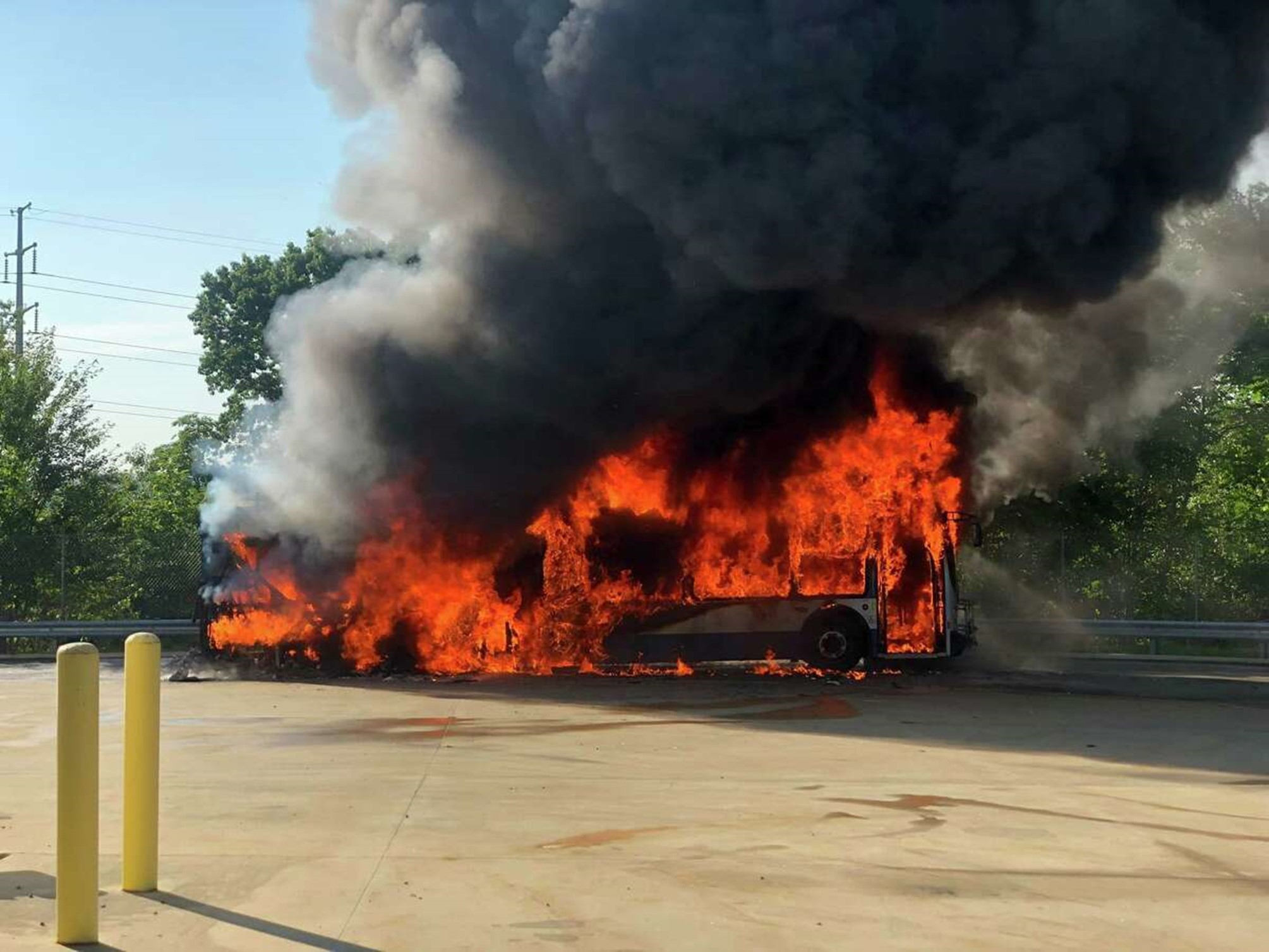
Here is something transit agencies do not talk about enough. Lithium-ion battery fires do not start with smoke or flames. They start silently, deep inside the battery pack, with heat building invisibly until the system enters thermal runaway. At that point, the battery generates its own heat faster than anything can stop it. Conventional fire suppression systems are not built for this. They respond to smoke and flames. By the time those appear, the damage is already done.
moviTHERM and Troman Industries just announced a partnership designed to catch the problem before it ever gets that far.
The hidden danger inside every electric transit fleet
Electric bus adoption is accelerating fast. The Federal Transit Administration has allocated billions toward zero-emission bus procurement, and agencies across North America are replacing diesel fleets at a pace that would have seemed ambitious just five years ago. However, the safety infrastructure supporting those fleets has not kept up.
The National Fire Protection Association has documented a significant rise in lithium-ion battery fire incidents across transportation, noting that thermal runaway requires fundamentally different detection and response methods compared to conventional vehicle fires. Several high-profile electric bus depot fires in North America and Europe have resulted in total fleet losses and millions of dollars in facility damage. In some cases, entire electrification programmes were set back by years.
The problem is not that the technology is inherently dangerous. The problem is that most agencies are deploying electric vehicles into safety environments designed for diesel ones.
What moviTHERM and Troman actually built together
The partnership combines two companies with genuinely complementary expertise. Troman Industries, based in Elkhart, Indiana, has spent years building on-vehicle thermal detection, fire notification, suppression systems, and linear heat detection hardware purpose-built for transit environments. This is not industrial equipment adapted for buses. It is built from the ground up for exactly this application.
moviTHERM, founded in 1999 in Irvine, California, brings over two decades of thermal imaging expertise and its cloud-connected iTL platform, which delivers real-time IoT-based monitoring with alerts accessible from any device. Its infrared cameras detect temperature anomalies invisible to conventional sensors, flagging dangerous conditions before they escalate.
Together, the platform covers the entire thermal risk environment in one unified system. Vehicles in service. Vehicles charging overnight. Depot facilities. Maintenance bays. Everything monitored, everything connected, everything alerting to a single dashboard. For a transit agency currently juggling separate vendor relationships for each piece of that puzzle, the consolidation alone is a significant operational win.
Why a unified platform changes the safety equation entirely
Individual thermal detection products are available. What has been missing is integration. A sensor on a vehicle does not help if the depot charging infrastructure has no monitoring. A depot camera does not help if the maintenance facility has a blind spot. Patching together solutions from multiple vendors creates gaps, and in thermal safety, gaps are where disasters happen.
The moviTHERM and Troman platform eliminates those gaps by design. Real-time notifications are accessible from any device, meaning a safety officer does not need to be on-site to know that a battery pack in Bay 7 is running three degrees hotter than it should be at 2am. That kind of early warning is the difference between an intervention and an insurance claim.
According to the American Public Transportation Association, transit agencies are under increasing pressure to demonstrate that their electrification programmes are operationally safe as well as environmentally beneficial. Unified thermal monitoring platforms are becoming a baseline expectation from regulators, insurers, and the communities these agencies serve.
The solution is available immediately. For transit agencies currently evaluating their safety posture as their electric fleets grow, there has never been a better moment to ask what their current system would actually catch at 2am before a thermal event becomes a catastrophe.
Sources
- Federal Transit Administration — Low or No Emission Vehicle Programme
- National Fire Protection Association — Lithium-Ion Batteries
- American Public Transportation Association — Transit Statistics
- moviTHERM — Official Press Release via PRNewswire
Editorial disclosure
This article is based on a press release issued by moviTHERM. It covers a commercial partnership between moviTHERM and Troman Industries addressing thermal safety risks in electric transit fleets. Market context is sourced from the Federal Transit Administration, the National Fire Protection Association, and the American Public Transportation Association. Commentary reflects the author’s own assessment. The information provided on this website is for informational and educational purposes only. Our content is derived strictly from verified online sources to ensure accuracy and objectivity. This analysis does not constitute financial, investment, or professional advice. Readers are encouraged to consult with qualified professionals before making decisions based on this information. For more information, please see our full DISCLAIMER.