
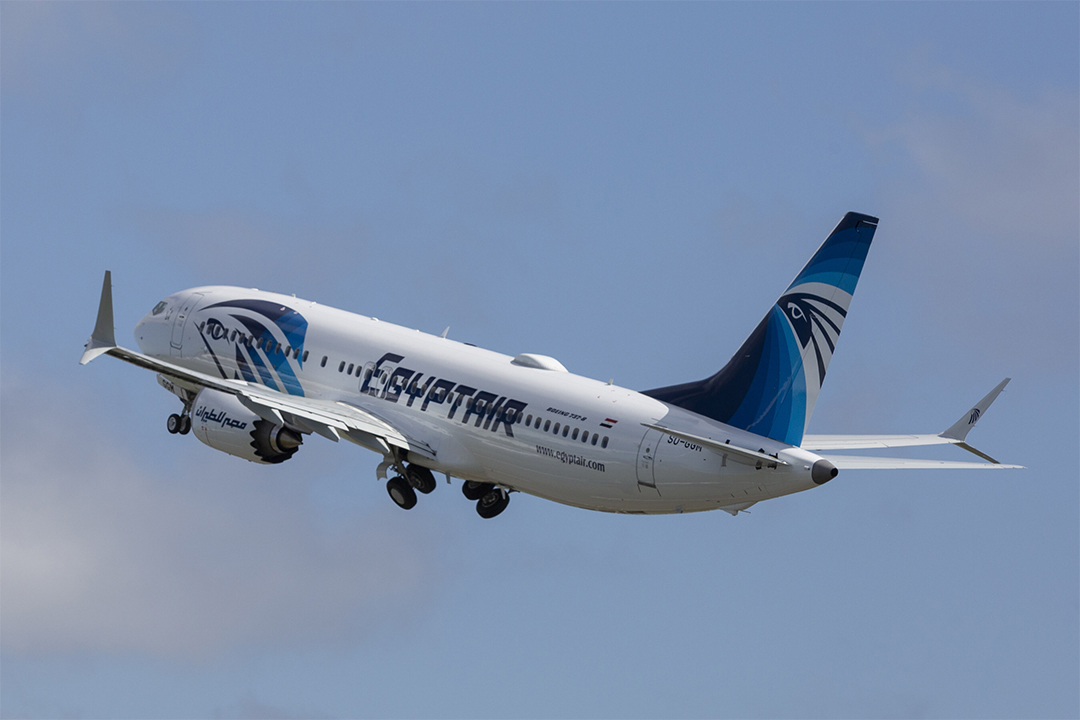
Egypt’s national carrier just took delivery of its first 737 MAX. Fifty years after EgyptAir first ordered the 737 family in 1975, the airline is joining the 450-plus operators globally that have made the MAX the backbone of short- and medium-haul aviation.
Boeing (NYSE: BA) announced on May 3, 2026 that EgyptAir has taken delivery of its first 737-8, the initial aircraft in an 18-plane lease agreement with SMBC Aviation Capital. The delivery marks the first 737 MAX to enter service in Egypt and represents a significant step in EgyptAir’s fleet modernization program.
The 737-8 will join a fleet that already includes 30 Next-Generation 737 jets, five 777s, and eight 787 Dreamliners. The new aircraft offers 20% better fuel efficiency than the planes it replaces and will be deployed on short and medium-haul routes to Paris, Brussels, Istanbul, and Vienna.
Why fleet modernization matters for EgyptAir specifically
African aviation is one of the fastest-growing segments of global air travel. The International Air Transport Association projects Africa will be the fastest-growing aviation market through 2040, with passenger numbers more than doubling from current levels. Egypt sits at the intersection of European, African, and Middle Eastern air traffic, and EgyptAir’s route network reflects that geography.
Older, less fuel-efficient aircraft carry higher operating costs that compound across thousands of flight hours. At jet fuel prices that have remained elevated through 2025 and into 2026, a 20% fuel efficiency improvement per aircraft is not a marginal operational gain. Across 18 aircraft operating on high-frequency short and medium-haul routes, the cumulative cost reduction over the lease period is substantial.
The 737 MAX also offers operational commonality with EgyptAir’s existing 737 fleet. Pilots already type-rated on the Next-Generation 737 can transition to the MAX with reduced training requirements. Ground crews, maintenance procedures, and spare parts overlap substantially between the two variants. For an airline managing a diverse fleet that includes three different Boeing widebody types alongside the narrowbody fleet, that commonality has real operational value.
SMBC Aviation Capital and the leasing model
EgyptAir is taking these aircraft through a lease from SMBC Aviation Capital rather than a direct purchase. Leasing has become the dominant model for airline fleet expansion globally, particularly in markets where capital access or balance sheet constraints make outright purchase difficult. SMBC Aviation Capital is one of the world’s largest aircraft lessors, with a portfolio of over 700 aircraft placed with airlines across more than 60 countries.
According to the IATA’s global fleet data, approximately 55% of the global commercial aircraft fleet is now leased rather than owned, with that proportion higher in Africa and the Middle East than in more mature aviation markets. The leasing model allows airlines to modernize without committing to the full capital cost of aircraft ownership and provides flexibility to return aircraft as demand patterns change.
Boeing’s Africa strategy and what EgyptAir represents
EgyptAir is one of Africa’s largest airlines and the continent’s third-oldest carrier. Boeing has maintained a commercial relationship with the airline since 1975, across multiple aircraft generations. The 737 MAX entry into Egypt opens a new chapter in that five-decade partnership and positions Boeing in a market where Airbus’s A320 family competes directly.
Boeing VP Anbessie Yitbarek, who oversees commercial sales and marketing for Africa, described the delivery as the start of a new era for Egypt. That framing reflects Boeing’s broader push to capture more of Africa’s fleet modernization cycle as the continent’s aviation sector expands. Ethiopian Airlines, Kenya Airways, and other African carriers have been deploying both Boeing and Airbus aircraft as their fleets grow, and each delivery by either manufacturer into the region reinforces its position for future orders.
Passengers on EgyptAir’s 737 MAX fleet will fly in Boeing’s Sky Interior configuration, featuring LED mood lighting, larger windows, and improved overhead bin space, bringing the aircraft’s cabin experience in line with the widebody experience that EgyptAir’s 787 Dreamliner passengers already receive.
Sources
Editorial disclosure
This article is based on a press release issued by Boeing and has been independently rewritten and editorially expanded. It covers EgyptAir’s delivery of its first Boeing 737 MAX aircraft. Boeing trades on NYSE under the ticker BA. Aircraft delivery figures and fuel efficiency comparisons are as stated by Boeing. Market context is sourced from IATA. Commentary reflects the author’s own assessment. The information provided on this website is for informational and educational purposes only. Our content is derived strictly from verified online sources to ensure accuracy and objectivity. This analysis does not constitute financial, investment, or professional advice. Readers are encouraged to consult with qualified professionals before making decisions based on this information. For more information, please see our full DISCLAIMER.