
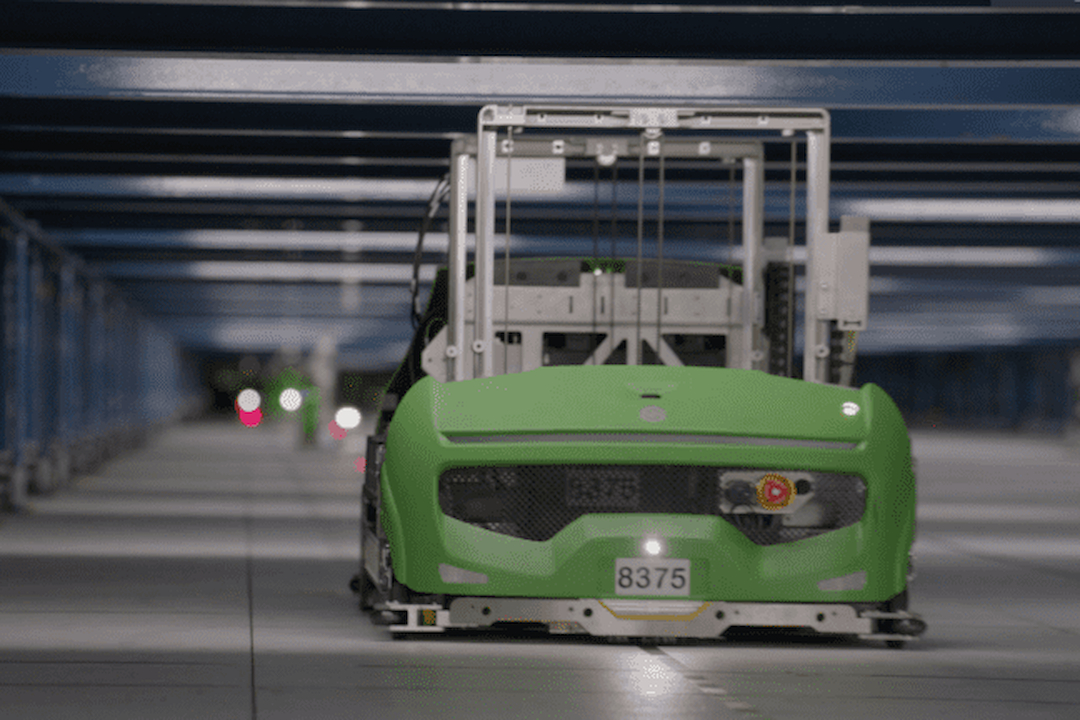
The robots that stock Walmart’s shelves are coming to healthcare supply chains. This is why it took so long.
Symbotic’s AI robotics system is not new technology.
Walmart has been deploying it at scale. So have large consumer goods distributors. The system depalletizes inbound freight, stores individual items, retrieves them on demand, and builds outbound pallets mapped to the specific layout needs of each recipient. It is faster, more accurate, and more scalable than human picking operations. The technology works. It has been proven at massive commercial scale.
Healthcare has not had it.
Until now.
On April 16, 2026, Medline (NASDAQ: MDLN) announced a strategic agreement to implement Symbotic’s AI-powered warehouse automation across its distribution network, becoming the first healthcare company to deploy this technology. A pilot will run in 2027 at one of Medline’s 45 US distribution centers. If it performs as it has in retail and consumer goods, the healthcare supply chain will look meaningfully different by the end of the decade.
Why healthcare lagged and why that gap is closing
Healthcare distribution is harder than retail distribution in specific ways that matter.
The product mix is enormous. Medline distributes medical-surgical products across thousands of SKUs with vastly different sizes, weights, fragility requirements, and storage conditions. Some items are sterile. Some are temperature sensitive. Some are single-use and some are durable. The variability that makes healthcare distribution complex is exactly the kind of problem that AI-enabled robotic systems are increasingly capable of handling.
The stakes are also higher. A missed or incorrect shipment at a Walmart distribution center creates a customer inconvenience. A missed or incorrect shipment to a hospital can affect patient care. That heightened consequence has historically made healthcare supply chain operators conservative about introducing new technology into fulfillment workflows.
What changed is the evidence base.
Symbotic’s deployments at scale across retail and consumer goods have generated years of performance data demonstrating accuracy rates, throughput improvements, and error reduction at commercial volumes. Healthcare distributors no longer have to accept theoretical performance claims. The technology has a track record.
According to McKinsey’s healthcare supply chain research, healthcare supply chains lose an estimated $25 billion annually to inefficiencies including picking errors, inventory inaccuracies, and fulfillment delays. Automation that addresses those failure modes at the distribution center level has direct financial consequences for both distributors and the healthcare providers they serve.
What the Symbotic system does that human operations cannot match at scale
The system’s core capability is not speed alone.
It is the combination of speed, accuracy, and intelligence about downstream needs.
When Symbotic builds an outbound pallet, it does not simply stack items. It organizes them according to the physical layout of the receiving facility, putting the items that need to be unloaded first at the top, and arranging by department or storage location. A hospital receiving a Medline shipment gets product organized for its specific receiving dock, storage room, and clinical floor layout rather than a generic pallet that requires manual reorganization on arrival.
That downstream intelligence reduces labor requirements at the receiving end, not just the shipping end. For hospitals already managing labor shortages and rising operational costs, receiving efficiency is a real and measurable benefit.
The American Hospital Association’s health care workforce report has documented persistent staffing pressures across clinical and operational roles. Anything that reduces the labor intensity of non-clinical tasks like receiving and stocking supplies creates capacity that can be redirected toward patient care.
Medline’s position makes this the right company to deploy it first
Medline is not an ordinary healthcare distributor.
It is vertically integrated, manufacturing the majority of the products it distributes. It operates 45 distribution centers in the United States. It employs more than 45,000 people worldwide and serves healthcare providers across more than 100 countries. Its chief supply chain officer Sean Halligan described the combination of manufacturing and distribution to all points of care as unique among healthcare suppliers.
That vertical integration matters for the Symbotic deployment because the system can be optimized across the entire product flow, from manufacturing output to distribution center inbound receiving to outbound fulfillment, rather than just at a single node. A distributor handling third-party products has less control over inbound formats and pallet configurations. Medline, manufacturing its own products, can design that upstream input to work optimally with the Symbotic system’s automated depalletizing and singulation capabilities.
Medline has also been investing systematically in distribution automation before this announcement, deploying goods-to-person robotic picking systems, automated packaging, and its proprietary Pick Pack Pro technology. The Symbotic partnership is not a first experiment. It is the next layer of a deliberate long-term automation strategy.
The 2027 pilot will generate the healthcare-specific performance data that could accelerate deployment across the broader 45-center network.
Sources
- McKinsey — Healthcare Supply Chain Research
- American Hospital Association — Health Care Workforce Report
- Symbotic — Official Website
- Medline — Supply Chain
Editorial disclosure
This article is based on a press release issued by Medline and has been independently rewritten and editorially expanded. It covers a strategic partnership between Medline and Symbotic for AI-powered warehouse automation in healthcare distribution. Medline trades on NASDAQ under the ticker MDLN. Market context is sourced from McKinsey and the American Hospital Association. Commentary reflects the author’s own assessment. The information provided on this website is for informational and educational purposes only. Our content is derived strictly from verified online sources to ensure accuracy and objectivity. This analysis does not constitute financial, investment, or professional advice. Readers are encouraged to consult with qualified professionals before making decisions based on this information. For more information, please see our full DISCLAIMER.