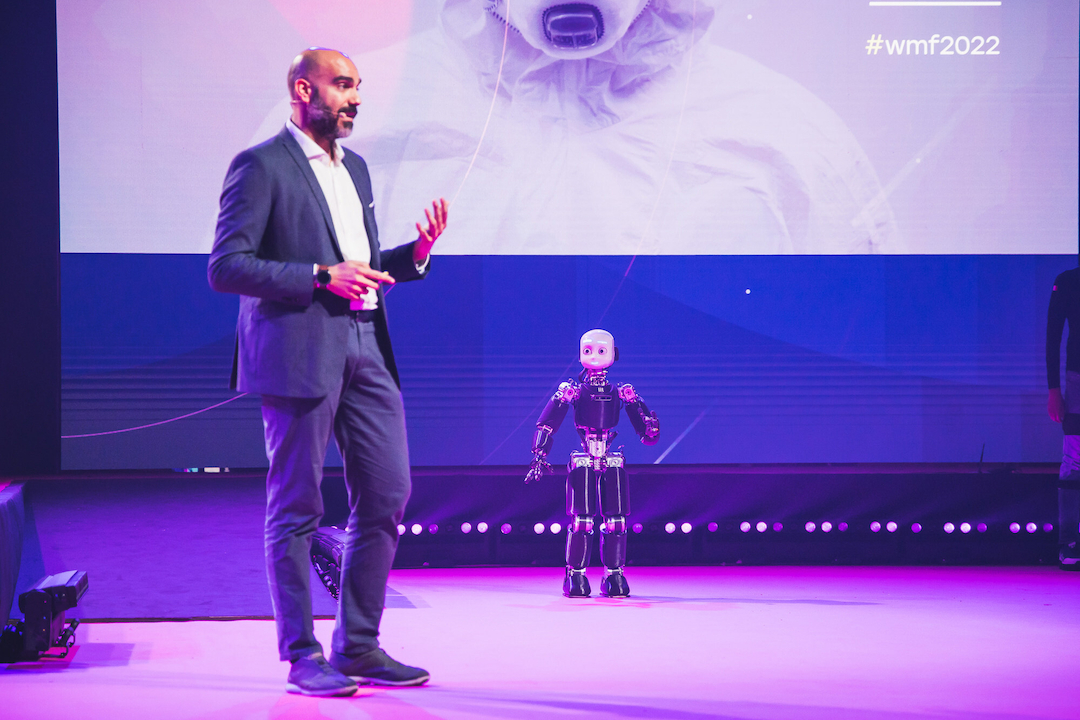
NVIDIA, Anthropic, and OpenAI will all be at the same event in Italy this summer. WMF 2026, We Make Future, takes place June 24 to 26 at BolognaFiere in Bologna and has established itself as the largest European event on digital innovation and artificial intelligence. At its center is the AI Global Summit, a forum designed to move beyond product announcements and into the harder questions: governance, regulation, geopolitics, and how AI is actually reshaping economies and institutions.
For anyone working in AI, policy, or business strategy in Europe, this is the event on the calendar.
What WMF and the AI Global Summit actually are
WMF started as Italy’s leading digital marketing conference before expanding into a full-scale innovation summit that now draws speakers and attendees from across Europe and beyond. The 2026 edition will feature 13 thematic stages, an expo area connecting startups from over 90 countries, and a program that spans technical AI development, business applications, robotics, and governance.
The AI Global Summit sits at the center of the program as the international benchmark event for AI policy and strategy discussions. Cosmano Lombardo, WMF’s founder and CEO, has framed this year’s summit around a clear thesis: artificial intelligence has become both a political and technological priority, requiring clear regulation, targeted investment, and broad debate involving business, institutions, research, and civil society. The goal is not just discussion but operational proposals and accelerated decision-making at European and international levels.
That framing reflects where the AI policy conversation in Europe actually is right now. The EU AI Act has entered into force, creating compliance obligations that European and global businesses are actively navigating. Digital sovereignty debates are intensifying as European governments weigh dependence on US-based AI infrastructure. Labor transformation questions are moving from academic discussion into union negotiations and government policy. WMF is positioning the AI Global Summit as the place where those conversations happen with the right people in the room.
The speaker lineup reflects genuine cross-sector depth
The main stage roster covers the full spectrum of the AI ecosystem. From the technology side, Marco Pavone from NVIDIA and representatives from Microsoft, Dell Technologies, Intel, and AMD bring the infrastructure and hardware perspective. Bryan Madden from AMD and Alicia Hanf from LG Nova add perspectives from adjacent hardware and innovation ecosystems.
From the AI model and platform side, Karen Zhou from Anthropic and Corey Ching from OpenAI bring the two companies most central to the current large language model moment. Their participation alongside Google’s Aprajita Jain creates a rare public forum where the three dominant AI platform companies will be represented on the same stage.
The research dimension is equally strong. Alberto Sangiovanni Vincentelli, one of the world’s most respected computer scientists and a professor at UC Berkeley, brings deep academic context. Daniele Pucci from the Italian Institute of Technology and Francesco Ubertini from CINECA, Italy’s national supercomputing center, represent European research infrastructure. ESA’s Φ-lab adds a space technology dimension that is increasingly relevant as AI intersects with satellite data and Earth observation.
The inclusion of fintech leaders like Klarna and Trade Republic reflects the commercial application reality of AI in financial services, while Arduino’s Marcello Majonchi connects the summit to the maker and hardware development community that has historically been one of Italy’s strongest technology contributions.
The governance track is where this event stands apart from most AI conferences
Most AI conferences focus on capabilities and applications. WMF’s AI Governance and Policy track addresses the questions that determine whether those capabilities get deployed constructively. Digital sovereignty, geopolitics, labor transformation, and public decision-making are on the agenda alongside participation from European institutions, the Italian Government, and Pierpaolo Bombardieri, General Secretary of UIL, one of Italy’s largest trade union confederations.
According to the European Commission’s AI policy framework, Europe is in the implementation phase of the world’s first comprehensive AI regulation, with obligations ranging from risk classification and transparency requirements to prohibited AI practices taking effect through 2025 and 2026. The AI Global Summit is taking place at exactly the moment when European businesses and institutions are most actively working through what compliance means in practice.
The participation of MAECI, Italy’s Ministry of Foreign Affairs, and MIMIT, the Ministry of Enterprises and Made in Italy, signals that this is not an industry event that governments are observing from the sidelines. Italian institutional participation at that level reflects national policy interest in shaping the AI governance conversation rather than simply reacting to it.
Why Bologna and why now
Bologna has been quietly building a reputation as one of Italy’s most important technology and innovation hubs alongside its historical identity as a university city. BolognaFiere is one of Europe’s largest exhibition venues, providing the infrastructure for an event of this scale. The city’s central location within Italy and strong transport connections to the rest of Europe make it a practical choice for an event drawing participants from across the continent.
The timing in late June positions WMF as a mid-year checkpoint for the AI industry, after the spring conference season and before the autumn run that includes many North American technology events. For European companies and policymakers, having a major AI summit on their own doorstep with genuine global participation is strategically valuable.
WMF’s 14 Future Challenges framework, which structures the expo and innovation programming, connects AI applications to real-world problems across sustainability, health, education, and urban development, reinforcing that this is not purely a technology celebration but an attempt to connect innovation to societal outcomes.
Sources
Editorial disclosure
This article is based on a press release issued by WMF and has been independently rewritten and editorially expanded. It covers the AI Global Summit at WMF 2026 in Bologna, Italy. Market context is sourced from the European Commission. Commentary reflects the author’s own assessment. The information provided on this website is for informational and educational purposes only. Our content is derived strictly from verified online sources to ensure accuracy and objectivity. This analysis does not constitute financial, investment, or professional advice. Readers are encouraged to consult with qualified professionals before making decisions based on this information. For more information, please see our full DISCLAIMER.