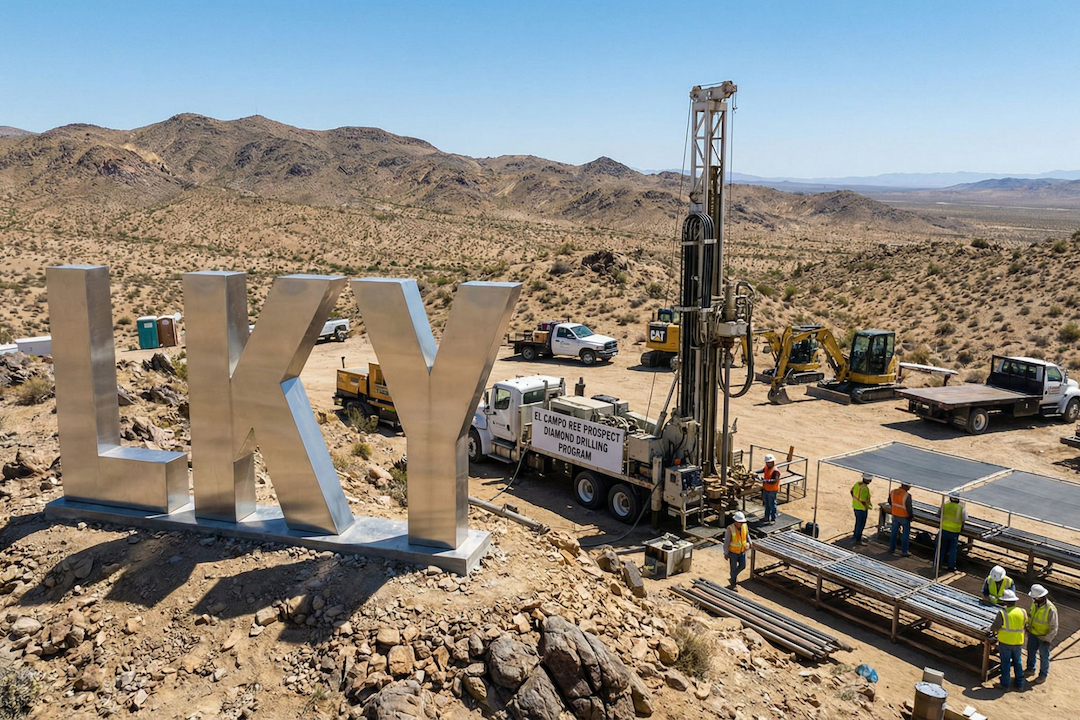
Mountain Pass is not subtle geography for a rare earth explorer.
MP Materials’ Mountain Pass mine in California is the only significant rare earth producer in the western hemisphere. The United States imports roughly 70% of its rare earth elements from China. The gap between those two facts is one of the most strategically uncomfortable positions in American industrial policy. On April 9, 2026, Locksley Resources (ASX: LKY | OTCQX: LKYRF) commenced diamond drilling at its El Campo Rare Earth Prospect, part of its Mojave Project in California. El Campo sits approximately four miles southeast of Mountain Pass.
That proximity is not coincidence. It is geology.
What Locksley found at surface and what drilling will tell them
El Campo has not been systematically drilled before. What the company has is historical work and recent surface sampling that returned results of up to 12.1% Total Rare Earth Oxide, a number that would be considered high-grade by any measure in REE exploration. The maiden drilling program comprises four diamond drill holes targeting sheared carbonatite-hosted REE mineralization across 900 meters of strike length.
Carbonatite is the right host rock for this kind of deposit. Mountain Pass itself is a carbonatite-hosted REE system. The geology connecting the two properties reflects the same regional structural setting, the same mineralization style, and the same suite of rare earth elements critical to electric vehicle motors, wind turbines, defense electronics, and the entire clean energy supply chain.
The program is designed to answer three specific questions. How deep does the mineralization go? Does it hold its grade below surface? And does the 900-meter surface expression represent a coherent, continuous body or disconnected zones?
Surface grades mean nothing without subsurface continuity. This drill program provides the first data that can answer that question.
Why the Mojave Project exists at this specific moment in US critical minerals policy
China controls approximately 60% of global rare earth mining and 85% of processing capacity according to the US Geological Survey’s 2025 Mineral Commodity Summaries. In December 2024, China expanded its export controls on rare earth processing technology. In early 2025, it imposed additional restrictions on rare earth magnet exports. The policy direction is unambiguous.
The US response has been to accelerate domestic critical minerals development through the CHIPS Act, the Inflation Reduction Act’s domestic content requirements, and executive orders designating rare earth supply chains as national security priorities. Mountain Pass is the anchor of that domestic supply chain. A second significant REE deposit four miles away, in the same geological setting, with the same carbonatite host rock, would not be unwelcome.
Locksley is not just an explorer sitting on a promising ground position. The company is executing what it describes as a mine-to-market strategy for antimony, with downstream technology partnerships with US research institutions and industry partners. The Mojave Project targets both rare earths at El Campo and antimony, which is separately on the US critical minerals list and subject to its own Chinese export restrictions.
The strategic context behind the numbers
12.1% TREO at surface is a meaningful grade. For comparison, Mountain Pass operates on resources grading approximately 7 to 8% TREO. High surface grades in carbonatite systems do not always reflect what lies beneath, which is precisely why drilling is the only way to resolve the question. But the surface work gave Locksley enough confidence to commit capital to a maiden program.
The Critical Minerals Institute has documented that the pipeline of advanced US rare earth projects outside Mountain Pass remains thin relative to the strategic need. Most REE exploration activity in the US is at early stage, with few projects carrying the combination of high-grade surface expression, proximity to established processing infrastructure, and carbonatite host rock that El Campo presents.
Mountain Pass processes its own ore on site. The existence of a major REE processing facility four miles from El Campo is an infrastructure advantage that most REE exploration projects anywhere in the world do not have. If El Campo delivers subsurface continuity that matches its surface grades, the pathway to production is shorter than it would be almost anywhere else.
What comes next and what investors should understand
Results from the four drill holes will be released as they become available. The program is testing 900 meters of strike. What it finds will determine whether El Campo advances toward resource definition drilling, resource estimation, and eventually prefeasibility work, or whether the surface grades prove to be surficial enrichment without meaningful depth.
Locksley is an ASX-listed junior explorer. El Campo is an early-stage exploration project with no mineral resource established under JORC or any other reporting standard. High surface grades are an encouraging signal, not a resource. The gap between a compelling surface sample and a defined, economically viable deposit is crossed with drill holes, assay results, and years of systematic work.
The drill is in the ground. That gap is now being tested.
Sources
- US Geological Survey — Rare Earths Mineral Commodity Summaries 2025
- Critical Minerals Institute — US REE Pipeline
- MP Materials — Mountain Pass Operations
- Locksley Resources — Investor Relations
Editorial disclosure
This article is based on a press release issued by Locksley Resources and has been independently rewritten and editorially expanded. It covers the commencement of diamond drilling at the El Campo Rare Earth Prospect, part of Locksley’s Mojave Project in California. Locksley Resources trades on the ASX under LKY and on OTCQX under LKYRF. El Campo is an early-stage exploration project with no mineral resource established under any reporting standard. High surface grades are not indicative of a defined economic deposit. This is a speculative early-stage exploration story carrying significant risk. Market context is sourced from the US Geological Survey, the Critical Minerals Institute, and MP Materials. Commentary reflects the author’s own assessment. The information provided on this website is for informational and educational purposes only. Our content is derived strictly from verified online sources to ensure accuracy and objectivity. This analysis does not constitute financial, investment, or professional advice. Readers are encouraged to consult with qualified professionals before making decisions based on this information. For more information, please see our full DISCLAIMER.

 Watch on YouTube