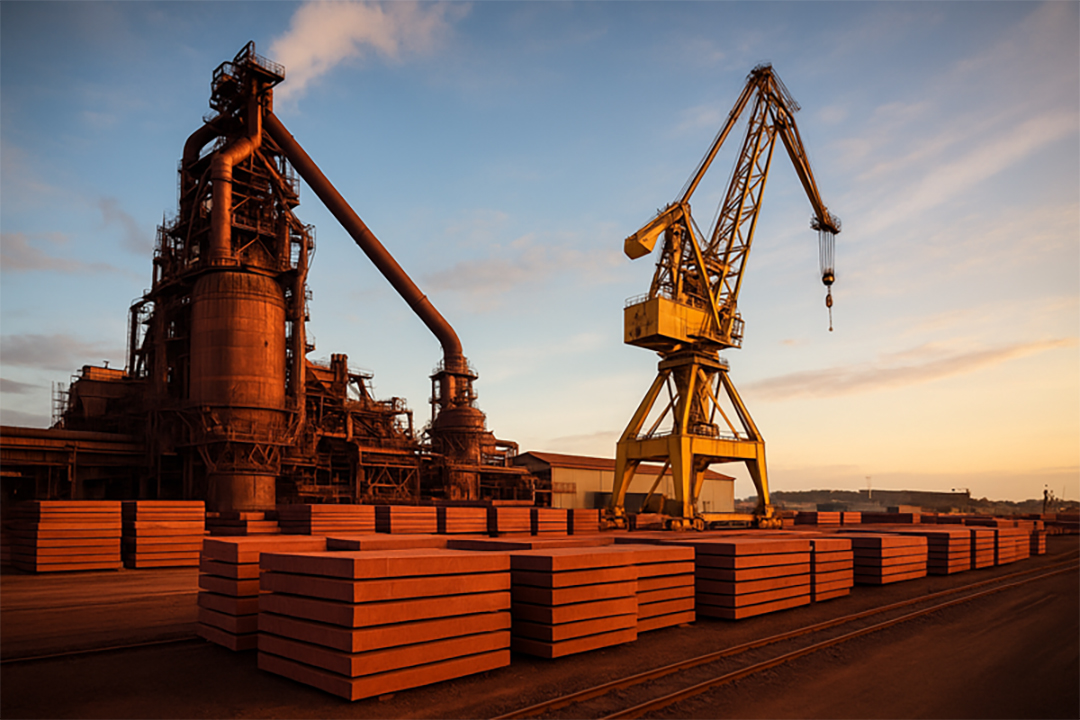
Metal Logic Secures Pilbara Site to Industrialize Modular Clean Steel Smelting
On March 13, 2026, low-carbon steel platform Metal Logic announced the acquisition of 1,000 hectares of tenements in the Pilbara region of Western Australia. This strategic location, situated within 20 kilometers of major rail corridors operated by BHP, Roy Hill, and Fortescue, serves as the launchpad for Australia’s first industrial-scale modular smelting hub. The site will host an initial capacity of one million tonnes per annum (1Mtpa), with first modules scheduled for deployment toward the end of the first half of 2026.
The facility utilizes an Australian-invented array smelting technology that is grade-agnostic, allowing for the economic processing of lower-grade iron ores that were previously considered stranded. By manufacturing these modular units at its dedicated Victorian production facility, Metal Logic reduces on-site construction risks and enables a rapid, capital-efficient ramp-up to full capacity.
Thermodynamic Efficiency Drives Competitive Advantages in Green Steel Production
Metal Logic’s technological breakthrough centers on superior thermal efficiency, which resets the cost and emission benchmarks for the steel industry. The following table highlights the operational benefits of the modular array system:
| Performance Metric | Conventional Steelmaking | Metal Logic Modular Smelting |
| Energy Consumption | ~7.5 Gigajoules per tonne | Optimized via thermodynamic efficiency |
| Grade Dependency | Requires high-grade (65%+ Fe) | Grade-agnostic; processes lower-grade ore |
| Value Retention | Raw ore exported at base price | Adds up to US$400 value per tonne onshore |
| Deployment Model | Fixed, large-scale infrastructure | Scalable, ‘smelting as a service’ modules |
| Market Resilience | Dependent on carbon subsidies | Economically viable via efficiency alone |
This approach allows the platform to remain globally competitive without relying on government subsidies or carbon border adjustment mechanisms. By unlocking care-and-maintenance deposits, the technology effectively extends the life of existing mines and creates a decentralized, repeatable model for steel production.
Pilbara Smelting Hub Aligns with Western Australia Strategic Green Steel Procurement
The acquisition of the Pilbara tenements positions Metal Logic to capitalize on the Western Australian Government’s recent Expression of Interest (EOI) for locally manufactured green steel. Under the Made in WA policy and the WA Industry Participation Strategy (WAIPS) Addendum, the state government has signaled a clear preference for low-emission steel in major infrastructure projects, including railways, roads, and hospitals.
Metal Logic’s initial focus on rebar for the construction sector directly meets the demand from these upcoming government projects. Because the smelting units produce steel with a verifiable carbon footprint and full traceability, they satisfy the enhanced sustainability metrics now mandatory in WA procurement frameworks. This integration into the local supply chain not only supports decarbonization but also bolsters the regional economy by creating manufacturing jobs in Victoria and operational roles in the Pilbara.
Smelting as a Service Redefines the Traditional Mining Value Chain
The shift toward a modular, scalable architecture represents a fundamental change in the global steel ecosystem. Historically, steelmaking required massive, centralized blast furnaces located near coal sources or deep-water ports. Metal Logic’s smelting as a service model flips this logic by bringing the smelter to the ore. This decentralized approach mitigates the logistical costs of transporting millions of tonnes of low-grade raw material, instead focusing on shipping high-value, finished steel products.
The true information gain for the sector is the decoupling of steel production from high-grade ore requirements. As global high-grade reserves deplete, the ability to process lower-grade magnetite and hematite via thermal efficiency—rather than complex chemical additives—provides a significant competitive moat. For Western Australia, this means transforming from a raw material exporter into a value-added manufacturing powerhouse. The successful deployment of these modules in the Pilbara will likely serve as a global proof-of-concept, suggesting that the future of clean steel lies not in larger plants, but in smarter, modular arrays that can be replicated across resource-rich jurisdictions.
Sources
- Metal Logic: Official Site Acquisition and Smelter Deployment Announcement
- Western Australian Government: Expression of Interest for Locally Manufactured Green Steel
- Steel Radar: Metal Logic Establishes Strategic Platform for Low-Emission Steel
- Metal Logic: Thermodynamic Efficiency and Modular Array Smelting Technology
- WA Industry Participation Strategy: Steel Procurement Addendum Guidelines
Editorial Disclosure
The information provided on this website is for informational and educational purposes only. Our content is derived strictly from verified online sources to ensure accuracy and objectivity. This analysis does not constitute financial, investment, or professional advice. Readers are encouraged to consult with qualified professionals before making decisions based on this information. For more information, please see our full DISCLAIMER.