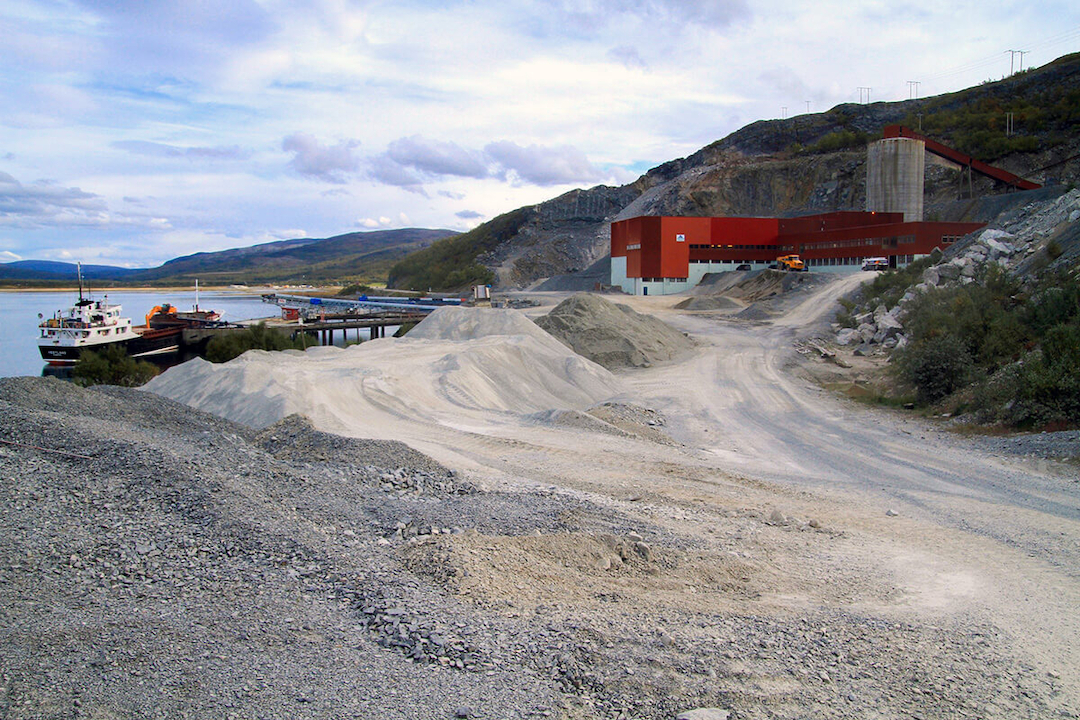
A European copper mine just proved its high-grade zone continues 200 meters further than anyone had drilled before. At over a kilometer deep.
Most mines have a known edge.
A boundary where the resource model stops and the geological question begins. Beyond that boundary, the deposit might continue. It might not. You drill to find out.
At the Nussir copper-gold-silver project in Arctic Norway, Blue Moon Metals (TSXV: MOON | NASDAQ: BMM) just found out.
Two daughter holes drilled from a single mother hole at depths exceeding 1,100 meters, each targeting a 200-meter step-out beyond a known high-grade intercept, both hit mineralization. The first returned 1.75% copper, 0.16 g/t gold, and 27.91 g/t silver over 6.7 meters, equivalent to 2.08% copper. The second returned 0.86% copper, 0.16 g/t gold, and 27.75 g/t silver over 3.0 meters. Both at over a kilometer below surface.
Few projects in the world deliver successive successful 200-meter step-out holes at over 1 km depth.
That is not marketing language. That is a technical reality. Drilling at that depth with navigational directional techniques to hit a specific geological target is genuinely difficult. Hitting it twice in a row from the same mother hole is a meaningful result.
What these holes are actually telling geologists
Nussir is not a typical copper deposit. The mineralization is stratiform, meaning it follows a specific rock layer with exceptional lateral continuity across more than 10 kilometers of strike length. The copper, silver, and gold occur within a dolomitic horizon of a Paleoproterozoic formation, primarily as chalcocite with subordinate bornite and chalcopyrite.
That geology has important implications for what the deep drilling means.
Stratiform deposits that are open at depth and along strike tend to be large. The lateral continuity at Nussir has already been demonstrated across a substantial strike length. The question the deep program is answering is whether that continuity extends downward at grades that remain economic.
The 2025 NI 43-101 Technical Report by Adam Wheeler, the independent qualified person for the project, defined an exploration target around three deep drill intersections that sit beyond the current inferred resource boundary. That target carries a conceptual tonnage of 8.5 to 16.5 million tonnes at 0.7 to 1.3% copper. The two step-out results just released are the first drill data attempting to bridge the gap between the current resource boundary and that exploration target.
Both hits are coherent with the known mineralization style and grade. The deep zone remains open at depth and along strike.
Norway is an exceptional jurisdiction for a copper mine of this scale
Nussir sits in Finnmark, Arctic Norway, within the Repparfjord Tectonic Window, a geological province known for sediment-hosted copper mineralization. Norway is one of the lowest-risk mining jurisdictions in the world, consistently rated highly by the Fraser Institute’s Annual Survey of Mining Companies for policy stability, regulatory clarity, and infrastructure quality.
For a deposit that Blue Moon’s VP of Exploration Theodore Veligrakis describes as potentially one of the most important copper mines in Europe, jurisdiction quality is not a secondary consideration.
Europe has a structural copper deficit. The continent consumes substantial copper for its energy transition, electric vehicle manufacturing, and electrical grid upgrades, while producing almost none domestically. The European Commission has classified copper as a critical raw material. The Critical Raw Materials Act is creating regulatory support for domestic European mining projects that can demonstrate credible development pathways.
A multi-generational copper mine in Arctic Norway, backed by shareholders including Teck Resources, Oaktree Capital Management, Hartree Partners, and Wheaton Precious Metals, is exactly the kind of project European critical minerals policy was designed to support.
The infill program is building the resource that matters first
While the deep drilling headlines are compelling, the parallel infill program is the work that drives near-term value.
Of 1,477 meters completed in a planned 3,000-meter surface infill program, the success rate for intersecting known mineralization is 100%. Holes NUS-DD-26-05 and NUS-DD-26-06 have identified mineralization in a previously void area of the resource model, where a formerly unconstrained fault had created a gap in the estimate. That gap is being filled with real drill data.
The infill program has also confirmed suspected mineralization in a parallel zone approximately 60 meters above the known resource. If that parallel zone proves continuous, it could represent an additional mineralized horizon that is not currently included in the resource model.
Assay results from the infill program are expected in Q2 2026.
There is one more detail worth noting. Blue Moon found two previously unsampled historical drill holes stored at Norway’s geological survey core archive at Løkken. Those holes intersect the current target horizon. Historical data that has never been incorporated into the resource model, now being analysed.
The deposit keeps giving up information.
According to the World Bank’s Commodity Markets Outlook, copper demand is projected to double by 2050 driven by electrification, with supply growth consistently lagging demand growth in the most optimistic scenarios. A high-grade stratiform copper deposit in a Tier 1 jurisdiction, with a 10-kilometer mineralized corridor that remains open at depth, positioned within Europe’s critical minerals supply chain, is a genuinely rare combination.
The drill is still turning.
Sources
- Fraser Institute — Annual Survey of Mining Companies
- World Bank — Commodity Markets Outlook
- European Commission — Critical Raw Materials Act
- Blue Moon Metals — Investor Relations
Editorial disclosure
This article is based on a press release issued by Blue Moon Metals Inc. and has been independently rewritten and editorially expanded. It covers Q1 2026 drilling results from the Nussir Copper-Gold-Silver Project in Norway. Blue Moon Metals trades on the TSX Venture Exchange under MOON and on NASDAQ under BMM. The exploration target referenced in this article is conceptual in nature. There has been insufficient exploration to define a mineral resource within the exploration target area, and it is uncertain whether further exploration will result in its delineation as a mineral resource. Drill results represent sample lengths and true widths may differ. This is a development-stage mining company and carries significant exploration and investment risk. Market context is sourced from the Fraser Institute, the World Bank, and the European Commission. Commentary reflects the author’s own assessment. The information provided on this website is for informational and educational purposes only. Our content is derived strictly from verified online sources to ensure accuracy and objectivity. This analysis does not constitute financial, investment, or professional advice. Readers are encouraged to consult with qualified professionals before making decisions based on this information. For more information, please see our full DISCLAIMER.