
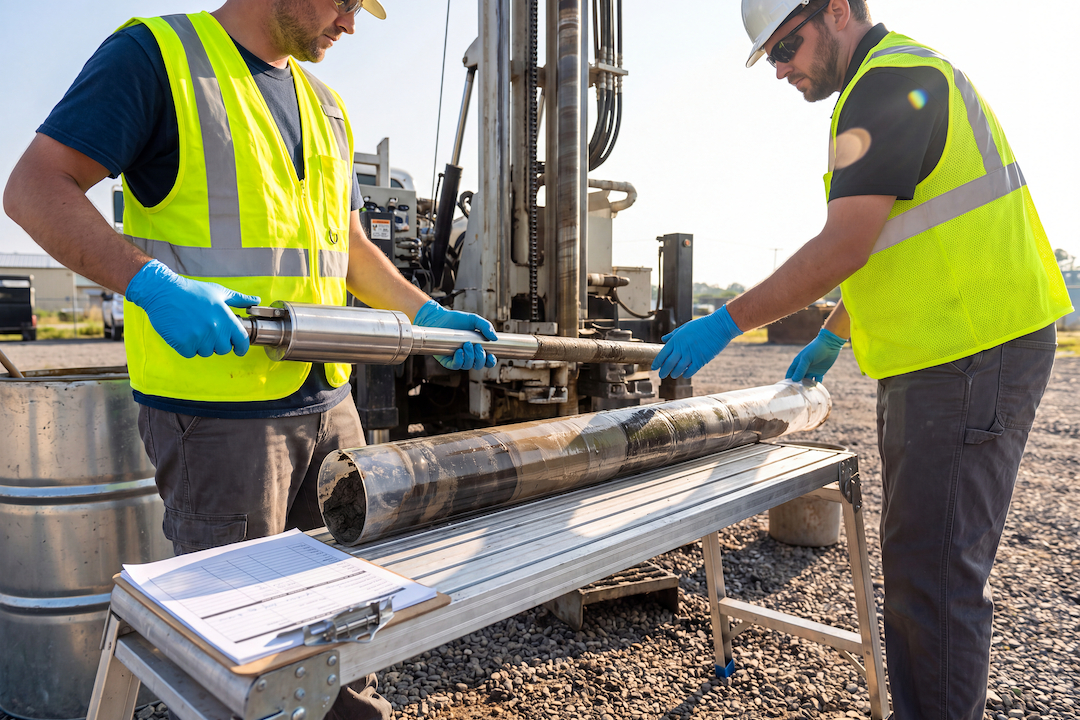
Eight holes have been drilled at West Diane so far. Six of them hit mineralization above the cutoff grade. Not one of those grades has been through a laboratory yet, and the company reporting them says so in its own footnotes.
Premier American Uranium Reports 10 Feet of 0.064% eU3O8 at West Diane
Premier American Uranium Inc. (TSXV: PUR) (OTCQB: PAUIF) reported on October 7 that initial drilling at the West Diane target of its wholly owned Kaycee Project, in the Powder River Basin of northeastern Wyoming, intersected mineralization grading 0.02% eU3O8 or higher in six of its first eight holes. Those eight holes total 7,360 feet. The standout, drillhole WD26-012, returned 10 feet grading 0.064% eU3O8, including 5.5 feet at 0.076% and 2 feet at 0.092%. The “e” matters: eU3O8 is an equivalent grade of uranium oxide estimated from a downhole gamma probe, not measured by chemical assay.
Higher peak grades showed up over shorter widths. WD26-011 returned 3 feet at 0.081%, including a single foot at 0.141%. WD26-013 posted 5 feet at 0.063%, including 1 foot at 0.119%. CEO Colin Healey told investors that WD26-012 is the thickest mineralized interval reported from the 2026 program to date.
West Diane is not virgin ground. Historical drilling there identified two sandstone host units within the Fort Union Formation, one of two historically productive host formations in the Smith Ranch-Highland area of the basin, and this season’s holes focus on the upper unit. The goal, according to the release, is to better define a paleochannel, an ancient buried river channel, that older drilling only partially outlined. PUR is exploring Kaycee for in-situ recovery (ISR), a method that dissolves uranium underground and pumps the solution to surface instead of digging out ore.
Kaycee Grades Come From Gamma Logs, Not Chemical Assays
Every grade in the release was calculated from gamma-ray logs recorded by Hawkins CBM Logging of Casper, Wyoming, whose probe was calibrated at the US Department of Energy’s Casper test pits in August 2026. No corrections were made for radiometric disequilibrium.
Disequilibrium happens when uranium and the decay products a gamma probe actually detects have separated over geologic time. When that occurs, an equivalent grade can overstate or understate the uranium really there. PUR states that numerous comparisons of eU3O8 against chemical assays of Powder River Basin core show the gamma method to be a reasonable indicator of actual uranium content. That is the company’s own characterization, and the October 7 release includes no chemical assays for these holes.
All holes were drilled vertically into generally flat-lying units, so the company says reported thicknesses approximate or modestly exceed true thicknesses. The technical information was reviewed and approved by J.J. Brown, P.G., under NI 43-101, Canada’s disclosure standard for mineral projects. Brown is PUR’s Vice President Exploration.
Rustler Returns Thinner Intercepts as PUR Adds 1,883 Acres
Rustler was patchier. Of 22 newly reported holes there, six intersected mineralization grading at least 0.02% eU3O8, the best being 2.5 feet at 0.063% in RT26-121 and 3.5 feet at 0.037% in RT26-116. The other 16 did not report intercepts at that cutoff.
Drilling at Rustler was paused after 45 holes while PUR secured adjacent ground. It has now added 1,883 acres of mineral rights north and west of the existing claim block, connecting its Rustler and Stampede claim blocks. The release does not disclose the cost or terms of that addition.
Two mineralized sandstone units have been identified at Rustler, both within the lower Wasatch Formation. PUR says gamma results indicate possible stacked roll fronts in the upper unit. A roll front is a crescent-shaped zone where uranium dropped out of moving groundwater; stacked fronts would mean more than one such zone at different depths. It is an interpretation, not a defined resource.
PUR’s Kaycee Program Passes 65,000 Feet of a Planned 100,000
As of September 25, PUR had completed 80 conventional mud-rotary drillholes for 65,620 feet, about 66% of the planned 100,000-foot program. Thirty of those holes, totaling 23,660 feet, were drilled after the company’s previous update. The company describes Kaycee as the largest grass-roots ISR drill program in the United States, with upwards of 400,000 feet drilled since 2023, and pairs it in its Wyoming portfolio with the Cyclone Project in the Great Divide Basin.
No mineral resource estimate accompanied the October 7 release. None of this year’s Kaycee results have been folded into one, and the release’s cautionary language lists negative operating cash flow and dependence on third-party financing among PUR’s risk factors. No specific cash position or runway was identified in the primary sources reviewed for this article.
PUR Plans to Finish West Diane Before Resuming Rustler Drilling
About 34,380 feet of the planned 100,000-foot Kaycee program remained as of September 25, based on the company’s reported totals. Drilling is currently focused on West Diane, and PUR says Rustler drilling is expected to resume after the West Diane campaign, weather permitting; no resumption date has been disclosed. The company has not given a timeline for a resource estimate incorporating the 2026 results.
Sources
Editorial Disclosure
This article is based on Premier American Uranium Inc.’s October 7, 2026 news release, distributed by GlobeNewswire and reproduced in full as received by BNN Bloomberg, with the original wire attribution and date visible. The security discussed is Premier American Uranium Inc. (TSXV: PUR) (OTCQB: PAUIF). aktiego.com has not received any compensation from Premier American Uranium, its management, investor relations representatives, or any third party. No staff member or principal of aktiego.com holds a position in this security at the time of publication.
All grades cited are equivalent uranium grades (eU3O8) calculated from downhole gamma-ray logs rather than chemical assays, and the company made no correction for radiometric disequilibrium; actual uranium content may differ from the reported figures. Reported thicknesses approximate or may modestly exceed true thicknesses, per the company. The Kaycee results are exploration-stage drilling. No mineral resource estimate incorporating them has been published, and the company’s own risk factors note no known mineral reserves. The qualified person who reviewed the technical information, J.J. Brown, P.G., is PUR’s Vice President Exploration, a company officer.
The release does not disclose the cost or terms of the 1,883 acres of mineral rights added at Rustler. No specific cash position or cash runway was identified in the primary sources reviewed. PUR’s cautionary statement lists negative operating cash flow and dependence on third-party financing among its risks; future equity financings could dilute existing shareholders. Remaining drilling, the resumption of Rustler drilling, and interpretations such as possible stacked roll fronts are company forward-looking statements and interpretations, not guarantees. Neither the TSX Venture Exchange nor its Regulation Services Provider accepts responsibility for the adequacy or accuracy of the company’s release, per the company’s standard disclosure.
Small cap and micro-cap stocks listed on the CSE, TSX, TSXV, and Nasdaq are speculative investments carrying significant risk including potential total loss of capital. Coverage on aktiego.com is provided for informational and educational purposes only. aktiego.com is not a registered investment advisor. Nothing in this article constitutes financial, investment, or professional advice. Readers are encouraged to conduct their own due diligence and consult a qualified financial advisor before making any investment decisions. For more information please see our full DISCLAIMER.