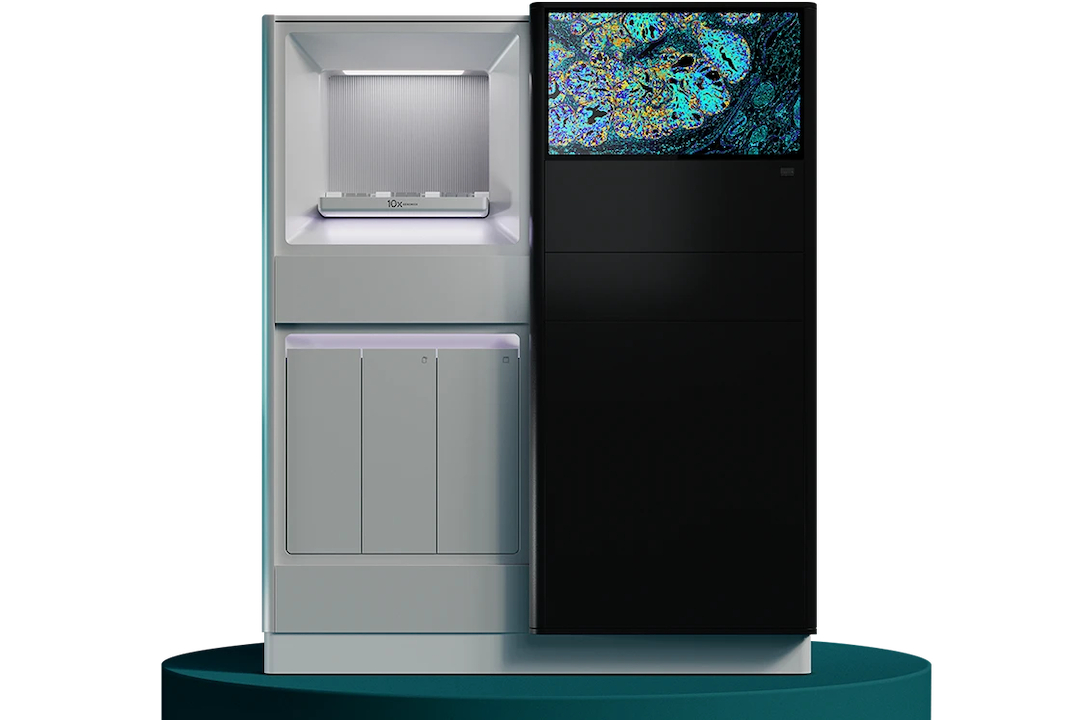
A new instrument just removed the biggest constraint in cancer biology research. Here’s why that matters.
To understand how cancer develops, you need to know three things simultaneously.
Which genes are being expressed in a cell. Which specific cell is expressing them. And exactly where in the tissue that cell sits.
The problem is that measuring all three together, at the resolution and scale that makes the data scientifically actionable, has been technically impossible. Existing spatial biology tools forced researchers to choose. High sensitivity or broad gene coverage. Large scale or precise cellular resolution. Every approach involved a trade-off that left part of the biological picture invisible.
On April 18, 2026, 10x Genomics (NASDAQ: TXG) announced Atera, a new in situ spatial biology platform that eliminates those trade-offs. Whole-transcriptome analysis. Single-cell sensitivity. Scale. All three simultaneously. The platform debuts with data presented at the American Association for Cancer Research Annual Meeting 2026, including results from Carl June’s lab at the University of Pennsylvania and from the German Cancer Research Center.
What those early results are showing is that biology is more complex than previously visible tools allowed scientists to see.
What spatial biology is and why the scale constraint has been so costly
Every cell in the human body contains the same genome. What makes a liver cell different from a neuron, and what makes a cancer cell different from a healthy cell, is which genes are being expressed and at what level. Single-cell genomics can measure that. The problem is that it requires dissociating tissue, destroying the spatial relationships between cells in the process.
Spatial biology preserves those relationships. It measures gene expression in cells while keeping them in their original position within intact tissue. The location of a cancer cell relative to immune cells, blood vessels, and stromal tissue determines how that cancer behaves, how it evades treatment, and how it might respond to therapy. That spatial context is not optional information. It is mechanistically important.
The constraint has been scale. Early spatial tools could measure a few hundred genes in spatially intact tissue. Getting to whole-transcriptome coverage, the full expression profile of every gene in every cell, required approaches that sacrificed either spatial resolution or the ability to process large numbers of samples at practical cost.
Atera removes that constraint.
What the early cancer research data is revealing
The data being presented at AACR from the German Cancer Research Center is the specific finding that stops you.
Researchers used Atera to analyze a single colorectal tumor sample. They distinguished multiple malignant and stem cell states across different disease stages within that single sample. They mapped how those cell populations interact with the surrounding immune microenvironment.
Then they found something that contradicts established assumptions.
Tumors that had been previously characterized as having limited or low immune infiltration were found to harbor active and diverse immune cell populations. The immune cells were there all along. Previous lower-resolution spatial tools simply could not see them at the resolution required to detect them.
That finding has direct therapeutic implications.
Immunotherapy works by activating the immune system against cancer. If clinicians are classifying tumors as immunologically cold, meaning immune-excluded, and making treatment decisions on that basis, but those tumors actually contain active immune populations that Atera can now detect, some patients may be receiving suboptimal treatment decisions based on incomplete biological information.
That is not a marginal scientific refinement. That is a finding that could change treatment protocols.
The Carl June lab at the University of Pennsylvania is similarly instructive. The lab works with tissue from glioblastoma patients treated with first-in-human bivalent CAR T cells. These samples are rare and irreplaceable. Every data point matters. Andrew Rech from the June lab described what Atera provided: the ability to resolve rare immune cells including T cells in the post-treatment tumor microenvironment and to understand tumor dynamics after treatment at a level not attainable with prior lower-plex spatial work.
CAR T cell therapy is one of the most promising and most complex advances in cancer treatment. Understanding exactly what happens in the tumor microenvironment after CAR T treatment, which immune cells are present, how the tumor is responding, where residual cancer cells persist, is the information that drives the next generation of therapy design. Atera provides that information from clinical samples that cannot be re-collected.
The Human Cell Atlas connection is the long-term significance
The Human Cell Atlas is the global consortium effort to map every cell type in the human body. It is one of the most ambitious biological research programs ever undertaken and its success will define the foundational reference against which all future disease biology is measured.
10x Genomics has announced that Atera will enable the HCA to achieve its next set of ambitious goals. That is not a marketing claim. It reflects a genuine technical capability gap the platform fills. Mapping every cell type requires whole-transcriptome data from spatially intact tissue at single-cell resolution across enormous numbers of samples from diverse human tissues and disease states. Previous tools could not deliver that at the required scale. Atera can.
According to Nature’s coverage of the Human Cell Atlas initiative, the consortium has already produced reference maps covering dozens of tissue types, but achieving comprehensive coverage requires substantial increases in throughput and sensitivity. Atera’s commercial availability in the second half of 2026 positions it as the primary enabling technology for the next phase of that effort.
The commercial ecosystem is already forming around Atera
Macrogen, a leading global CRO, has committed to deploying multiple Atera instruments, becoming the first global service provider to adopt the platform. That commitment reflects biopharma demand for high-throughput spatial analysis in drug development pipelines.
Bioptimus, the French AI biotech company building one of the world’s largest spatial datasets through its STELA initiative, is starting with Xenium now and expanding to Atera in 2027. The dataset will power M-Optimus, Bioptimus’s multimodal AI platform for drug discovery. The scale Bioptimus requires for AI-driven biology is only achievable with Atera’s throughput.
10x has also launched Catalyst Research Services, enabling direct sample submission for whole-transcriptome spatial analysis for researchers who cannot wait to acquire their own instruments. Pre-orders are open. Commercial shipping begins in the second half of 2026.
The platform is debuting into a field that is ready for it.
Sources
- Nature — Human Cell Atlas Coverage
- American Association for Cancer Research — Annual Meeting 2026
- 10x Genomics — Investor Relations
Editorial disclosure
This article is based on a press release issued by 10x Genomics, Inc. and has been independently rewritten and editorially expanded. It covers the announcement of Atera, a new spatial biology platform from 10x Genomics. 10x Genomics trades on NASDAQ under the ticker TXG. Atera is expected to begin shipping in the second half of 2026 and is not yet commercially available. Early access data presented at AACR represents preliminary research findings and should not be interpreted as establishing clinical or therapeutic conclusions. This article does not constitute medical advice. Market context is sourced from Nature and the American Association for Cancer Research. Commentary reflects the author’s own assessment. The information provided on this website is for informational and educational purposes only. Our content is derived strictly from verified online sources to ensure accuracy and objectivity. This analysis does not constitute financial, investment, or professional advice. Readers are encouraged to consult with qualified professionals before making decisions based on this information. For more information, please see our full DISCLAIMER.