Executive Summary
The United States entered Operation Epic Fury in a state of documented mineral dependency that did not begin with the Iran conflict and will not end when it does. According to the US Geological Survey Mineral Commodity Summaries 2025, the US is 80% import-dependent for rare earth compounds and metals, with 56% of that consumption sourced from China over the 2020 to 2023 period. For gallium, a critical input to radar and electronic warfare systems, US import reliance is 100%. China accounts for more than 90% of global rare earth refining and processing capacity. In December 2024, China’s Ministry of Commerce implemented an embargo on gallium, germanium, and antimony exports to the United States, which the USGS has formally identified as a 100% probability trade disruption scenario in its 2025 Critical Minerals methodology.
The 2025 Federal Register Final List of Critical Minerals includes 60 commodities. The USGS 2025 methodology ranked terbium, dysprosium, gallium, germanium, and tungsten among the highest risk categories, driven primarily by near-complete dependence on Chinese production at the processing stage. Each of these minerals is a direct input to the weapons systems being fired in the Iran campaign: NdPr and dysprosium magnets in THAAD and PAC-3 guidance systems, gallium arsenide in radar and electronic warfare, tungsten in armor-piercing penetrators, and antimony trisulfide as a non-substitutable component in over 300 munition types according to the US Army’s Picatinny Arsenal.
The federal government has been investing in domestic alternatives since at least 2020. The DoD has committed $258 million to Lynas USA’s Texas processing facility. Perpetua Resources has received more than $80 million in DoD funding for its Idaho antimony project. MP Materials operates the only active rare earth mine in the US at Mountain Pass, California. REalloys listed on NASDAQ on February 24, 2026 and received a DLA contract through its Terves LLC subsidiary on March 2, the day Operation Epic Fury began. These investments represent years of effort to rebuild a supply chain that was largely dismantled between the 1990s and 2010s. None of them are yet producing at scale. The gap between where the supply chain is today and where it needs to be is the central risk this article addresses.
China’s Export Controls Predate the Iran Conflict
The critical minerals dependency at the center of the US defence supply chain was not created by Operation Epic Fury. It was documented, officially measured, and formally classified as a national security risk in federal policy for years before the first missile was fired. What the Iran conflict did was convert a theoretical supply chain vulnerability into an operational constraint with an active military campaign running in the background.
The US Geological Survey has published the Mineral Commodity Summaries annually since 1970. The 2025 edition, the most recent, records that the US is 80% net import-reliant for rare earth compounds and metals. Over the 2020 to 2023 period, an estimated 56% of that consumption was met by imports from China. For yttrium, a rare earth element used in radar systems, lasers, and navigation equipment, import reliance is 100%, with 93% coming from China. For gallium, used in compound semiconductor devices that form the basis of US radar and electronic warfare systems, import reliance is 100%. For antimony, used in primers, flame retardants, and munition components, import reliance is 85%.

China’s response to escalating US trade pressure has not been to negotiate. It has been to weaponize the supply chain. In 2023, China imposed export controls on gallium and germanium. In September 2024, antimony was added. In December 2024, China’s Ministry of Commerce implemented a full embargo on gallium, germanium, and antimony exports to the United States specifically, and tightened restrictions on graphite. The USGS 2025 methodology for the List of Critical Minerals assigned a 100% probability to trade disruption scenarios for 17 mineral commodities that China has explicitly restricted or banned, including antimony, dysprosium, gadolinium, gallium, germanium, lutetium, samarium, terbium, and tungsten.

The 2025 List of Critical Minerals, published in the Federal Register on November 7, 2025, includes 60 minerals. The USGS methodology ranked the supply chain risks using an economic model covering 1,200 disruption scenarios across 402 US industries. Gallium, germanium, dysprosium, terbium, and tungsten were placed in the highest risk category. Antimony and neodymium were placed in the elevated risk category. Together, these minerals are inputs to the weapons systems that are being consumed faster than they can be replaced in the Iran campaign.
What the US Mines, What China Processes, and Why the Gap Matters
Rare earths are a group of 17 elements that include the lanthanides plus scandium and yttrium. They are called rare not because they are scarce in the earth’s crust but because minable concentrations are uncommon and processing them is technically demanding, chemically hazardous, and historically expensive relative to the price the market would support. China built its processing dominance over three decades by absorbing those costs through subsidized state enterprise, driving non-Chinese competitors out of business, and accumulating both the infrastructure and the technical expertise to process rare earths more cheaply than anyone else.
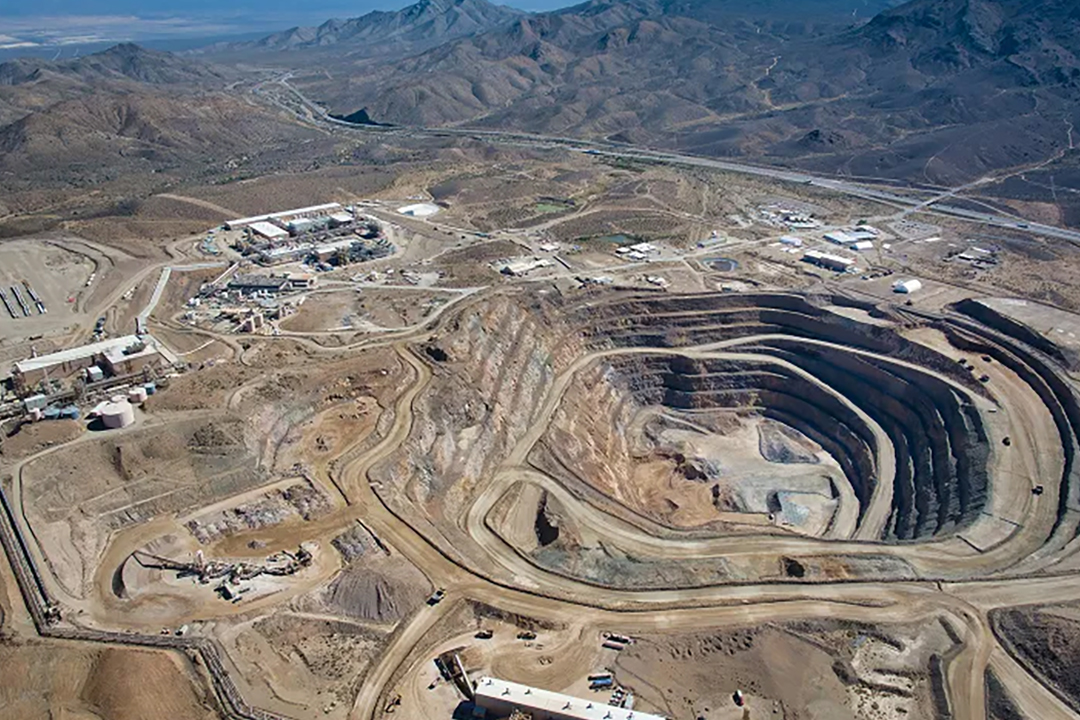
The result, as recorded by the USGS, is that China mined approximately 270,000 metric tons of rare earth oxide equivalent out of a global total of 390,000 metric tons in 2024. That is roughly 69% of global mining output. At the processing stage, the concentration is higher. USGS data places China’s share of global rare earth refining and processing capacity at approximately 90%. The US produced 45,000 metric tons of rare earth oxide equivalent in 2024, entirely from the Mountain Pass mine in California operated by MP Materials. Nearly all of that ore was exported or processed into mixed concentrates; limited quantities were processed into individual separated rare earth compounds domestically. North America’s measured and indicated rare earth resources are substantial, estimated at 3.6 million tons in the United States and more than 14 million tons in Canada, according to the USGS 2025 Mineral Commodity Summaries. The resource is not the constraint. The processing infrastructure is.

The defence supply chain consequence is direct. The NdPr (neodymium-praseodymium) magnets in THAAD guidance systems, PAC-3 seeker heads, F-35 actuators and engines, Tomahawk guidance systems, and virtually every precision-guided munition in the US arsenal require neodymium iron boron magnets. Dysprosium and terbium are added to those magnets to maintain coercivity at high operating temperatures. Without adequate dysprosium and terbium content, the magnets lose their strength when heated and the precision guidance system fails. Both dysprosium and terbium are classified as heavy rare earths, and the USGS 2025 methodology identified both as among the highest GDP impact disruption scenarios given near-complete Chinese production dominance at the processing stage. The FY2024 and FY2025 DoD government stockpile acquisitions explicitly included neodymium-praseodymium oxide and neodymium-iron-boron magnet block, confirming the DoD has identified this as an active procurement gap.
MP Materials
Lynas Rare Earths
REalloys Inc.
Energy Fuels Inc.
American Rare Earths
300 Types of Munitions Depend on a Mineral China Just Banned Exporting
Antimony is not a name most investors would recognize. It is not traded on a public exchange with daily price visibility in the way that gold or copper are. But the US Army’s Picatinny Arsenal, the primary research and development center for US armaments, has described antimony trisulfide as an essential and non-replaceable component of over 300 types of munitions. Colonel Steven Power of Picatinny’s Program Manager for Maneuver Ammunition Systems said specifically in May 2025 that establishing a fully domestic supply chain of this critical mineral is foundational to keeping America’s warfighters safe.

Antimony trisulfide is used as the primary ignition compound in small arms primers, artillery fuses, rocket and mortar propellants, incendiary and tracer compounds, and as a component in infrared-transparent glass for missile seeker heads. It cannot be substituted in these applications without significant re-engineering of the munition. The US has no active domestic mining source. According to the USGS 2025 Mineral Commodity Summaries, US import reliance for antimony is 85%. China, Russia, and Tajikistan together account for approximately 90% of globally mined antimony. In December 2024, China banned antimony exports to the United States. That ban is in effect as of the start of Operation Epic Fury.
The US government has been aware of this vulnerability for years. Antimony has appeared on every iteration of the DoD and USGS Critical Minerals List. The Stibnite mine in Idaho, operated by Perpetua Resources, is explicitly described by the DoD as the sole domestic geologic reserve of antimony that can meet Department of Defense requirements. The mine produced antimony for the US ammunition industrial base during World War II and the Korean War and has been dormant since. Perpetua has received more than $80 million in DoD funding to advance the project. This includes $59.2 million under a Technology Investment Agreement through Defense Production Act Title III and $22.4 million through the Defense Ordnance Technology Consortium to develop a fully domestic ground-to-round antimony trisulfide supply chain for the US Army. The DOTC funding is specifically for building a modular pilot plant to produce military-specification antimony trisulfide from Stibnite ore. The project is expected to supply up to 35% of US antimony demand in its first six years of operation, based on the 2023 USGS antimony commodity summary.
Perpetua Resources
US Antimony Corporation
100% Import Dependent, Embargo in Effect, No Domestic Production
Gallium and germanium are two of the most strategically exposed minerals on the US critical minerals list. Both are byproducts: gallium is recovered primarily from bauxite ore during aluminum refining, and germanium is recovered from zinc concentrate during zinc smelting. Neither is mined as a primary product anywhere in the world. This byproduct structure means supply is constrained by the economics of the primary metals rather than by gallium and germanium pricing, making new supply inherently difficult to incentivize.
China has produced more than 90% of global primary gallium since 2014, according to USGS data. For germanium, Chinese production dominance is similarly high. As of 2023, US net import reliance for primary gallium was 100% and for primary germanium was greater than 50%, both recorded in the USGS Mineral Commodity Summaries 2025. China implemented export controls on gallium and germanium in 2023 and escalated to a full embargo on exports to the United States in December 2024. The USGS 2025 methodology assigned a 100% probability to trade disruption scenarios for both minerals given the explicit MOFCOM restrictions already in place.
The defence applications are specific and not easily substituted. Gallium arsenide (GaAs) and gallium nitride (GaN) are compound semiconductor materials with electron mobility characteristics that silicon cannot replicate at the power densities and frequencies required for radar, electronic warfare, and directed energy weapons. GaN-on-silicon carbide transistors are the foundation of active electronically scanned array (AESA) radar systems, including the AN/APG-77 and AN/APG-81 radars in F-22 and F-35 aircraft. The Patriot and THAAD radar systems both use GaN-based components. Germanium is used in infrared optics, fiber optic components, and certain night vision systems. Without gallium and germanium inputs, these systems cannot be manufactured. The embargo has not yet caused production stoppages because manufacturers held inventory, but the USGS economic model estimates that a sustained full disruption in gallium supply would produce one of the largest probability-weighted decreases in US GDP across all 84 mineral commodities examined.
There is no near-term domestic answer to the gallium and germanium gap. The US has no active primary gallium or germanium recovery operations. Canada produces some germanium as a byproduct of zinc refining at the Teck Resources Red Dog mine in Alaska, which is the only meaningful alternative production source for germanium currently accessible to the US market. The USGS 2025 List ranked gallium and germanium in the highest risk category, with gallium ranked sixth overall and germanium seventh. The 2025 Federal Register Final List of Critical Minerals includes both. This section does not feature domestic company profiles because no domestic production exists at present. The investment story in gallium and germanium is a gap analysis, not a company showcase.
Armor-Piercing Rounds, Jet Engine Components, and a 50% Import Gap
Tungsten has the highest melting point of any element, at 3,422 degrees Celsius, which makes it irreplaceable in specific high-temperature and high-hardness applications. In defence, the most critical application is kinetic energy penetrators: the long rod projectiles fired by the M1 Abrams tank and fired from the 30mm cannons of A-10 Warthog aircraft to defeat armored vehicles. Tungsten heavy alloy rods achieve penetration through mass and velocity rather than explosive effect. Depleted uranium is also used in penetrators, but tungsten is used where radioactive contamination is a concern. Tungsten is also used in jet engine turbine components, armor plating for vehicles and aircraft, and ballistic fragmentation in certain munitions.

According to the USGS Mineral Commodity Summaries 2025, US import reliance for tungsten is 50%. The USGS estimates that 14% of US tungsten consumption was met by Chinese imports on average over the 2020 to 2023 period, but China’s dominance of global tungsten processing means a larger share of US consumption passes through Chinese-controlled supply chains even when the direct import share appears moderate. China’s MOFCOM has explicitly identified tungsten as a restricted export under its 2024 and 2025 trade measures, and the USGS 2025 methodology placed tungsten in the highest risk category on the Critical Minerals List, ranked ninth overall.
Almonty Industries
Global Tungsten and Powders (privately held): GTP is the primary US tungsten processor and a subsidiary of Plansee Group, an Austrian materials company. It operates a facility in Towanda, Pennsylvania, that processes ammonium paratungstate into tungsten powder and other downstream products used in armament manufacturing. GTP is the main domestic processing link in the US tungsten supply chain. It is privately held and does not have publicly traded equity.
How Critical Minerals Companies Moved and What the Data Suggests
The equity market reaction in critical minerals was faster than in almost any other sector following the outbreak of Operation Epic Fury. MP Materials had already risen 394% year-to-date by the time the conflict began, reflecting the 2025 build-up of rare earth policy and Chinese export control escalation. Energy Fuels had risen 236% over the prior year. REalloys listed on February 24, 2026, five days before the conflict began, and upsized its $50 million offering on March 6. The DLA contract to REalloys’ Terves subsidiary on March 2 was the first direct DoD procurement signal to coincide with active combat operations. The table below covers the primary listed companies in the space.
| Company | Ticker | Exchange | Primary Mineral Focus | DoD / Federal Funding | Investment Stage and Key Variables |
| MP Materials | MP | NYSE | Light rare earths: NdPr, lanthanum, cerium | DoD public-private partnership announced July 2025 for mine-to-magnet supply chain | Only operating US rare earth mine. Mountain Pass, California. Processing majority of ore domestically following 2022 investment cycle. Light REE focus limits heavy REE dysprosium/terbium exposure. +394% YTD entering conflict. |
| Lynas Rare Earths | LYC / LYSDY | ASX / OTC | Light and heavy rare earths: NdPr, Dy, Tb | $258M DoD contract for Texas heavy rare earth separation facility (fully funded by DoD) | Largest rare earth processor outside China. Mt Weld mine, Western Australia. Texas facility targeted operational FY2026. First commercial-scale heavy REE separation plant outside China when complete. Primary ASX listing; OTC in US. |
| REalloys Inc. | ALOY | NASDAQ | Heavy rare earths (Dy, Tb), NdPr; magnet alloys | DLA contract to Terves LLC subsidiary March 2, 2026. $200M EXIM Bank letter of interest. JOGMEC MOU. | NASDAQ listing February 24, 2026. $50M offering upsized March 6. Hoidas Lake Saskatchewan: 3.8Mt @ 2.0% TREO (S-K 1300 MRE Oct 2024). Euclid Magnet Facility, Ohio. Only NA company with U/Th removal capability. Phase 1 production target H1 2027. |
| Energy Fuels Inc. | UUUU | NYSE American | Mixed rare earth carbonate (from monazite); uranium | White Mesa Mill: only conventional uranium mill in US; DoD relevance via uranium and REE processing | White Mesa Mill, Utah. Processes monazite sands into mixed rare earth carbonate as byproduct of uranium recovery. Upstream processing stage; not a magnet producer. +236% over prior year entering conflict. |
| Perpetua Resources | PPTA | NASDAQ / TSX | Antimony (trisulfide); gold byproduct | $80M+ total DoD funding. $59.2M DPA Title III. $22.4M US Army DOTC. Final permits received 2025. | Stibnite Gold Project, Idaho. Only known domestic source of antimony for defense. 35% of US demand in first 6 years. Gold >90% of projected revenue. EXIM Bank letter of interest up to $1.8B. Construction decision pending financing close. |
| US Antimony Corp. | UAMY | NYSE American | Antimony processing (oxide, metal, trisulfide) | Only existing US antimony processor with mil-spec capability. Metallurgical testing MOU with Perpetua Dec 2024. | Thompson Falls, Montana processing facility. No active domestic mine; sources concentrate externally. Key processing link in any fully domestic antimony supply chain. Small market cap; high sensitivity to antimony price. |
| American Rare Earths | ARR | ASX / OTC | Light rare earths: Halleck Creek, Wyoming | No federal funding announced as of March 2026 | Halleck Creek project, Wyoming. One of the largest US rare earth deposits by tonnage. Pre-feasibility stage. Earlier-stage development than REalloys or MP Materials. Longer timeline to production. |
| Almonty Industries | AII | TSX / OTCQX | Tungsten | Sandong mine financed by Korea Development Bank; no direct US federal funding confirmed | Sandong tungsten mine, South Korea. One of largest ex-China tungsten deposits. Under construction, production targeted 2026. Also operates Los Santos mine, Spain. Primary play on tungsten supply chain ex-China. TSX-listed. |
Sources: USGS MCS 2025; DoD press releases (Lynas, Perpetua); SEC filings and ASX announcements (MP Materials, REalloys, Energy Fuels, American Rare Earths, Almonty); DLA contract award to Terves LLC, March 2, 2026; REalloys CIM deck, Hoidas Lake S-K 1300 MRE, October 2024; Perpetua Resources investor relations; EXIM Bank letters of interest (REalloys $200M, Perpetua $1.8B).
What to Watch Going Forward
The most important near-term variable in critical minerals is the gap between policy intent and physical production. Every company profiled in this article has either a federal funding commitment, a resource estimate, or a development timeline. None of them, with the exception of MP Materials and Lynas, are currently producing at scale. The production ramp commitments made at the March 6 White House CEO meeting for munitions depend on the same rare earth supply chain that is still three to seven years from reaching adequate domestic output. Scaling THAAD to 400 per year, PAC-3 to triple current rate, and Tomahawk to 1,000 per year all require NdPr and dysprosium magnets in quantities that cannot currently be sourced domestically.
The second variable is whether the China trade escalation extends to medium and heavy rare earth processing technology exports. China imposed controls on rare earth processing technology in December 2023, which limits the ability of non-Chinese companies to license Chinese processing methods. This is a slower-moving constraint than a direct export ban on raw materials, but it is the constraint that makes Lynas’ Texas facility and REalloys’ Euclid facility strategically significant: they are building processing capability outside China without Chinese technology licenses.
The third variable is the US government’s willingness to treat these projects as national security infrastructure rather than commercial ventures. The DPA Title III mechanism, which has funded both Lynas and Perpetua, allows the DoD to invest in industrial capacity that the commercial market alone would not build at the required scale or speed. The March 2026 executive environment, post-Epic Fury, appears more favorable to aggressive use of DPA authority than any point since the Korean War, when the act was originally written.
The fourth variable is financing. Perpetua’s construction decision depends on closing EXIM Bank debt financing for up to $1.8 billion. REalloys’ Phase 1 target of H1 2027 depends on converting its $200 million EXIM letter of interest into a binding facility. Lynas’ Texas facility is fully funded by DoD contract. MP Materials’ DoD partnership is the most advanced in terms of government commitment at the mine-to-magnet level. The degree to which the post-Epic Fury environment accelerates these financing timelines is the most direct variable for investors in the space.
Sources
- USGS: Mineral Commodity Summaries 2025 – Rare Earths
- Federal Register: Final 2025 List of Critical Minerals
- DoD: Domestic Heavy Rare Earth Separation Capability Award
- Perpetua Resources: DoD Funding for Domestic Antimony Supply Chain
- USGS Open-File Report 2025-1047: Methodology for the 2025 List of Critical Minerals
Editorial Disclosure
The information provided in this article is for informational and educational purposes only and does not constitute investment advice. This reporting is based on verified government data and corporate regulatory filings. The analysis reflects the subjective expertise of the author regarding strategic supply chain constraints. Please see our full Disclaimer.