
Executive Summary
The Islamabad talks collapsed on a single core issue: Iran refused to commit to abandoning nuclear weapons development. After 21 hours of the highest-level US-Iran engagement since the 1979 Islamic Revolution, VP Vance announced no deal and boarded Air Force Two. Trump immediately ordered a naval blockade of Iranian ports in the Strait of Hormuz. CENTCOM confirmed the blockade takes effect at 10am ET Monday April 13 and applies specifically to vessels entering or departing Iranian ports. Brent crude surged 7.4-8% to above $101-103 per barrel Monday morning, crossing back above $100. WTI climbed as much as 9.3% to above $105. European natural gas futures spiked 18%. S&P 500 futures are down 0.8-1%. KOSPI fell 1.4%, Nikkei 0.4%, European shares are set to open 1.5% lower. The dollar strengthened and the euro fell to $1.1672. The blockade is legally and operationally more targeted than initially understood: it does not close the entire strait to all traffic, only interdicts vessels entering or departing Iranian ports and those that have paid Iran a transit toll. Two US destroyers already transited the strait Saturday in mine-clearance operations. A complicating technical factor: Iran reportedly lost track of some of the mines it planted, meaning it cannot physically fully reopen the strait even if it wanted to. The IEA confirmed the war reduced global oil supply by approximately 11 million barrels per day as of end of March. Analysts now project a Q2 2026 oil market deficit of approximately 3 million barrels per day. The ceasefire expires April 22. The WSJ is reporting a new round of talks may be possible within days, though Trump has separately said he does not care if Iran returns to negotiate.
WHAT HAPPENED IN ISLAMABAD

21 Hours, No Deal, and a Naval Blockade
Talks began in Islamabad on Saturday April 11 with VP Vance leading the US delegation alongside special envoy Steve Witkoff and Jared Kushner. Iran sent Foreign Minister Abbas Araghchi and Parliament Speaker Mohammad Bagher Ghalibaf. Pakistan’s PM Sharif and army chief Asim Munir participated directly, a three-way format that reflected Islamabad’s determination to be more than a host.
The talks ran for 21 hours across multiple sessions. Written proposals were exchanged. The US brought a 15-point framework; Iran presented its 10-point plan. At moments, sources reported genuine optimism. But the gap remained unbridgeable on the core issue. Vance’s summary was blunt: the simple fact is that we need to see an affirmative commitment that Iran will not seek a nuclear weapon. We haven’t seen that. Iran’s Parliament Speaker Ghalibaf framed the breakdown from Tehran’s side: the US failed to gain the trust of the Iranian delegation. Iranian diplomats accused Washington of excessive demands, saying the US demanded what it could not achieve through war.
Iran’s full demand set went well beyond the nuclear question. Tehran sought guaranteed Hormuz transit fee authority, an end to Israeli operations in Lebanon, lifting of all sanctions, release of frozen assets, and war reparations. The US confirmed none of those terms. Pakistan urged both sides to uphold the ceasefire and pledged continued mediation. No date, location, or format for a follow-up round has been set.
THE NAVAL BLOCKADE

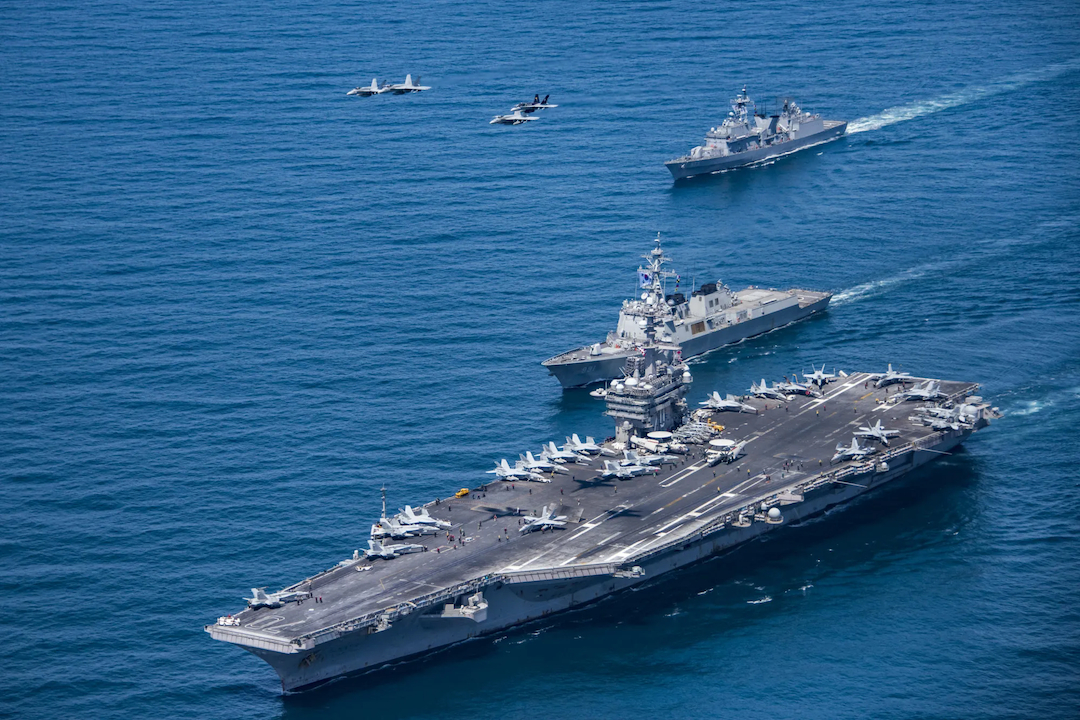
Targets Iranian Ports Specifically — Active from 10am ET Monday
Hours after Vance’s press conference, Trump posted on Truth Social: Effective immediately, the United States Navy, the Finest in the World, will begin the process of BLOCKADING any and all Ships trying to enter, or leave, the Strait of Hormuz. He instructed the Navy to interdict every vessel in international waters that has paid a toll to Iran. On Fox News Sunday he expanded: the blockade will be complete and all or none.
CENTCOM subsequently clarified the operational scope, which is more targeted than Trump’s Truth Social post implied. The blockade applies specifically to vessels entering or departing Iranian ports, not a total shutdown of all Hormuz transit. This is a legally and strategically meaningful distinction. It means Chinese and Indian flagged vessels transporting non-Iranian cargo could theoretically still transit the wider strait without being interdicted, unless they have paid Iranian toll fees. The enforcement of that distinction in a contested, mine-laced waterway 21 miles wide at its narrowest is an open operational question. The blockade takes effect at 10am ET Monday April 13.
A significant technical complication has emerged. According to reporting by Wikipedia’s Hormuz crisis article citing intelligence sources, Iran reportedly lost track of some of the mines it planted in the strait, meaning Tehran is physically unable to fully reopen the waterway even if it reaches a diplomatic agreement to do so. US mine-clearance operations by the USS Frank E. Peterson and USS Michael Murphy, the first American warship transit since the war began, are the operational response to that problem. Trump confirmed Britain will send minesweepers. Senator Mark Warner raised the strategic paradox: I don’t understand how blockading the strait is going to push the Iranians into opening it. A blockade that prevents Iranian oil revenue while the strait remains physically hazardous is a pressure tool, not a reopening mechanism.
OIL AND ENERGY MARKETS

Brent Back Above $100. European Gas Spikes 18%. Supply Deficit Now Structural.
Oil had fallen 15-16% on the April 8 ceasefire announcement. Those gains are now being fully reversed. As of Monday morning April 13, WTI climbed as much as 9.3% to above $105 per barrel. Brent surged 7.4-8% to above $101-103 per barrel, crossing back above $100 for the first time since the ceasefire relief trade. European natural gas futures spiked 18% on blockade news, a signal that the energy market is treating the collapse of talks as a fundamental shift back toward sustained disruption rather than a temporary setback.
The supply picture has moved from a disruption story to a structural deficit story. The IEA confirmed the war reduced global oil supply by approximately 11 million barrels per day as of end of March. ANZ Bank estimated roughly 9 million barrels per day of crude supply effectively removed as of April 9. Eight analysts polled by Reuters now project the oil market will run a 750,000 barrel per day average demand surplus across all of 2026, with the Q2 2026 deficit estimated at approximately 3 million barrels per day. Analysts lifted their 2026 Brent price forecasts by roughly 30% to an average of $82.85 per barrel — and that forecast was made before Monday’s move back above $100.
Even the physical restoration of supply is not straightforward. ANZ estimates only 2-3 million barrels per day can return in the first month after exports resume, and another 2-3.5 million barrels per day over the rest of Q2 due to operational friction, damaged infrastructure, and export bottlenecks. Saudi Arabia restored full pumping capacity through the East-West pipeline to the Red Sea and restarted Manifa field output. But Iranian attacks on Saudi oil facilities earlier in the conflict still cut production capacity by approximately 600,000 barrels per day and pipeline throughput by around 700,000 barrels per day. Qatar’s Energy Minister has warned of $150 oil and $40 per million BTU LNG if the conflict extends. Columbia University’s Karen Young put it plainly: it could be a long time from now before oil prices go down, even after the war ends, because even after Hormuz reopens, damaged facilities need to be repaired. Those are huge variables which are really, really unsolved.
MARKET SCENARIOS
Four Paths from Here and What Each Means for Prices
| Scenario | Oil Price Range | Implications |
| Blockade works — Iran capitulates, Hormuz reopens fully | Falls to $75-85 | Iran agrees to US nuclear terms and cedes Hormuz control. Full commercial traffic resumes. War risk insurance reinstated. Tanker backlog clears over 2-3 weeks. Oil gives back most of its 40%+ war premium. Airlines, travel, shipping, Korean and Japanese equities stage a full recovery. Defense supplemental still passes but urgency premium deflates. This is the best-case scenario and the least likely in the near term given the 21-hour talks produced zero movement on nuclear. |
| Blockade stalemate — neither side escalates, ceasefire limps past April 22 | $95-110 | Iran does not fire on US warships. The blockade holds nominally but enforcement is limited. Selective passage continues for Chinese and Indian vessels in a grey zone the Navy tolerates to avoid a confrontation with Beijing. Ceasefire quietly extends beyond April 22 with no formal announcement. Oil stays in the $95-110 range as the war premium partially persists. Markets remain in the TACO pattern: threat, reversal, range-bound. Defense spending commitments hold. This is the base case most analysts are pricing. |
| Kinetic escalation — Iran fires on US warships or mining incident | $120-135+ | An Iranian attack on a US destroyer or a mine detonation under a Navy vessel triggers direct US military retaliation at scale. The ceasefire collapses entirely. Brent moves toward the $120-135 range that Rystad Energy modeled for a sustained two to four month full closure. The SPR operational floor of 150 million barrels comes into view. Fed rate cut expectations reverse. Stagflation risk becomes the dominant macro narrative. Gold and Treasuries rally hard. Equities sell off broadly. Defense primes rebound sharply. |
| China confrontation — secondary sanctions force China to halt Iranian oil purchases | $110-125, high volatility | Trump imposes secondary sanctions on Chinese entities buying Iranian crude. China retaliates with export controls on rare earths, gallium, or other critical materials. This scenario layers a US-China trade confrontation on top of the energy crisis. Oil prices are complex: Iranian supply tightens further, but Chinese demand softens if the Chinese economy slows. The semiconductor and critical minerals supply chains covered in the earlier articles in this series all come under simultaneous pressure. This is the tail risk scenario investors are not yet pricing adequately. |
SECTOR WINNERS AND LOSERS NOW
Monday Morning: Oil Up 9%, Equities Down, European Gas Spiking
| Sector | Direction April 13 | Reasoning |
| Defense primes (LMT, NOC, RTX, BA) | Re-bid higher | The ceasefire deflated some defense premium. The blockade and failed talks reinstate it. The $50 billion-plus supplemental that Feinberg was drafting has renewed political urgency. Lockheed committed to quadruple THAAD production; RTX to accelerate five munitions programs. Those commitments hold regardless of ceasefire status. War costs estimated at $18 billion to the US as of March 19; Pentagon has requested a further $200 billion. |
| US domestic refiners (VLO, MPC, PSX) | Crack spreads widen again | WTI back above $105 intraday widens refiner margins. The structural domestic advantage over Gulf-dependent refiners holds. Military JP-8 procurement runs at elevated tempo. Valero and Marathon Petroleum are the primary beneficiaries. Permian Basin producers with no Hormuz exposure and low production costs are also outperforming. |
| European LNG and gas (Shell, Equinor, TotalEnergies) | European gas +18% | European natural gas futures spiked 18% Monday morning, the most dramatic single-session move since the early war days. European gas storage entered the conflict at just 30% capacity after a harsh 2025-26 winter. The summer refill season requires consistent LNG imports through late Q2 and Q3. With Qatar still offline and Hormuz talks collapsed, European gas is now pricing in a prolonged supply crunch. LNG spot prices above $20/mmbtu will force Taiwan into costly substitution and compound the semiconductor helium risk. |
| Airlines and travel (DAL, UAL, Lufthansa, EasyJet) | Give back ceasefire gains | The April 8 ceasefire rally of 10-11% in European airline names is fully reversed as oil moves back toward $100-105. Jet fuel costs re-elevate. United and Delta had already signaled potential flight reductions at sustained oil above $120. That threshold is back in view if the blockade escalates or the ceasefire collapses on April 22. |
| Tankers (NAT, BWET ETF) | Day rates hold elevated | A US blockade targeting Iranian ports does not reopen Hormuz to commercial traffic. The 230 stranded tankers inside the Gulf remain stranded. Cape of Good Hope rerouting continues. Ton-miles stay extended. Tanker day rates that had partially softened on ceasefire news remain supported. |
| Korean and Japanese tech (Samsung, SK Hynix, Nikkei) | KOSPI -1.4%, Nikkei -0.4% | The KOSPI slumped 1.4% Monday and the Nikkei fell 0.4%. The April 8 ceasefire rally in Korean names was driven by relief on energy and helium supply risks. Both are now fully back on the table. Qatar’s Ras Laffan remains offline. Helium spot prices remain 40-100% above pre-war levels. European gas spiking 18% is a direct leading indicator for Asian LNG costs. |
| Gold and Treasuries | Safe-haven demand rises | Dollar strengthened. Euro fell to $1.1672. Bond yields fall as rate cut bets return. Gold moves higher. The safe-haven bid is back. The dollar’s gain is meaningful: it signals investors are treating the failed talks as a risk-off event rather than a minor setback. |
| Broad equities (S&P 500) | Futures -0.8 to -1% | S&P 500 futures dropped 0.8-1% on Monday morning. European shares are primed to open 1.5% lower. The market had priced in ceasefire progress that did not materialize. The combination of higher oil, stalled talks, and a live blockade starting at 10am is a triple negative for equity sentiment. |
THE MACRO PICTURE
Stagflation Risk, the Fed, and the SPR Floor
The Iran war is now ten weeks old and the economic damage is compounding. The European Central Bank postponed planned rate cuts on March 19, raised its 2026 inflation forecast, and cut GDP growth projections. UK inflation is forecast to breach 5% in 2026. European chemical and steel manufacturers have imposed surcharges of up to 30% on energy and feedstock costs. Some sectors face risks of permanent deindustrialization if the maritime blockade extends through the summer energy refill season.
In the US, the Fed paused its planned rate cut path due to energy-driven inflation. Consumer gasoline is still $3.72 per gallon nationally. Diesel at $4.99 is adding fuel surcharges across trucking. Food prices are rising as fertilizer supply chains tied to Qatari and Iranian production remain offline. The SPR drawdown of 172 million barrels began March 18 and was designed to last 120 days. At the 120-day mark, around July 15, the SPR will hold approximately 243 million barrels, just $93 million above the 150-million-barrel operational floor. If the blockade extends through June as CBA’s Carol Kong projected, that floor comes into view.
International Crisis Group’s Iran project director Ali Vaez offered the most measured read: the likelier scenario is not immediate war but a volatile period of pressure, signaling, and last-minute attempts to prevent a wider conflagration. The path forward, if there is one, lies in a limited reciprocal deal that buys time and lowers the temperature. That is the base case. But the base case for this conflict has been wrong before. It was wrong on February 28 when Operation Epic Fury began. It was wrong on April 7 when Trump accepted the ceasefire two hours before his own deadline. Markets have learned to treat each binary event as genuinely binary.
WHAT TO WATCH THIS WEEK
Six Variables Between Now and April 22
- 10am ET Monday: Blockade enforcement begins. CENTCOM confirmed the blockade takes effect at 10am ET today. The first operational test is whether any vessel attempts to enter or exit an Iranian port in defiance of the order and what the US Navy does. Iran has vowed to retaliate against any military vessels in the strait. The first confrontation, if one occurs, is the most consequential market event of the week.
- New round of talks within days? The WSJ reported Sunday that a new round of US-Iran negotiations may be possible within days. Trump separately told reporters he does not care if Iran returns to negotiate. Those two signals are contradictory and both may be true simultaneously as negotiating postures. Watch for any Pakistan, Oman, or European diplomatic statement signaling back-channel engagement. Iran’s FM Araghchi said after Islamabad that he wanted to speak with Europeans in Berlin, Paris, and London.
- China and secondary sanctions. The blockade targets Iranian port traffic. China imports approximately 1.55 million barrels per day of Iranian crude. If the US moves toward secondary sanctions on Chinese entities buying Iranian oil, Beijing faces a direct economic confrontation. Watch for any statement from China’s foreign ministry or commerce ministry on the blockade. Any sign of Chinese compliance reduces Iran’s revenue and increases pressure. Any sign of defiance raises the risk of a US-China confrontation layered on top of the Iran war.
- April 22 ceasefire expiry. This remains the hard deadline. If the ceasefire expires with no extension and the blockade is active, both sides have legal and political cover to resume full-scale operations. Pakistan’s Foreign Minister Ishaq Dar has called on both parties to uphold the ceasefire commitment. An informal extension is the most likely near-term outcome but requires both sides to act with restraint that neither has consistently demonstrated.
- European gas storage and the summer refill. European gas futures spiked 18% Monday morning. European storage entered the conflict at 30% capacity after a harsh winter. The summer refill season runs April through October. If Qatar’s Ras Laffan remains offline and Hormuz stays effectively closed through May, Europe faces a genuine energy emergency heading into the 2026-27 winter. Watch for any ECB or European Commission emergency energy statement, which would signal the supply crunch is being treated as a systemic rather than market risk.
- SPR weekly data Wednesday. The EIA Weekly Petroleum Status Report publishes Wednesday. It will show the pace of the 172-million-barrel SPR drawdown that began March 18. At maximum drawdown rate of 4.4 million barrels per day, the full release takes a minimum of 39 days. At the 120-day completion timeline, around July 15, the SPR will hold approximately 243 million barrels, just $93 million above the 150-million-barrel operational floor. Watch for any indication the release pace is
Sources
- NPR — Iran peace talks in Islamabad collapse
- Al Jazeera — US and Iran fail to reach truce after marathon talks
- CNBC — Asia markets open lower as US moves to blockade Iran ports
- Bloomberg — Oil Market News April 13, 2026
- IBTimes UK — Naval blockade of Strait of Hormuz takes effect
- PBS NewsHour — Failed US-Iran negotiations raise questions about ceasefire
- The National — 21 hours in Islamabad: How talks collapsed
Editorial disclosure
This article is based on a market analysis report covering the collapse of US-Iran ceasefire talks in Islamabad and the imposition of a US naval blockade of Iranian ports effective April 13, 2026. It discusses publicly traded securities including defense companies, energy producers, airlines, tanker companies, and technology stocks. All market prices cited include intraday and pre-market data from April 13, 2026, and may differ from official closing prices. The US naval blockade took effect at 10am ET Monday April 13. The ceasefire expires April 22. The situation is evolving rapidly and material developments may have occurred after the time of writing. This article does not constitute investment advice. Commentary reflects the author’s own assessment. The information provided on this website is for informational and educational purposes only. Our content is derived strictly from verified online sources to ensure accuracy and objectivity. This analysis does not constitute financial, investment, or professional advice. Readers are encouraged to consult with qualified professionals before making decisions based on this information. For more information, please see our full DISCLAIMER.

 Watch on YouTube