PAID PROMOTIONAL CONTENT

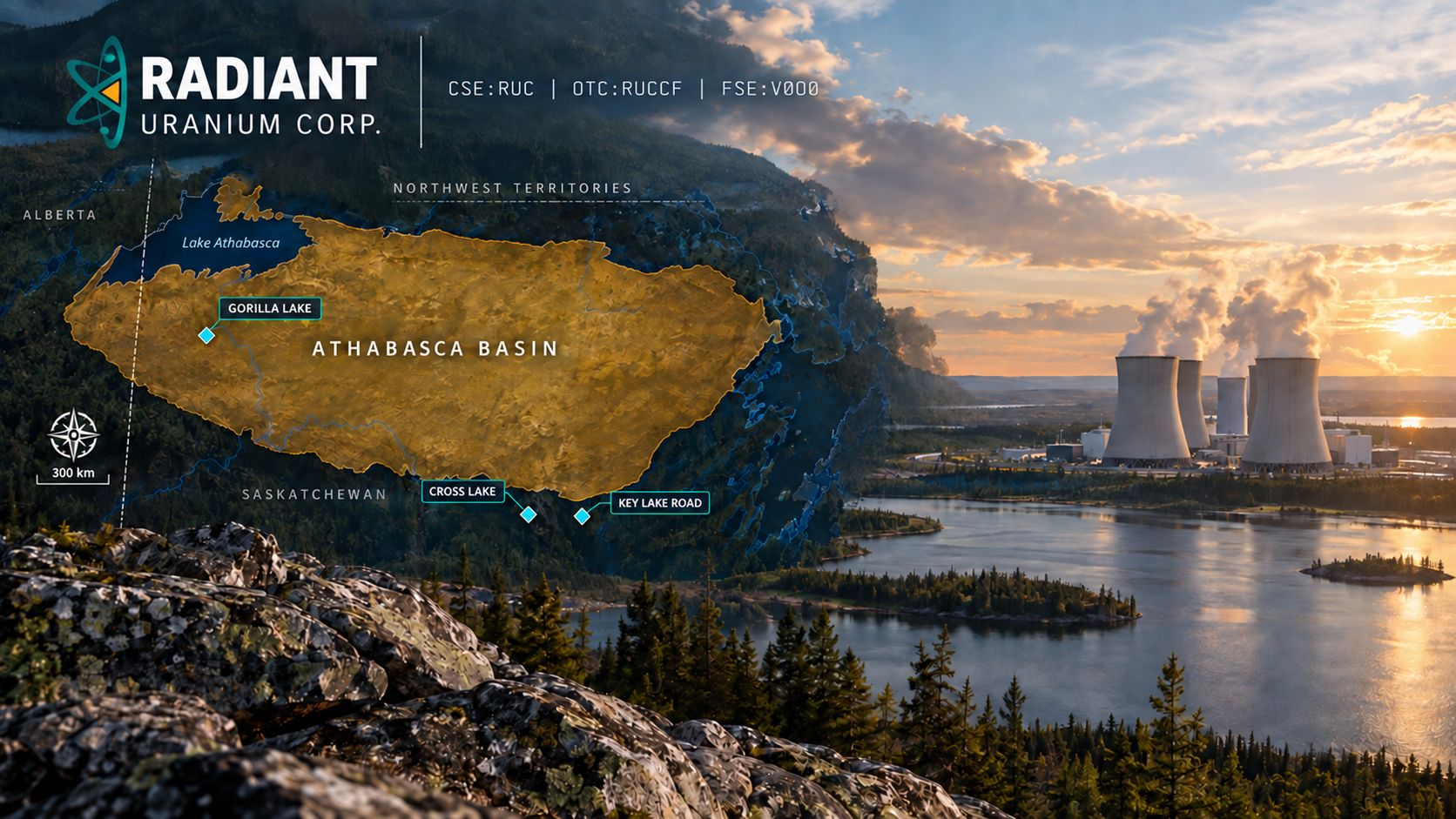
Radiant Uranium Corp. is a Canadian exploration company advancing the Cross Lake, Gorilla
Lake and Key Lake Road uranium projects in Saskatchewan’s Athabasca Basin — home to the
highest-grade uranium deposits on Earth.
PAID PROMOTIONAL CONTENT: This article has been prepared and paid for by Radiant Uranium Corp. (CSE: RUC; OTC: RUCCF; FSE: V0O0) and should not be considered independent editorial content. Full disclosure follows the Sources section below.
The scientific and technical information in this article has been reviewed and approved by Tim Henneberry, P.Geo., a Qualified Person as defined by National Instrument 43-101, Standards of Disclosure for Mineral Projects. Mr. Henneberry is a director and consultant to Radiant Uranium Corp. and is not independent of the Company for the purposes of NI 43-101.
Radiant Uranium Corp. (CSE: RUC; OTC: RUCCF; FSE: V0O0) is a Canadian explorer with three uranium projects in Saskatchewan’s Athabasca Basin: Key Lake Road, Gorilla Lake, and Cross Lake. No NI 43-101 compliant resource exists on any of them. Nothing has been drilled yet on any of them either. What Radiant does have is three separate historic clues in one of the richest uranium districts on the planet, and a plan to test all three.
Three Projects. Distinct Exploration Settings.
Radiant Uranium’s portfolio brings together three uranium exploration projects in Saskatchewan’s Athabasca Basin — from a historical uranium system requiring further verification to reported historical uranium indications and underexplored ground.
A Basin With a Long Memory
Companies have pulled uranium out of the Athabasca Basin for decades. The historic Cluff Lake Mine, a decommissioned property operated by Orano Canada Inc., produced over 62 million pounds of U₃O₈ between 1979 and 2002.
Cameco’s Key Lake mine produced roughly 209 million pounds between 1983 and 2002. Both are historic production totals from mines Radiant does not own, and both explain why explorers keep returning to this district.
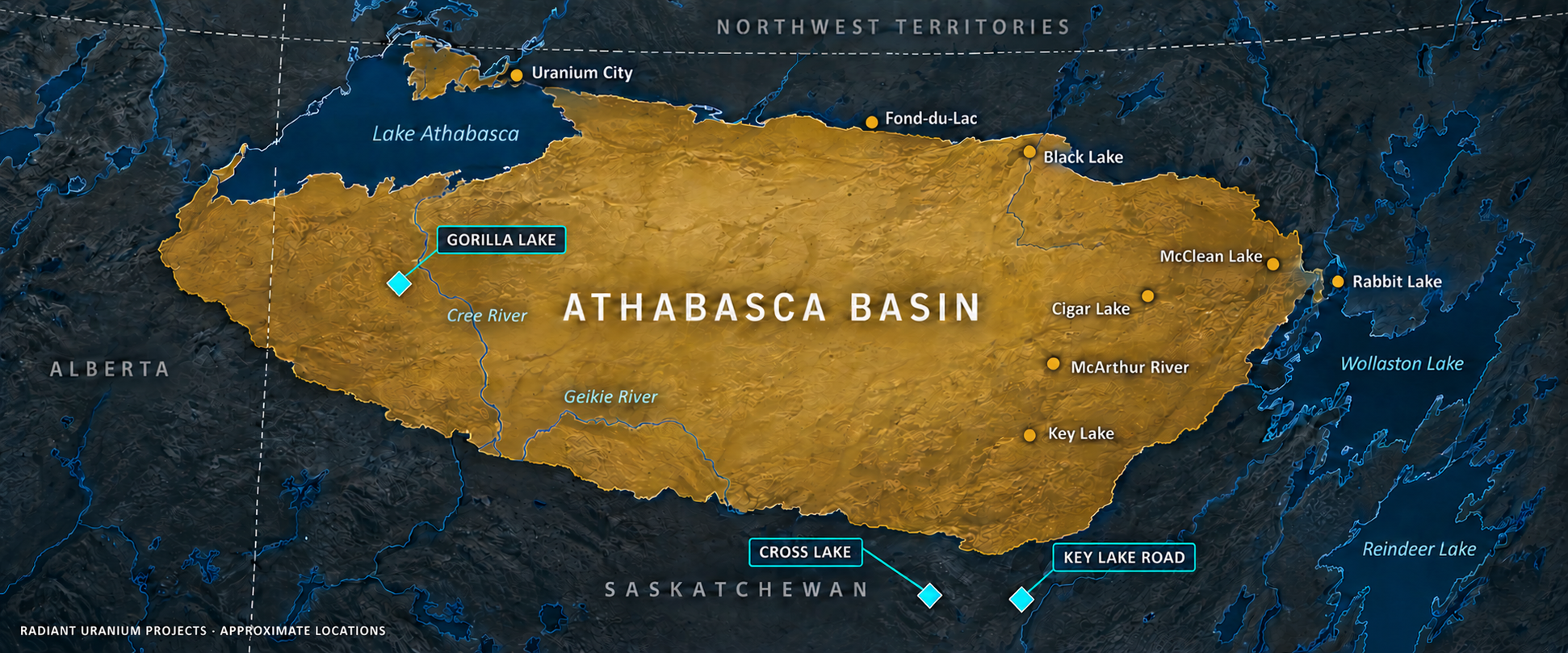
Radiant’s own ground sits across three parts of that basin. Key Lake Road, roughly 90 kilometers south of the Key Lake mine, in the same corridor as the Cigar Lake and McArthur River mines. Gorilla Lake, near the historic, third-party Cluff Lake site. And now Cross Lake, further south again.
None of that neighboring history predicts what is on Radiant’s own claims. It explains why the Company staked ground there in the first place.
Three Projects, One Basin
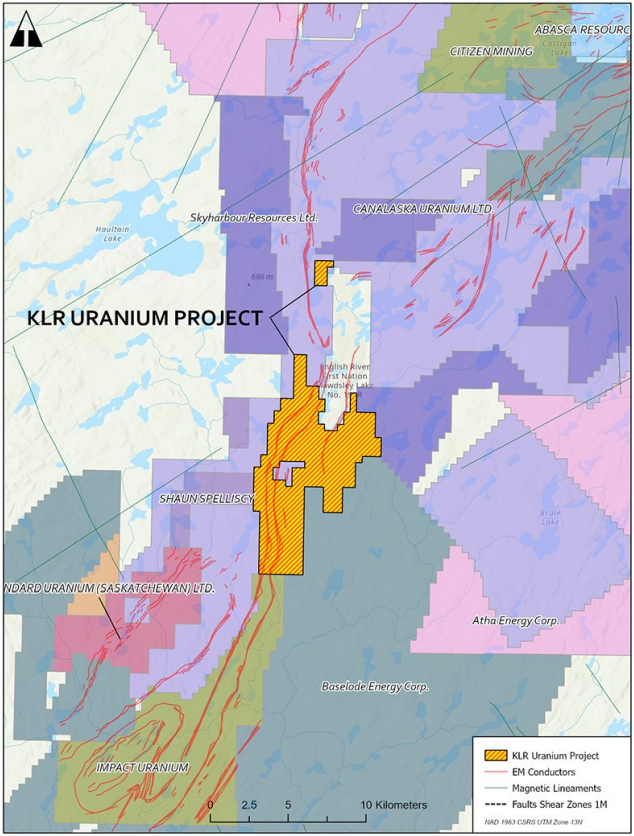
Key Lake Road project, roughly 5,521 hectares along provincial Highway 914. A selective 2023 program at the DD Zone hit up to 642 ppm U and 0.34% nickel, with gamma readings as high as 10,300 counts per second.
The Highway Zone’s historic 2015 result is the more striking number: 1.9% U₃O₈ over just 0.29 meters, an interval Radiant has not independently verified. Radiant believes a deeper feeder structure beneath that shallow mineralization has never been tested, and is permitting an induced polarization survey and up to 30 drill holes to find out.
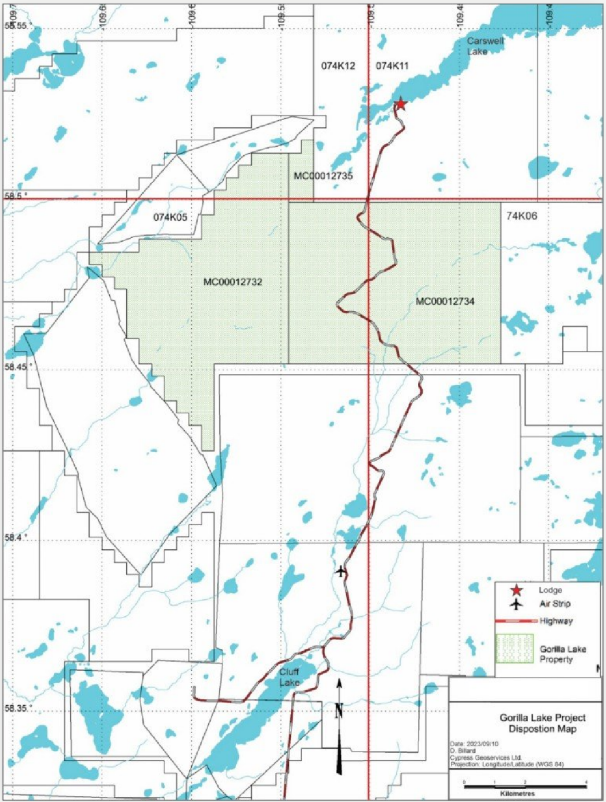
Gorilla Lake, together with the more recently staked Douglas River ground, forms the Carswell Complex: 8,230.9 hectares near the historic, third-party Cluff Lake Mine. Drill holes CLU-01 and CLU-07 intersected mineralization tied to a structure extending roughly 700 meters, work completed long before Radiant’s involvement and never followed up.
Concentrated historic exploration covered only the western portion of the claim group, so most of the property has never been touched by modern methods. Radiant has secured permitting for up to 7,000 meters of diamond drilling here, pending an airborne EM survey and ground truthing that come first.
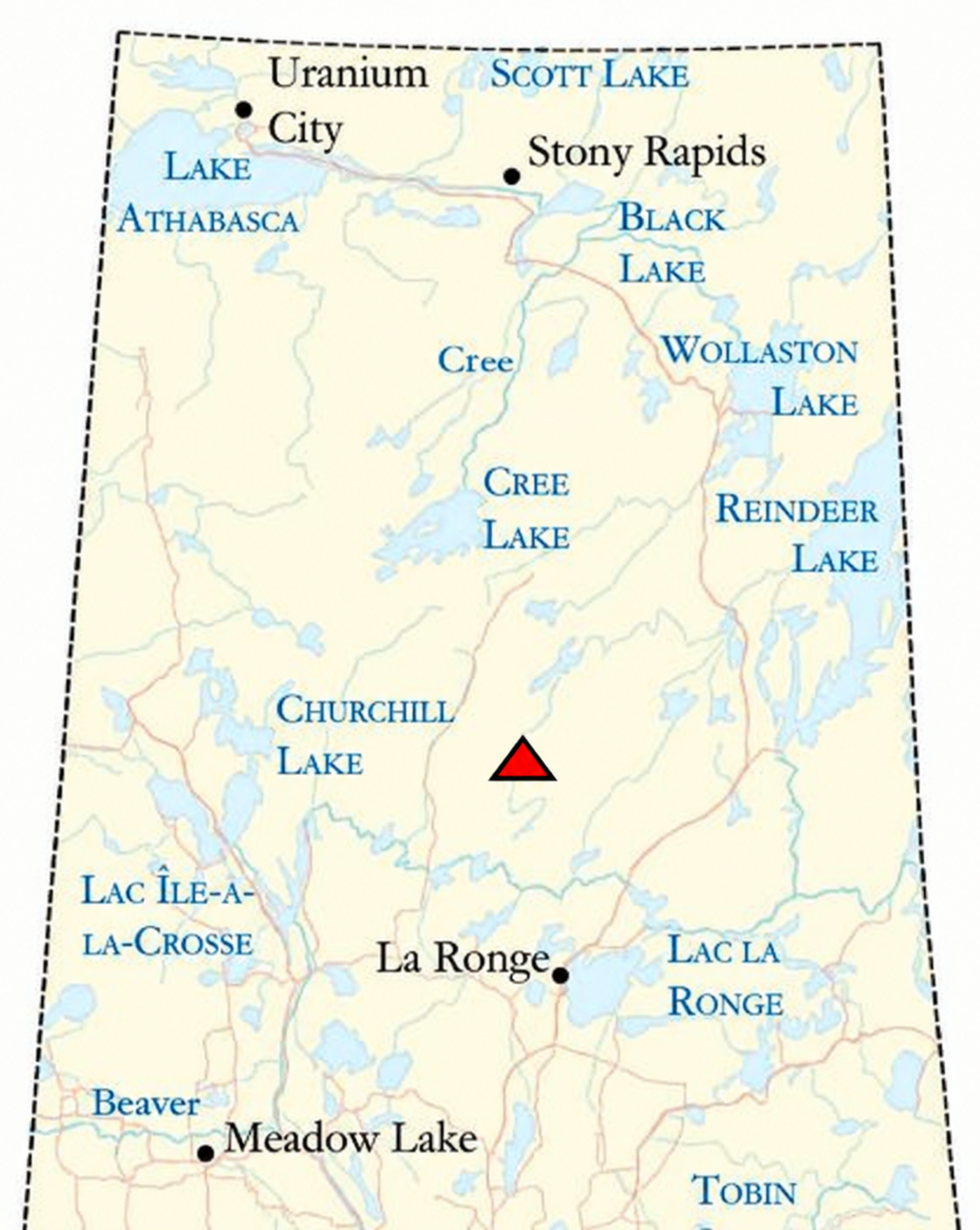
Cross Lake is the newest addition, roughly 2,048 hectares about 87 kilometers south of the Key Lake mine, across three historic showings: the Narrows, Portage, and Cross zones, along a 2.4-kilometre trend. A 1979 drill program produced a historical estimate for the Narrows Zone of approximately 330,000 tonnes grading 0.51 kg U₃O₈ per tonne (approximately 1.2435 lbs/tonne), equating to roughly 371,038 pounds of U₃O₈ to a depth of about 75 meters, as documented in Saskatchewan’s public Mineral Deposits Index (SMDI #0941).
This is a 1979 historical estimate of approximately 330,000 tonnes grading 0.51 kg U₃O₈ per tonne (≈ 1.2435 lbs/tonne), or roughly 371,038 pounds of U₃O₈, as documented in Saskatchewan Mineral Deposits Index SMDI #0941. A qualified person has not done sufficient work to classify this historical estimate as a current mineral resource or mineral reserve, and Radiant Uranium Corp. is not treating it as a current mineral resource or mineral reserve. Key assumptions, parameters and methods are limited to those described in the 1979 report; the estimate does not use NI 43-101 categories; and twinning plus infill drilling would be required to upgrade or verify it as a current resource.
Uracan Resources Ltd. drilled the area again in 2008 and confirmed uranium was present, including a standout intercept of 2,443 ppm U over 5.8 meters at the Portage Zone. Radiant holds an option to earn a 100% interest from Bromell Mining LLP, subject to a 1% net smelter return royalty, by paying an aggregate $200,000 in staged payments, issuing 4,000,000 common shares, and incurring $250,000 in exploration expenditures before full ownership transfers.
Putting the Historic Numbers in Context
The 62-million-pound figure from Cluff Lake and the 209-million-pound figure from Key Lake anchor most conversations about this district, and neither belongs to Radiant. Its own numbers are modest and older: 642 ppm at the DD Zone, 1.9% U₃O₈ at the Highway Zone, a 700-metre untested structure at Gorilla Lake, and a 1979 historical estimate of approximately 330,000 tonnes grading 0.51 kg U₃O₈ per tonne (approximately 1.2435 lbs/tonne), or roughly 371,038 pounds of U₃O₈, at Cross Lake. Different programs, different decades, and none of them meet current disclosure standards.
This is a historic selective sample/interval that predates Radiant Uranium’s involvement. A qualified person has not done sufficient work to classify it as a current mineral resource or mineral reserve, and the Company is not treating it as such. It is not necessarily representative of mineralization across the property.
A historic assay, like a surface grab sample, can show that mineralization exists at a specific point. It cannot show how wide it is, how it behaves at depth, or whether it holds up across a larger area. That is what the surveys, the IP work, and the drill programs described above are built to test.
Why Uranium, Why Now
The case for uranium now rests on federal policy already in motion. In May 2025, four executive orders directed an expansion of domestic uranium mining, enrichment, and conversion capacity. In January 2026 the Department of Energy awarded $2.7 billion to boost domestic enrichment.

US nuclear operators purchased 46.9 million pounds of uranium in 2025 against roughly 2.1 million pounds produced domestically that year. Industry estimates point to 5 to 7% annual uranium demand growth through 2040, against mine supply that currently covers only about 40% of requirements.
Spot uranium was trading around US$90 per pound as of September 2026. Whether that price fully reflects a widening supply gap remains an open question among analysts.
DataM Intelligence sizes the global uranium market at roughly $9.73 billion in 2025, growing toward $13.59 billion by 2033. Mordor Intelligence sizes uranium enrichment specifically at $14.24 billion in 2025, growing toward $22.16 billion by 2030. Per the World Nuclear Association, Kazakhstan, Canada, and Australia together produce close to 75% of the world’s uranium, with Kazakhstan alone at roughly 39%, the exact concentration US policy is now trying to offset.
From Kirkstone to Radiant
Formerly Dunbar Metals Corp., then Kirkstone Metals Corp., the Company relisted on the Canadian Securities Exchange as Radiant Uranium Corp. (CSE: RUC; OTC: RUCCF; FSE: V0O0) on August 6, 2026, following a voluntary delisting from the TSX Venture Exchange. Dropping a legacy, ambiguous name for a transparent identity built entirely around high-potential uranium exploration.
Experienced Team. Focused on Discovery.
Radiant Uranium is backed by a team with decades of combined experience across mineral exploration, public companies, capital markets and corporate development.
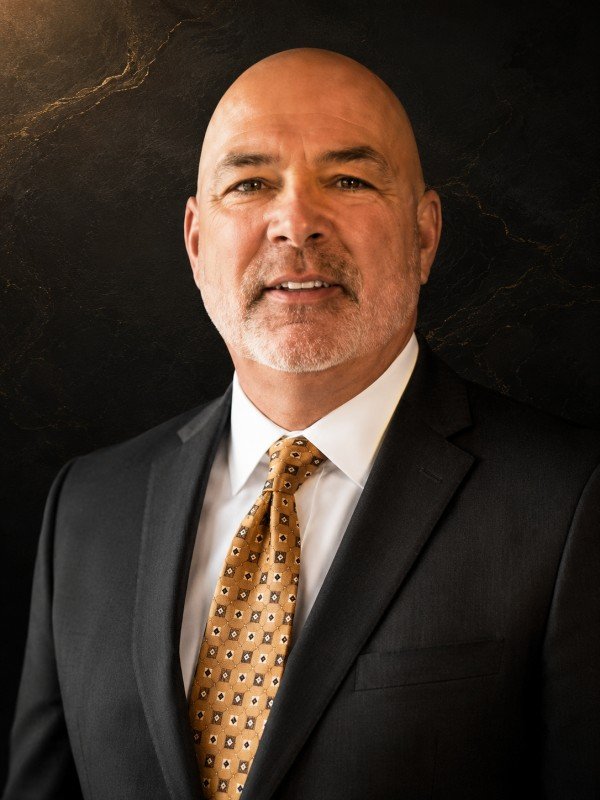
Clive Massey
CEO, President & Director
Mr. Massey has held senior management and directorship positions with multiple TSX Venture Exchange-listed companies, including Redhill Resources, Windfire Capital, Aldever Resources, Prescient Mining and Universal Uranium. He has also coordinated marketing programs for numerous public companies.

Alex Helmel
CFO & Director
Mr. Helmel is an independent management consultant specializing in early-stage venture companies and Canadian capital markets. His experience includes private-to-public market transitions, corporate governance, senior management development and corporate growth strategies.

Jim D. Romano
Independent Director
Mr. Romano brings over three decades of experience with publicly listed companies in Canada’s and the US resources and technology sectors. His background spans senior management, directorship, investor relations, strategic planning, corporate communications and financing.
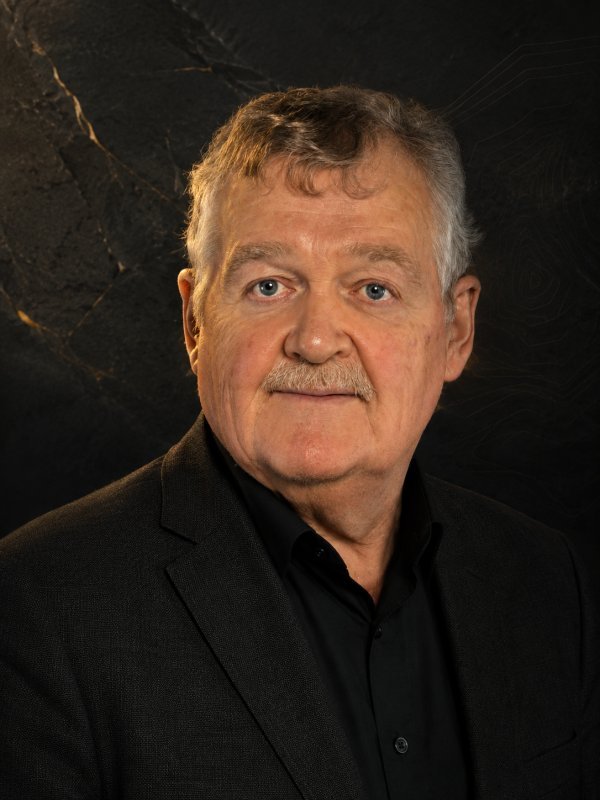
Tim Henneberry
Director
Mr. Henneberry is a Professional Geoscientist registered in British Columbia with 45 years of domestic and international exploration and production experience across precious and base metals, uranium and industrial minerals. His career includes mining production, junior mining consulting and management.
Clive Massey leads as CEO, President, and Director, with prior senior roles at public resource companies including Universal Uranium. Alex Helmel serves as CFO and Director, with a background taking early-stage companies public on Canadian capital markets. Jim D. Romano is Independent Director. Tim Henneberry, P.Geo., serves as director and Qualified Person under NI 43-101, bringing roughly 45 years of exploration and production experience.
The Risks Investors Need to Understand
Radiant Uranium is still an explorer, not a producer. No NI 43-101 resource exists on any of its three properties, and nothing has been drilled yet. The historic numbers covered above, Cluff Lake’s 62 million pounds, Key Lake’s 209 million, the DD Zone’s 642 ppm, Cross Lake’s 371,038-lb estimate, belong to other operators or to drill programs from years or decades past. A drill program on Radiant’s own ground is what will answer the question, history alone won’t.
Cross Lake adds a wrinkle the other two properties don’t have. Radiant’s interest there is an option earned in stages, cash payments, share issuance, and a defined exploration spend, rather than a completed purchase. Missing a milestone could mean losing the option entirely.
Regulatory approval, community consultation, and short northern field seasons all sit outside the Company’s control, and any of them can push a survey or drill program back a season.
Financing is the more immediate issue. Radiant reported less than a year of cash runway in its most recent disclosure. Advancing three properties costs money the Company doesn’t yet have, and raising it usually means issuing more shares, which dilutes existing holders. A nimble core runs all of it, and losing a key person could slow the work down.
Uranium prices move in cycles the Company can’t control, and the federal policy tailwind described above could change with the next administration or the next act of Congress.
Investing in early-stage exploration is high risk. It’s possible to lose the entire investment.
Coming Next
Cross Lake, the newest addition, with its historic estimate and its path to becoming a modern resource comes first. Then Key Lake Road: the historic high-grade clue near surface, and the deeper structure Radiant has never tested. Then the Carswell Complex, Gorilla Lake and Douglas River together, and the scale of ground still unexplored there. Then comes the team, the capital structure, and the supply chain this exploration is ultimately aimed at.
None of Radiant’s three properties has been drilled to date. All are working through permitting, surveys, or early technical review. Whatever results follow will be binary: they could confirm the geological model, partially confirm it, or fail to confirm it.
Sources
- Radiant Uranium Corp. corporate presentation, August 2026
- Radiant Uranium Corp. company website
- Canadian Securities Exchange Welcomes Listing of Radiant Uranium Corp., Newsfile Corp., August 6, 2026
- Cluff Lake Project Concludes Mining Life Cycle, Orano Canada Inc., May 11, 2023
- Kirkstone Metals Updates Gorilla Lake and Key Lake Road Permitting and Terminates Samson Metals Acquisition, TheNewswire, June 10, 2026
- Radiant Uranium Acquires the Cross Lake Property,, September 22 2026
- Saskatchewan Mineral Deposits Index, SMDI #0941 (Narrows/Portage/Cross Uranium Zones), Government of Saskatchewan (documents the 1969-70 Can-Fer Resources discovery, the 1979 Bralorne Resources/Can-Fer Resources joint drilling and historic estimate, and 2008 Uracan Resources Ltd. drilling)
- Reinvigorating the Nuclear Industrial Base, Executive Order, The White House, May 23, 2025
- One Year After Executive Orders, U.S. Nuclear Energy Renaissance Is in Full Swing, U.S. Department of Energy, 2026
- 2025 Uranium Marketing Annual Report, U.S. Energy Information Administration
- U.S. Uranium Production More Than Tripled in 2025, U.S. Energy Information Administration
- World Nuclear Association Outlines Uranium Market 2026 Supply-Demand Outlook, DataM Intelligence, 2026
- Radiant Uranium (OTCPK:RUCC.F) Stock Analysis, Simply Wall St, accessed September 9, 2026
- Kirkstone Metals Corp. company information (predecessor name Dunbar Metals Corp.), Simply Wall St
Disclosure
Paid Promotional Content
This page is a paid advertisement intended for informational and marketing purposes only. It should not be considered independent editorial content and does not constitute investment advice, a recommendation, or an offer or solicitation to buy or sell any security.
Radiant Uranium Corp. is a client of Bai Media Group Ltd., operating under its brand AktieGo. Radiant Uranium Corp. has agreed to pay Bai Media Group Ltd. €32,500 per month, for the creation and distribution of content under a four-month promotional program beginning September 2026. Bai Media Group Ltd. has not been granted stock options of Radiant Uranium Corp. as part of this arrangement. The cash compensation creates a financial interest in the Company and a potential conflict of interest. AktieGo and Bai Media Group Ltd. may buy or sell shares of companies profiled on this page before, during, or after publication.
Qualified Person
The scientific and technical information contained in this article has been reviewed and approved by Tim Henneberry, P.Geo., a Qualified Person as defined by National Instrument 43-101 — Standards of Disclosure for Mineral Projects. Mr. Henneberry is a director of Radiant Uranium Corp. and is not independent of the Company for the purposes of NI 43-101.
Data Verification and Historical Information
Tim Henneberry, P.Geo., has reviewed and approved the scientific and technical information presented in this article. The information is based on the Company’s public disclosure, available technical and assessment reports, historical exploration records and other supporting information available to the Company.
Certain scientific and technical information concerning the Company’s properties was generated by previous operators and is historical in nature. Verification of historical results is limited by the availability and completeness of original drill logs, sampling records, assay certificates, analytical documentation, quality assurance/quality control information and other supporting data. Review and approval of the inclusion of historical information in this article does not constitute independent confirmation of every underlying historical result. Specific sources and material verification limitations should be identified alongside the applicable information.
Any historical estimate discussed in this article is not a current mineral resource or mineral reserve. A Qualified Person has not completed sufficient work to classify the historical estimate as a current mineral resource or mineral reserve, and Radiant Uranium Corp. is not treating it as such. Historical estimates should not be relied upon as current estimates of mineral resources, mineral reserves or economic viability.
Historical drill results, radiometric measurements, gamma-probe readings and selective samples may not represent mineralization across a property and do not establish grade continuity or economic viability. Counts per second, or CPS, are measurements of detected radioactivity and do not directly establish uranium grade. Laboratory assays and additional geological work are required to determine uranium grades and the nature and continuity of mineralization.
Exploration Risk
Radiant Uranium Corp. is an early-stage exploration company. The Company’s properties, including the Key Lake Road, Gorilla Lake and Cross Lake uranium projects, do not contain a current mineral resource or mineral reserve as defined by NI 43-101. Historical exploration results, geological interpretations, geophysical anomalies, radiometric measurements and prospective exploration targets do not establish the existence of an economically viable uranium deposit.
The location of a property within the Athabasca Basin, or its proximity to uranium deposits, mines, processing infrastructure or discoveries on adjoining or nearby properties, does not establish that comparable mineralization exists on Radiant Uranium Corp.’s properties. Mineralization on adjacent or nearby properties is not necessarily indicative of mineralization on the Company’s properties.
Exploration may fail to identify economically significant mineralization. Planned exploration activities may be modified, postponed or cancelled and may require additional financing, regulatory approvals, consultation, property access, suitable weather and seasonal conditions, and the availability of contractors, equipment and personnel. Additional financing may not be available on acceptable terms and could result in dilution to existing shareholders.
Forward-Looking Information
This article contains forward-looking information, including statements concerning proposed exploration programs, geophysical surveys, permitting activities, drill targeting, planned drilling, anticipated exploration expenditures, the timing and interpretation of exploration results, potential discoveries, property acquisitions or advancement, future financing, uranium-market conditions and the Company’s future plans and objectives.
Forward-looking information contained in this content is based on assumptions and expectations believed to be reasonable as at the date of this content, including that required financing, permits and approvals will be available; consultation and access requirements will be satisfied; contractors, equipment and personnel will be available as planned; and exploration activities and laboratory analysis will be completed on anticipated timelines. Although these assumptions and expectations are considered reasonable, they are inherently subject to significant business, economic, geological, environmental, market, regulatory and competitive uncertainties and contingencies, many of which are beyond the control of Radiant Uranium Corp. There can be no assurance that these assumptions will prove correct or that the outcomes contemplated by the forward-looking information will occur.
Such risks and uncertainties include, among others, the speculative nature of mineral exploration; the absence of current mineral resources or mineral reserves; the possibility that historical results cannot be verified or reproduced; failure to identify economically significant mineralization; differences between exploration results and geological interpretations; failure to obtain necessary financing, permits, approvals, access or consultation outcomes; operational, laboratory or seasonal delays; contractor and equipment availability; changes in exploration plans; and uranium-price and capital-market volatility.
Information Sources and Investment Risk
The information presented here has been obtained from sources believed to be reliable, including Radiant Uranium Corp.’s public disclosures, website and available technical and historical records. AktieGo and Bai Media Group Ltd. make no representation or warranty, express or implied, as to its accuracy or completeness. Market prices, valuations, capital-structure figures, commodity prices and market statistics reflect the dates identified in the article and are subject to change.
Investing in early-stage exploration and junior mining companies involves a high degree of risk, including the potential loss of your entire investment. Readers should conduct their own independent research and consult a licensed financial advisor before making an investment decision. Neither AktieGo nor Bai Media Group Ltd. is a registered broker-dealer, investment advisor or financial planner.
Securities discussed: Radiant Uranium Corp. (CSE: RUC). Share and market data are sourced from the Canadian Securities Exchange company listing and public market-data providers as of the dates cited in the article. Figures should be reverified at the time of publication.
Coverage on aktiego.com is provided for informational and educational purposes only. aktiego.com is not a registered investment advisor. Nothing in this article constitutes financial, investment or professional advice. Readers are encouraged to conduct their own due diligence and consult a qualified financial advisor before making any investment decisions. For further information, please see our full DISCLAIMER.