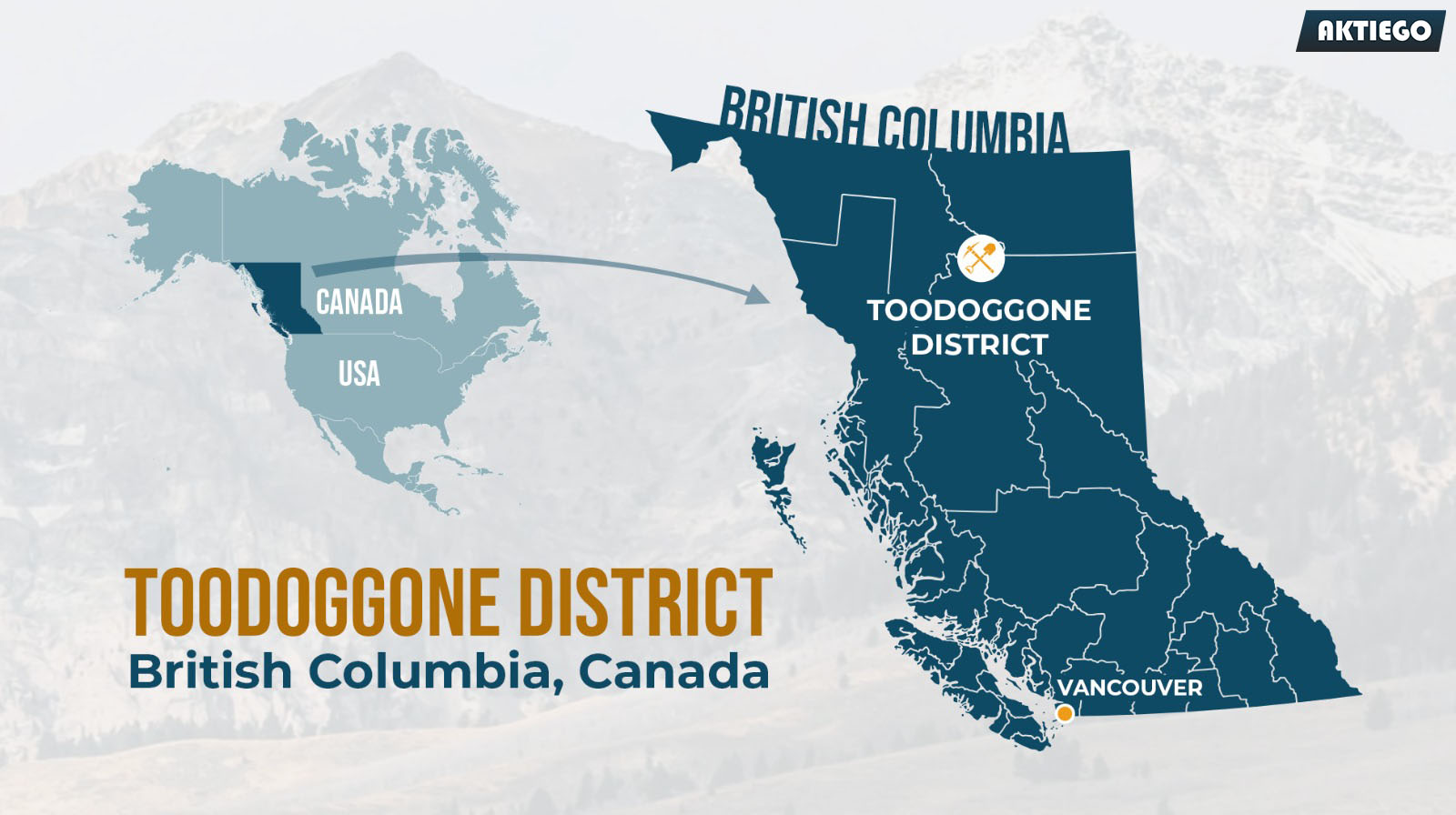


What’s Going On in Toodoggone?

In mining, location is not a small detail. It is almost the whole story.
Ore bodies do not show up at random. They cluster. The same forces that push mineral rich fluids through one section of rock usually affect the ground around it too. Same structures. Same host rocks. Same plumbing system underground. When a real deposit is found, geologists do not celebrate for long. They immediately start asking what sits next door.
The Toodoggone District is not theory. It has history.

The Kemess South Mine ran from 1998 to 2011 and produced roughly 3 million ounces of gold and 800 million pounds of copper. That is not a promotional headline. That is metal that came out of the ground and went through a mill. The Baker Mine and Shasta Mine pulled high grade gold and silver from epithermal systems between 1981 and 2012. These were operating mines in a different gold price environment. Lower prices. Tighter margins. They still worked.
What has changed is the understanding of the Toodoggone district?
Modern geophysics can see deeper and clearer than it could twenty years ago. Geological models are sharper. The picture of how these systems form has improved. By modern standards, the Toodoggone is barely scratched. Estimates suggest only about ten percent of the district has been properly explored with current methods. That leaves a lot of ground that has never seen a serious drill campaign.
Infrastructure is the part most retail investors overlook.
A surprising number of discoveries never become mines because they sit in the middle of nowhere. No road access. No power. No nearby workforce. Building that from scratch can cost hundreds of millions before a single ton is mined. In some cases, you are looking at half a billion to a billion dollars just to make a project buildable.
The Toodoggone is different.
There is grid power into the Kemess area. There are roads into much of the district. The old Kemess site still has a 50,000 ton per day processing plant, camps, and an airstrip mothballed. It is not theoretical infrastructure drawn up in a feasibility study. It exists. There is a local workforce with mining experience. First Nations in the region have long standing relationships and established frameworks with operators.
This is not frontier exploration in a vacuum.

It is more like owning the empty lot between established houses in a neighborhood that already has paved streets and utilities. You are not betting that a district might someday matter. It already does.

The only real question is whether the ground you control carries the same geological charge as the ground that has already produced. And in mining, that is a question you can answer with a drill bit.
Additional Reading from Resourceworld.com:
Toodoggone Mining District Heats Up as Juniors and Majors Race to Unlock B.C.’s Next Big Gold-Copper Camp
The Red Line: A Geological Treasure Map
Geologists in British Columbia sometimes talk about something they call the red line.
It is not marketing language. It is a feature you can see on regional maps. The line marks an unconformity between Triassic Stuhini rocks and Jurassic Hazelton rocks. On many maps that boundary is shaded red, and the name stuck. What it really represents is a major break in the geological record, often tied to faulting and long lived structural zones.
That structural history is what makes it important.
Across north central British Columbia, a striking number of porphyry and epithermal deposits sit along or close to this unconformity. The boundary itself did not magically create gold or copper. But the faults and weaknesses associated with it later acted as pathways for mineral rich fluids. When heat and metal bearing fluids moved through the crust, they followed those zones.
If you think about it statistically, it becomes obvious. If you had to narrow your search to one corridor in a vast region, you would follow the red line. It would not guarantee success, but your odds would be better than wandering into ground with no structural story behind it.

READ MORE: BC Survey’s ‘red line’ a game changer for explorers
The Toodoggone District sits right along this unconformity. Several of the known deposits in the district line up with it. Hi-View Resources controls ground that falls directly within that same prospective belt.
That does not mean a deposit is sitting there waiting to be outlined. Proximity alone proves nothing. But it does mean the company is operating in the same geological neighborhood that has already produced meaningful discoveries. This is not random staking in an overlooked corner of the province. It is targeted ground selection based on a structural framework that has worked before.
A simple analogy helps. You can cast a fishing line anywhere in the ocean. Or you can fish where others have consistently pulled fish out of the water. The red line is where the fish have shown up.
This matters when you think about valuation.
If a micro cap explorer is drilling in terrain with no track record and no structural rationale, you almost have to assign near zero probability of success. The base rate is too low. But if the company is exploring along a corridor known to host deposits, inside an active district with fresh discoveries and serious capital flowing in, the probability is not zero. It is unknowable, but it is meaningfully higher than random chance.
And when the market prices something as if the odds are essentially zero, any real probability above that creates asymmetry. That is where opportunity lives at the micro cap end of the spectrum.
Valuation Disparity
Picture this. You are looking at a neighborhood where Centerra Gold just valued their property at $1.1 billion. Down the street, Thesis Gold’s place is worth $2.37 billion according to their latest appraisal. Amarc Resources, backed by Freeport McMoRan, is preparing to spend over $110 million developing their lots after making one of the most significant copper gold discoveries in recent British Columbia history.
And then there is the property in between, owned by Hi-View Resources, a company with a market cap of only around CAD $9 million.
| Company | Land Package (Ha) | Market Cap |
|---|---|---|
| Centerra Gold CG:TSX · NYSE:CGAU | ~32,661 | $4.49B CAD |
| Thesis Gold TAU:TSX-V · OTCQX:THSGF · FSE:A3EP87 | ~49,500 | $762.7M CAD |
| TDG Gold Corp. TDG:TSX-V · OTCQX:TDGGF | ~50,000 | $150.2M CAD |
| Amarc Resources AHR:TSX-V · OTC:AXREF | ~48,296 | $187M CAD |
| Sun Summit Minerals SMN:TSX-V · OTCQB:SMREF | ~25,000 | $38.8M CAD |
| Finlay Minerals FYL:TSX-V · OTCQB:FYMNF | ~17,249 | $18.7M CAD |
| Hi-View Resources GXLD:CSE · OTCQB:HVWRF · FSE:B63 | ~27,797 | $9.23M CAD |

This is not a real estate story. It is happening right now in British Columbia’s Toodoggone District. Same district. Same rocks. Same geological story.
Hi-View Resources is valued at less than what Centerra plans to spend this year just advancing Kemess. At $0.29 a share and about 30.75 million shares outstanding as of Mid-February 2026, after switching its ticker from HVW to GXLD on January 12, the entire company is valued at roughly $9 million, a small number compared with the scale of capital being deployed elsewhere in the district.
Regional Operator Valuations

Centerra Gold Inc.
(CG:TSX) (NYSE:CGAU)
ISIN: CA1520061021 WKN: A0B6PD

Centerra’s January 2026 preliminary economic assessment outlined a $1.1 billion valuation, a 16.4 percent internal rate of return, and average annual production of 250,000 gold equivalent ounces over 15 years.


Thesis Gold Inc.
(TAU:TSX-V) (OTCQX:THSGF) (FSE:A3EP87)
ISIN: CA8839301097 WKN: A3EP87

Thesis Gold posted a 54.4 percent IRR with peak annual production of 327,000 gold equivalent ounces. These are not early-stage concepts scribbled on a map. They are engineered studies backed by metallurgy, environmental work, and detailed cost estimates. These projects are marching toward production decisions.


TDG Gold Corp
(TDG:TSX-V) (OTCQX:TDGGF)
ISIN: CA87190J1057 WKN: A3CUPK

TDG Gold is trading around a $200 million market cap and controls roughly 50,000 hectares in the district, including the past producing Baker and Shasta mines.


Amarc Resources Ltd.
(AHR:TSX-V) (OTC:AXREF)
ISIN: CA0229121094 WKN: 907038

Amarc, factoring in Freeport’s earn in, sits somewhere in the $250 to $300 million range based on recent trading. Different management teams, different capital structures, but all chasing the same style of deposit in the same camp.

What is easy to forget is that none of these companies started out at these valuations. Thesis was once just another junior poking holes into the Lawyers Ranch ground, hoping the model held together. They drilled. They hit. They kept drilling. Their footprint grew. The resource came. The study followed. The market responded. Amarc made the AuRORA discovery and suddenly Freeport was at the table with a checkbook.
The market does not slowly reward discovery. It ignores it until it cannot anymore.
The Overlooked Player
Now look back at Hi-View.

Hi-View Resources Inc.
(GXLD:CSE) (OTCQB:HVWRF) (FSE:B63)
ISIN: CA42841L2075 WKN: A419HN


They control 27,791 hectares spread across multiple property areas right in the middle of this activity. In May 2025, had around 9,787 hectares. By early 2026, through staking and acquisitions, that number nearly tripled. That is not passive landholding. That is consolidation in a district where majors are writing nine figure commitments.
Yet the market currently values Hi-View as a very early-stage explorer. As if the billion-dollar valuations surrounding it are a coincidence. As if geology stops neatly at claim boundaries.
Maybe the market is right. Maybe the ground is worthless and $9.23 million is fair value.
The real question is whether the 27,791 hectares the company owns carries the same kind of mineral systems that have already been found elsewhere in the district.
If the answer is that the odds of success are close to zero, then the valuation makes sense. If the odds turn out to be higher than the market currently assumes, the valuation gap starts to make more sense in the context of exploration risk.
A Different Way to Look at Valuation
Market capitalization is the most common way investors compare mining companies, but it is not the only lens that can be used.
Another simple metric is value per hectare of ground controlled within the district. While this measure does not account for project stage, drill results, or resource size, it can offer a useful way to visualize how the market is valuing land positions within the same geological belt.
When companies operating in the Toodoggone District are compared on this basis, a wide range emerges. Larger and more advanced operators command significantly higher valuations per hectare, reflecting defined resources, engineering studies, and years of exploration work.
Earlier-stage explorers typically trade at much lower levels while they work to advance their projects and test new targets.
When the numbers are laid side by side, the spread is notable. Valuations per hectare across companies operating in the same regional system range from well over $140,000 per hectare at the upper end to under $300 per hectare at the lower end.
| Company | Market cap | Land package (ha) | CAD/ha |
|---|---|---|---|
| Centerra Gold | $4.49B CAD | ~32,661 | ~137,470 |
| Thesis Gold | $762.72M CAD | ~49,500 | ~15,408 |
| Amarc Resources | $187.02M CAD | ~48,296 | ~3,872 |
| TDG Gold | $150.20M CAD | ~50,000 | ~3,004 |
| Sun Summit | $38.86M CAD | ~25,000 | ~1,554 |
| Finlay Minerals | $18.72M CAD | ~17,249 | ~1,085 |
| Hi-View Resources | $9.23M CAD | ~27,797 | ~332 |
Major Moves
In this business, “major interest” usually gets tossed around in press releases like it means something. Most of the time it does not. In the Toodoggone District, you can measure that interest in actual dollars. Nine figures at a time.
Look at Centerra Gold. This is not a junior chasing a headline. It is a multi-billion-dollar producer. In January 2026 they put out a preliminary economic assessment on Kemess showing a $1.1 billion after tax net present value. That kind of number does not come from casual optimism. It comes after engineers, geologists, and accountants have stress tested the project from every angle.

Kemess alone hosts 3.3 million ounces of indicated gold and 1.1 billion pounds of indicated copper. On paper it outlines a potential 15-year mine, and most of heavy lifting on infrastructure was already done during the previous operation. That lowers risk in a way spreadsheets cannot fully capture.
Then look at Freeport-McMoRan through its earn in with Amarc Resources. Freeport is one of the largest copper producers on the planet. They do not partner with juniors because a slide deck looks good. Their technical teams tear projects apart before a dollar gets committed. In this case, they have agreed to spend more than $110 million at the JOY property following the AuRORA discovery.
The AuRORA holes were not subtle. One interval returned 156 meters averaging 2.21 percent copper equivalent, including 90 meters at 2.67 percent. For context, many copper porphyries around the world operate comfortably at 0.3 to 0.5 percent copper.
AuRORA is coming in at multiples of that. In September 2025, Freeport elected to move into Stage 2 of the agreement, committing another $75 million. That is not dipping a toe in the water. That is leaning in.

Why does that matter for Hi-View Resources?
Because AuRORA sits just over four kilometers from Hi-View’s Saunders Property. Same regional structures. Same volcanic belts. Potentially the same mineralizing engine that fed the systems now being drilled.
It is not just Freeport and Centerra. Skeena Resources made an $8 million strategic investment in TDG Gold in early 2025. Centerra took a 9.9 percent stake in Thesis Gold. These are deliberate positions taken by groups that understand district scale opportunity.
Major mining companies tend to focus their attention on districts where deposits have already been proven to exist. They look for proven mineral systems where multiple deposits can support long term, integrated operations. Before they write a check, their teams review drill core, re log data, run their own models, and pressure test assumptions. When several of them arrive in the same camp within a short window, that is not coincidence. It is conviction.
And it is worth remembering that every one of these companies started as a small explorer with a theory. Thesis was tiny before Lawyers took shape. Amarc was just another name on a map before AuRORA. The market did not price in success ahead of time. It reacted after the evidence was undeniable.
Recent Moves by Major Operators
And the story did not stall in 2025.
On February 19, 2026, Amarc Resources announced a third new porphyry copper-gold discovery at JOY. TWINS now joins AuRORA and CANYON, alongside the historical PINE and Brenda deposits. That is no longer a single-zone narrative. It is a district narrative.
TWINS sits roughly 17 kilometers southeast of AuRORA along the 10-kilometer PINE Porphyry Trend. The target is defined by an 8.5 square kilometer induced polarization chargeability anomaly. That is not a pinprick. That is a system-scale footprint.
Large-Scale Mineral Systems Host the AuRORA, CANYON and TWINS Discoveries, PINE Deposit, NWG and Other Sulphide Systems

READ MORE: Amarc Confirms Discovery of Third New Porphyry Copper-Gold System at JOY
Early scout holes hinted at something deeper. The 2025 follow-up drilling confirmed it. This is how districts evolve. First discovery. Second center. Third confirmation that the plumbing is regional, not isolated.
And now add another data point. On February 19, 2026, Thesis Gold announced a $44 million CAD strategic financing anchored by AngloGold Ashanti, with participation from Centerra Gold.
AngloGold is not a newsletter name. It is one of the largest gold producers in the world. Under the agreement, it will acquire roughly 5 percent of Thesis at $2.79 CAD per share, committing approximately $38.7 million CAD. The price was set at the volume-weighted average. No discount. No promotional sweetener.
That detail matters. Strategic money does not usually pay market price for optionality unless it sees something durable underneath.
At the same time, Centerra elected to fully exercise its participation rights, investing an additional $5.7 million CAD to maintain a 9.9 percent ownership stake. This is not passive ownership drifting lower through dilution. It is active defense of position.

Now lets look at TDG Gold Corp. The company controls roughly 50,000 hectares in the Toodoggone District, including the past-producing Baker and Shasta mines, which historically produced high-grade gold and silver. The company currently trades around a $180–200 million market capitalization, making it one of the larger junior players operating in the district.
Recent drilling shows the story is still evolving.
In February 2026, TDG announced the discovery of a new mineralized zone called the “4300 Zone” beneath the historic Hidden Creek Mine at its Anyox Project. The discovery hole intersected 25 meters grading 2.1% copper equivalent, including higher-grade intervals approaching 2.9% copper equivalent.
For context, those kinds of grades are well above what many copper systems require to be economically viable.
The zone sits roughly 700 meters below the deepest historical mining, suggesting the system may continue well beyond what earlier operators were able to access. Importantly, the discovery remains open in all directions, and additional drill results are still pending.
TDG’s work highlights something investors often overlook about districts like Toodoggone.
READ MORE: TDG Discovers New ‘4300 Zone’ VMS Lens Below Former Hidden Creek Mine at Anyox Project
Step back and look at the pattern.
- Freeport writing nine-figure checks into JOY.
- Centerra advancing Kemess with a billion-dollar PEA.
- AngloGold taking an equity position in Lawyers–Ranch.
- Juniors such as TDG Gold making new discoveries
These are not retail investors speculating on drill season. These are global operators allocating capital inside the same district.
And they are not spreading it randomly across the province. They are clustering it inside the Toodoggone belt.
What Makes Hi-View Different

Hi-View is not hanging its future on one flashy drill hole.
They are not lining up a single target and hoping it turns into a headline. What they have done instead is assemble one of the larger contiguous land packages in the Toodoggone District and approach it methodically.
The 27,791 hectares now under control span several distinct property areas, each with its own angle.
Golden Stranger carries historical drilling from the 1980s that intersected high grade gold. The Lawyers ground shows geophysical signatures consistent with porphyry style targets. Saunders sits along the same structural corridor that hosts Amarc’s AuRORA discovery. Borealis has an old induced polarization anomaly that was identified years ago but never properly chased with modern follow up.
That mix matters. If you are going to explore in a proven district, you want more than one shot. Some targets might represent shallow, high grade epithermal systems. Others could be larger, bulk tonnage porphyries at depth. Different deposit styles. Different risk profiles. Same mineralized neighborhood.
The expansion itself tells a story.
In May 2025, the company’s presentation showed roughly 9,787 hectares. By early 2026, that number had climbed to 27,791 through staking, option agreements, and acquisitions. That is not random land grabbing. It looks deliberate, like management is stepping outward from known mineralized trends and locking up what they believe is strategic ground.
The Saunders and Nub acquisitions are good examples.
Saunders sits within that northwest trending structural corridor near AuRORA. The property hosts three documented BC MINFILE occurrences where earlier work identified mineralization. Historical sampling returned values up to 1.42 grams per ton gold and 11.7 grams per tonne silver. The mineralization is tied to the northwest trending Saunders Fault and related splays, which is exactly the kind of structural control you would expect in this district.
Nub is earlier stage, but it features a magnetic anomaly offset by northwest faulting. It had not seen serious follow up. The signature was compelling enough that Hi-View chose to secure it before someone else connected the dots.
Step back and the strategy becomes clear.
Secure prospective ground in an active camp. Run modern geophysics and surface work. Prioritize targets. Drill the best ones. Let the data dictate where capital goes next.
There is another subtle advantage. Hi-View has no mandatory work commitments tied to its option agreements. That means they are not drilling just to keep ground in good standing under tight timelines. They can move capital toward the most promising targets as results come in. If one area starts to light up, they can lean into it. If another stalls, they can shift focus.
In exploration, that kind of flexibility is not a small thing. It can be the difference between forcing a story and following the geology where it actually leads.
Hi-View Toodoggone Properties
Golden Stranger: The Surface Smoke
Picture a heat engine buried deep underground. Magma sits below the surface, hot and restless. That heat pushes into surrounding rock and groundwater. The water heats up, starts moving, and as it moves it strips metals out of the rocks around it. Gold. Silver. Copper. Zinc. Lead. All of it can get carried in the solution.
That metal rich fluid is under pressure. It needs somewhere to go. So, it forces its way upward through cracks and faults, like steam finding a seam in concrete. As it rises, it cools. Pressure drops. The metals can no longer stay dissolved, so they fall out of the solution and line those fractures as veins.
Gold and silver often drop out at relatively shallow levels under the right temperature conditions. Those are epithermal deposits. They can be high grade. They can be near the surface. And they can be very profitable.

But here is the key idea. The veins are the smoke. They are not always the source of the heat.
In many systems, the real engine is deeper. A porphyry copper deposit at depth can drive the entire hydrothermal system. The porphyry is the fire. The epithermal veins above it are just the visible expression of that deeper source.
Golden Stranger has all the signs of being epithermal.
Historical work in the 1980s returned exactly what you would expect from that kind of system. One drill hole cut 10 meters averaging 11.55 grams per tonne gold. Another hit 5 meters at 6.23 grams per tonne gold. A surface sample ran 111.5 grams per tonne gold and 2,740 grams per tonne silver.
No, those numbers are not compliant with modern reporting standards. The work predates today’s rules. But numbers like that do not come from random background rock. Someone drilled there because the rocks were already speaking.
There was even a historical estimate in 1989 suggesting just under 500,000 tonnes grading 2.74 grams per tonne gold, or roughly 40,000 ounces. Again, not compliant by today’s standards, but enough to show there was continuity and substance.

What makes it more interesting is the copper.
The old work identified copper anomalies alongside the gold and silver. One narrow zone of semi massive chalcopyrite returned 0.224 percent copper, along with lead and zinc values. In epithermal systems, chalcopyrite can be a clue. It can mean you are getting closer to something hotter and larger below.
That is where the smoke versus fire concept comes in.
Golden Stranger clearly shows smoke. High grade gold and silver in veins near the surface. That alone could justify serious follow up. But if those veins are leaking off a deeper porphyry system, the scale changes completely. Porphyries are usually lower grade, but they are huge. They can run for decades and anchor entire mining districts.
Hi-View Resources has smoke at Golden Stranger.
The only way to know if there is fire underneath is to drill with that model in mind and see what the rocks say next.
Lawyers East: Exploration at Scale
Those looking for large deposits start in areas where large deposits have already been discovered.
Lawyers East sits within the Black Lake Intrusive Suite, based on regional mapping. That matters. Those intrusive rocks are the right age and the right chemistry to host porphyry systems. In camps like the Toodoggone District, that is not a small detail. It is the starting point.
Hi-View’s airborne magnetic survey outlined strong magnetic anomalies that line up with regional mineralized trends. When you see that kind of magnetic response in the right intrusive package, it gets your attention. It suggests there is something substantial at depth, not just a narrow vein but a broader system.

The structure is just as important.
The geophysics shows intersecting trends cutting across the property. Where faults and fractures meet, rocks tend to break open. That creates space. Hydrothermal fluids move more easily through broken ground. When flow increases, metal deposition often increases with it. Many large deposits sit right at those structural intersections.
There is another clue. Historical soil sampling just off the property boundary, along strike with these same trends, returned elevated gold values. It was not Hi-View’s work. It predates them. But geology does not care about claim lines. If the structure carries mineralization in one direction, there is no reason to assume it stops neatly at a boundary post.

The scale here is different from Golden Stranger.
At Golden Stranger you are looking at veins. At Lawyers East, the magnetic anomalies stretch for more than a kilometer. That is porphyry scale. Porphyries are not tight, high grade shoots you chase with selective mining. They are broad systems where mineralization is disseminated through a huge volume of rock. Grades are lower, but the tonnage can be immense.
Think of the tradeoff. A high-grade epithermal system might host half a million ounces at strong grades. A porphyry could host several million ounces at a fraction of that grade. The contained metal can be dramatically larger, and so can the mine life.
Look down the road at Kemess. Centerra Gold is outlining 3.3 million ounces of gold and 1.1 billion pounds of copper there. That is porphyry scale. The AuRORA discovery that pulled Freeport-McMoRan into the district is also porphyry style mineralization. When companies talk about 15-year mine lives, this is the kind of system that makes that possible.
No one knows yet whether Lawyers East hosts a porphyry. Until a drill bit cuts core, it is still a model.
But the ingredients are there. The right intrusive rocks. The right structural setting. Magnetic signatures consistent with alteration and mineralized trends. Surface geochemistry nearby that suggests the system is alive.
This is exploration at scale.
You are not chasing a visible vein you can sample with a hammer. You are targeting a buried system that, if it exists, could change the scale of the entire company. The risk is real. You do not get the obvious surface clues you see in epithermal veins. But if you are right, the upside is measured in multiples, not percentages.
Borealis: Earth Scan
Induced polarization surveys are about as close as we get to giving the Earth a medical scan.
You push electrical current into the ground and measure how the rocks respond. Certain minerals, especially sulfides that are often tied to metal deposits, hold and release that charge in a distinctive way. You are not looking at the rock directly. You are watching how it behaves under stress and reading between the lines.
At Borealis, there is an old scan on file.
In the 1990s, Placer Dome ran IP surveys over the property. The data outlined a large, coherent chargeability anomaly. The size, shape, and geological setting line up with what you would expect from a buried porphyry system. It is not a random blip. It has structure and continuity.

Placer Dome drilled a few initial holes, but they never pushed deep enough to really test the heart of it. Then metal prices softened. Capital moved elsewhere. The project was shelved.
That does not mean the geology failed. It means the timing did.
Fast forward three decades. Copper prices are multiples of where they were in the 1990s. Infrastructure across the Toodoggone District is significantly better. Exploration tools are more precise. Targeting is sharper. And global demand for new copper supply is not a theoretical theme anymore. It is a structural issue.
Today, Hi-View Resources controls that ground. The anomaly has not gone anywhere. It has simply been sitting there. The company confirmed this with new airborne scans.

If drilling confirms the model, it could significantly change the scale of the project.
If it does not, it is one target in a broader portfolio. That is the difference between a single asset story and a district scale strategy.

The historical angle matters. Placer Dome was not a promotional junior chasing noise. It was a serious operator with experienced geologists. They spent real money generating that IP data because they believed there was potential. The economics did not line up at the time. That is different from saying the rocks were wrong.
Mining is full of examples where projects were abandoned for reasons that had nothing to do with geology. Prices were too low. Infrastructure was missing. Technology was not good enough. Years later, someone comes back with a different cost structure and a different market backdrop, and suddenly the same ground tells a different story.
Borealis has the kind of geophysical signature you would expect to see over a significant system. It sits in the right neighborhood. It fits the district scale model.
What it does not have yet is a modern drill program to answer the only question that matters. Is the anomaly just an interesting signal, or is it the top of something much bigger?
District Complexity: Bren and Firesteel
Talk to enough geologists and you will hear the same thing. The clean, simple maps rarely host the biggest mines. It is usually the messy ground that delivers surprises.
The Lawyers East South Block is not tidy. Mapping shows remnants of Hazelton volcanics, sedimentary units with skarn mineralization, signs of multiple intrusive phases, and strong epithermal alteration layered over top. It does not fall into a neat textbook diagram.
For some teams, that kind of geological noise is a headache. For experienced explorers, it can be a signal.
Complex geology often points to multiple mineralizing events. The area may have been hit more than once by hydrothermal systems, each tied to a different intrusive pulse. Fluids move through the same structural corridors at different times, dropping off different metals as conditions change. Over time, you can end up with a polymetallic system carrying gold, silver, copper, zinc, and lead in overlapping zones.
Across its ground in the Toodoggone District, Hi-View Resources has identified evidence of exactly that mix.

At Bren and Firesteel, historical samples returned silver grades exceeding 2,700 grams per tonne. That is not promotional rounding. Those are extreme numbers even in high grade epithermal systems. Zinc shows up in multiple areas. Copper minerals are not rare. Gold and silver are present in different structural settings.
When you see that kind of metal suite together, it usually suggests a fertile system. Not a single narrow vein, but something broader and longer lived.
Is it one large deposit at depth feeding several expressions at surface. Is it multiple smaller centers spread across the block. Is it part of a district scale engine with several mineralized hubs. At this stage, no one can say with certainty.
But history shows that districts with this level of metal rich complexity are often sitting in the right neighborhood for meaningful discoveries.
There is also a practical angle. Polymetallic systems can be powerful economically. If a project is primarily targeting gold but also produces silver, copper, zinc, or lead as byproducts, those credits can materially change the math. Each additional payable metal helps offset costs and lowers the effective cutoff grade required to make a mine work.
The complexity also hints at duration. Multiple pulses of alteration and mineralization imply that the hydrothermal system was active for a long time. That usually requires a sustained heat source at depth, often a sizeable intrusion.
And when you are hunting for porphyries, that is exactly what you hope is still sitting down there.
How Juniors Could Actually Win
A lot of investors misunderstand what junior explorers are actually trying to do.
Companies like Hi-View Resources are not planning to finance and build a billion dollar mine on their own. That is a different league. Mine construction takes years of engineering, environmental work, permitting, and hundreds of millions in capital. Juniors do not have that kind of balance sheet, and they are not supposed to.
Their job is earlier in the chain.
A junior’s role is to find the deposit, outline it, and prove there is enough scale and grade to matter. Once that threshold is crossed, value shifts quickly. At that point, a larger producer steps in with capital and operating experience, either through an acquisition or a joint venture.
That is the model. Discovery and de risking, not mine building.

When it works, the returns can be dramatic. A company trading at a micro cap valuation can see its share price move multiples higher between first meaningful drill results and an initial resource. The move does not usually happen because a mine was built. It happens because the market suddenly believes a mine could be built by someone.
Look at the capital moving into the Toodoggone District. Centerra Gold has taken strategic positions in companies with strong ground. Freeport-McMoRan committed over $110 million to back a discovery made by Amarc Resources. Skeena Resources invested in TDG Gold. None of that capital is casual. It is strategic positioning.
The majors are not just looking at single deposits. They are looking at districts that could supply copper and gold for decades. They want exposure at different stages, from early exploration through advanced development. If a smaller company controls a key piece of ground in the middle of that vision, it becomes relevant.
For a company like Hi-View, the endgame is not to pour first gold. The question is simpler. Can they find something that a producer wants badly enough to write a serious check for?
The typical path is straightforward. You drill. You release results that show real mineralization. The stock reacts as the market starts recalculating probabilities. You drill again to show continuity and scale. The valuation climbs as the deposit begins to take shape. At some point, a larger company approaches with an offer or proposes to earn in.
Most of the upside usually happens before the buyout headline.
When a real discovery takes shape, the market often re-values the company long before a mine is ever built. A final acquisition at a modest premium adds more, but the re rating on discovery is where the real leverage sits.
That is why positioning matters. By the time results are obvious and the story is widely accepted, the easy part of the move is gone. Buying at today’s valuation is a bet that the probability of discovery is higher than what the market currently assumes.
That is how juniors win.
Management Matters
In junior mining, rocks matter. But people matter just as much.
You can control the best looking ground in a hot district and still go nowhere if the team does not know how to explore it properly, explain it clearly, and finance it when the market window opens. This is a capital intensive business built on technical judgment. The margin for error is small.
Hi-View Resources has been assembling a team that fits the opportunity in the Toodoggone District. It does not look random. The pieces line up with what the strategy requires.
In January 2026, Nader Mostaghimi stepped in as VP of Exploration. He is a professional geologist who previously worked at Barrick Gold. That background carries weight. Barrick is not in the business of chasing showings for the sake of it. Their teams are trained to think systematically about scale, structure, alteration, and economics. Mostaghimi’s academic and field work focused on structural geology and porphyry systems, including research tied to the Gibraltar copper molybdenum mine in British Columbia. That experience maps directly onto the epithermal and porphyry targets Hi-View is pursuing.
People with that training have options. When someone with major company exposure chooses a micro cap, it usually means they see geological merit worth betting their time on.
Bob Schafer joined as Technical Advisor in August 2025. He brings more than four decades in the industry, including founding Eagle Mines Management and serving as Executive VP of Business Development at Hunter Dickinson Inc.. He has also held senior roles at Kinross Gold and BHP. Schafer’s strength is not just geology. It is understanding how majors evaluate projects, structure earn ins, and decide what is worth acquiring. In a district where larger players are already writing checks, that perspective is practical, not theoretical.
CEO Nick Horsley brings the capital markets side. With more than twenty years in finance, investor relations, and M&A, he understands how these stories are funded and how markets react to discovery. He has also been a mineral prospector since 2008, so he is not disconnected from the field. Junior explorers survive on their ability to raise money at the right time. Knowing when to finance and how to communicate results is not a side skill. It is core.
CFO Daryn Gordon adds stability. A Chartered Professional Accountant with over two decades of experience, including time at Grant Thornton and PwC, he has spent years supporting Canadian public companies. In a sector known for promotional excess, having straightforward financial oversight is underrated.

The advisory bench fills in the gaps. Michael Dufresne of APEX Geoscience brings decades of consulting experience and deep familiarity with technical reporting standards. Scott Dorion, who worked as Exploration Manager for TDG Gold on the Baker Shasta properties, knows the local geology firsthand. That kind of district level memory is hard to replace. James Place, a retired geologist and long serving director, adds further technical continuity.
Then in January 2026, Perry Cook was brought in for corporate development. His background in Northern British Columbia’s natural resource sector, including work with the Tsay Keh Dene First Nation, addresses a reality many investors overlook. Projects can stall not because of geology but because relationships were mishandled. Building those connections early, while still in exploration, shows an understanding of how modern projects actually advance.
Is the team large. No. There is key person risk, as there always is at this scale. But for a company at this stage, depth of experience matters more than headcount.
You have technical expertise aligned with porphyry and epithermal systems. You have deal making experience with majors. You have capital markets knowledge. You have professional financial oversight. You have advisors who know both the district and the regulatory framework.
That does not guarantee success. Nothing in exploration does.
But if you are going to take geological risk, this is the kind of bench you would want in place while you do it.
Let’s Look at Valuations Again
Strip away the story for a minute and let’s just look at the numbers again.
| Company | Land Package (Ha) | Market Cap |
|---|---|---|
| Centerra Gold CG:TSX · NYSE:CGAU | ~32,661 | $4.49B CAD |
| Thesis Gold TAU:TSX-V · OTCQX:THSGF · FSE:A3EP87 | ~49,500 | $762.7M CAD |
| TDG Gold Corp. TDG:TSX-V · OTCQX:TDGGF | ~50,000 | $150.2M CAD |
| Amarc Resources AHR:TSX-V · OTC:AXREF | ~48,296 | $187M CAD |
| Sun Summit Minerals SMN:TSX-V · OTCQB:SMREF | ~25,000 | $38.8M CAD |
| Finlay Minerals FYL:TSX-V · OTCQB:FYMNF | ~17,249 | $18.7M CAD |
| Hi-View Resources GXLD:CSE · OTCQB:HVWRF · FSE:B63 | ~27,797 | $9.23M CAD |
Centerra Gold carries a market cap around $5 billion. Its Kemess project alone was assigned a $1.1 billion after tax value in the January 2026 PEA.
Thesis Gold sits near a $800 million market cap, supported by a December 2025 prefeasibility study outlining a $2.37 billion after tax NPV at Lawyers Ranch.
Amarc Resources has Freeport-McMoRan committing up to $110 million to advance AuRORA, a discovery that is already talking in terms of scale and grade that move the needle.
TDG Gold trades around a $150 million valuation, with roughly 50,000 hectares that include past producing mines and advanced stage targets.
Then there is Hi-View Resources at approximately $9.23 million, controlling 27,791 hectares in the same Toodoggone District, positioned between and alongside these players.
The gap is not subtle.
Hi-View trades at roughly one nineteenth of TDG’s valuation and about one sixty ninth of Thesis’s. On a per hectare basis, the discount is even wider.
Of course stage matters. Hi-View does not have a defined resource. It does not have a prefeasibility study. It has not yet delivered modern drill campaigns that anchor a valuation. Early stage ground should trade at a discount.
The real question is whether that discount should be this extreme.
At today’s price, the market is effectively assuming that the land has no meaningful chance of hosting a deposit, that historical results carry no signal, that geophysical anomalies will not convert into drill success, that management will fail to execute, or that the company will not be able to finance its work.
That is a long list of near worst case assumptions.
If you simply valued the ground at $1,000 per hectare, still conservative relative to more advanced peers, you arrive at a theoretical valuation near $28 million. That is roughly 2.6 times the current market cap, without a single new discovery. Just a district positioning argument.
Hi-View Resources Inc.
(GXLD:CSE) (OTCQB:HVWRF) (FSE:B63)
ISIN: CA42841L2075 WKN: A419HN


At $0.30 per share, investors are looking at a company the market currently values as a small early-stage explorer. If nothing works, then the market is correct. If a serious discovery emerges and the valuation starts to resemble even a fraction of its neighbors, the re rating could be multiples of today’s level.
The reason the gap exists is not complicated.
Hi-View is too small for most institutions. There is no broad analyst coverage. Liquidity is thin. Many investors simply do not know it exists. In the micro cap world, awareness often lags fundamentals.
In the micro-cap world, awareness often arrives later than the geology.
Once drilling starts and results begin to flow, the audience changes. If the numbers are strong, more eyes follow. Liquidity improves. Comparisons to neighbors become harder to ignore. Valuations start to converge.
The only real decision is timing. By the time a discovery is obvious, most of the attention has already arrived.
DOWNLOAD Hi-View’s Investor Presentation:

Final Thoughts
Mineral exploration is a tough business. Most drill programs do not lead to a mine. Many promising targets end up being nothing more than expensive holes in the ground.
That should always be kept in mind.
But location matters. The Toodoggone District is not some random patch of land. It has produced gold and copper before. New discoveries are being made there today. Roads and power already exist. Large mining companies are spending serious money in the area.
This is not a bet on an unknown region. It is ground in the middle of an active and proven mining district.
Timing matters too. The world needs more copper, but building new mines takes years and billions of dollars. Because of that, large producers tend to focus on areas where multiple deposits could support long-term operations. In Toodoggone, we are already seeing that pattern play out.
Now consider Hi-View.
The company controls nearly 28,000 hectares in the same district. There is historical gold and silver on parts of the property. There are strong geophysical signals that have never been properly tested with modern drilling. The land sits along the same geological trends that host nearby discoveries.
Yet the company is valued at roughly $9.23 million.
Maybe the market is right to be skeptical. Drilling can disappoint. Financing can become difficult. Geological ideas can turn out to be wrong.
But it is worth asking whether the current valuation assumes that the chances of success are almost zero.
What supports the case that the market may be underestimating Hi-View?
- Proven Neighborhood – The property sits between advanced projects backed by billion-dollar valuations and major mining companies.
- Large Land Position – Almost 28,000 hectares in a district where size clearly matters.
- Several Targets, Not Just One – High-grade vein potential at Golden Stranger, deeper large-scale targets at Lawyers East, and a strong IP anomaly at Borealis.
- Existing Infrastructure – Roads and grid power are already in the region, which lowers long-term development barriers.
- Experienced Team – Geologists and advisors with major mining company backgrounds and local district knowledge.
- How Mining Camps Evolve – In active districts, smaller companies often make discoveries and then partner with, or are acquired by, larger operators already working nearby.
- Wide Valuation Gap – Compared to its neighbors, Hi-View trades at a fraction of the market value, reflecting early-stage risk but also leaving room for re-rating if results are positive.
None of this guarantees success. It simply frames the risk.
In mining, small exploration companies rarely build billion-dollar mines themselves. More often, they drill enough to prove there is something meaningful, and then a larger company steps in. Sometimes through a partnership, sometimes by buying the project outright. That is how many districts grow.
Whether that happens here depends entirely on what the drill results show.
At today’s price, Hi-View is being valued as if little or nothing will be found. If that view turns out to be correct, the current valuation makes sense. If drilling confirms meaningful mineralization, the way the project is viewed could change quickly.
For now, it is still early. The ground has promise, but it needs proof.
The next round of drilling will not settle everything. But it will start to move the story from theory to evidence.
And in early-stage exploration, it is usually that shift from possibility to proof that makes all the difference.
References
Hi-View Ticker Change to GXLD: CSE Bulletin: Symbol Change – Hi-View Resources Inc.
Hi-View $2M Private Placement: Hi-View Announces Upsized Private Placement Following District Success
Thesis Gold Strategic Financing: AngloGold Ashanti and Centerra Gold Invest C$44M in Thesis Gold
Amarc Resources TWINS Discovery: Amarc Confirms Discovery of Third New Porphyry System at JOY
TDG Gold 4300 Zone Discovery: TDG Discovers New ‘4300 Zone’ VMS Lens at Anyox Project
Centerra Gold Kemess PEA: Centerra Gold Reports $1.1B NPV for Kemess Project in 2026 PEA
Hi-View Saunders & Nub Acquisition: Hi-View Finalizes Acquisition of Strategic Toodoggone Land Package
The “Red Line” Geological Theory: The Northern Miner: BC Survey’s ‘Red Line’ a Game Changer for Explorers
Hi-View Proximity to AuRORA: Hi-View Defines New Porphyry Target Within 4km of AuRORA Discovery
The “Red Line” Concept: BC Survey’s ‘Red Line’ a Game Changer for Explorers
Historical Production (Kemess South): BC MINFILE: Kemess South Production History and Mineral Inventory
District Infrastructure: Centerra Gold: Kemess Project Site & Infrastructure Details
Private Placement: Hi-View Upsizes Private Placement to $2M Following District Activity
Disclaimer
This content is for informational purposes only and does not constitute investment advice or a recommendation to buy or sell any security. Investing involves risk, including loss of capital. AktieGo and its contributors may hold positions in mentioned securities and may receive compensation for certain publications.
Full disclaimer: https://aktiego.com/disclaimer/