
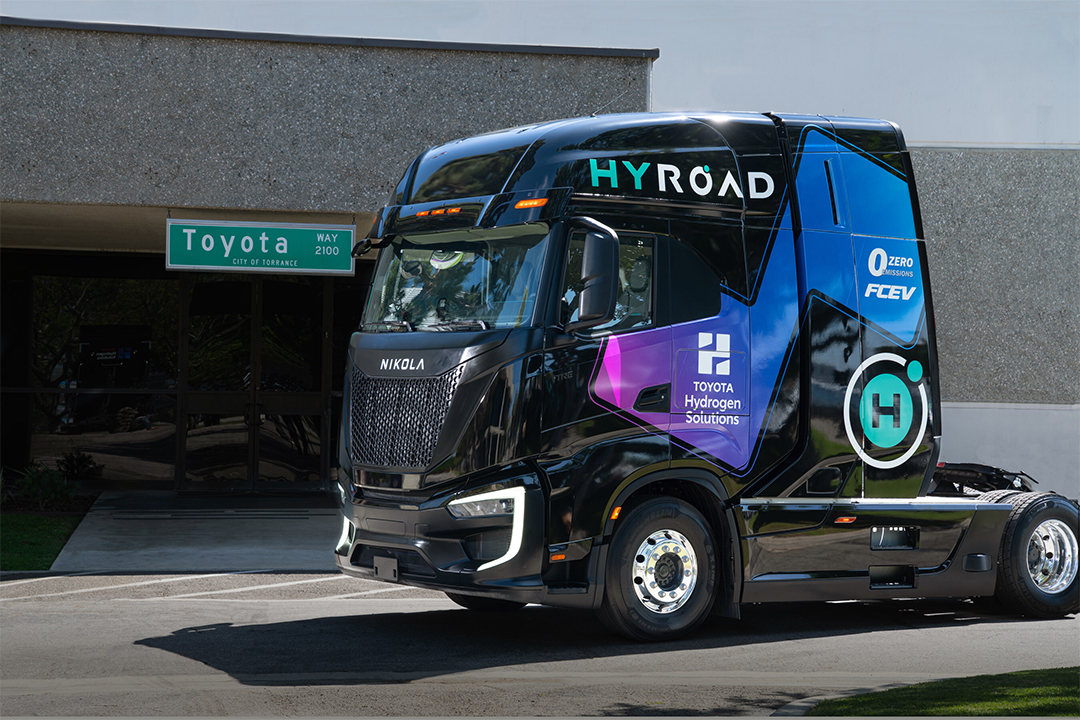
Hydrogen trucking has been stuck in pilot program purgatory for years. Forty trucks under a definitive commercial agreement is a different kind of announcement.
Hyroad Energy and Toyota Motor North America announced on May 4, 2026 at ACT Expo in Las Vegas that they have signed a definitive agreement to deploy 40 hydrogen fuel cell Class 8 commercial trucks in Southern California. Hyroad provides the trucks, maintenance, and fleet management software. Toyota supplies the hydrogen through its own refueling infrastructure currently under development in Ontario, California.
The agreement covers the full operational stack: vehicle, fuel, software, and maintenance under a single commercial framework. For fleets that have avoided hydrogen trucks because assembling all those components independently is too complex, that integration is the point.
Why 40 trucks matters at this stage
Hydrogen trucking has a chicken-and-egg problem that has defined the sector for most of the past decade. Fleets will not commit to hydrogen trucks without reliable fuel supply. Fuel infrastructure investors will not build stations without committed fleet demand to justify the capital. That loop has kept deployment small and commercial progress slow.
Forty trucks under a definitive agreement, with Toyota building the fueling infrastructure in Ontario simultaneously, does not solve the loop entirely. It breaks it at one specific location for one specific operator. The Southern California ports corridor is the right place to break it first. The LA and Long Beach port complex handles roughly 40% of US containerized imports. The trucks moving freight through that corridor run on predictable, repeatable routes with known fuel consumption, making hydrogen refueling infrastructure economics significantly more calculable than open-road long-haul applications.
Toyota has spent more than 30 years developing fuel cell technology. Its commercial fuel cell system, derived from the passenger vehicle technology in the Mirai, has been deployed in Class 8 trucks through the Joint Hydrogen Initiative at the Port of Los Angeles since 2021. The Ontario refueling infrastructure represents an expansion of that commitment into commercial logistics operations at a scale that matters.
Hyroad’s unusual origin story and what it means for the market
Hyroad acquired 117 hydrogen fuel cell trucks, spare parts, software platforms, and IP assets from Nikola Corporation’s bankruptcy auction in August 2025. That acquisition is worth understanding.
Nikola’s collapse was one of the most visible failures in the clean transportation sector. The company promised a hydrogen trucking revolution, delivered very little before its CEO was convicted of fraud, and eventually liquidated. Its physical assets, the actual trucks it had built, were real even if the company around them was not.
Hyroad bought those assets and reoriented around an OEM-agnostic operator model: assemble vehicles from multiple sources, pair them with hydrogen supply and fleet software, and sell the bundle on a pay-per-mile basis rather than requiring fleets to purchase trucks outright. That model removes the capital barrier that has historically slowed alternative fuel adoption in commercial freight, where fleet operators prioritize asset utilization and resist large upfront technology bets.
The pay-per-mile structure also transfers technology risk from the fleet to Hyroad. If a hydrogen truck underperforms, Hyroad bears the consequence in economics rather than the fleet operator.
The operational specifications that make the comparison to diesel honest
A fuel cell Class 8 truck takes 15 to 20 minutes to fill with up to 70 kilograms of hydrogen. Range is approximately 500 miles between fill-ups. Those numbers are competitive with diesel for regional freight operations on predictable routes.
Battery-electric trucks present a different comparison. Current Class 8 battery-electric trucks carry 600 to 900 kilowatt-hours of battery capacity and require 1 to 4 hours to charge depending on the charger. Their range in real-world freight conditions typically runs 200 to 350 miles per charge under load. For short-haul drayage operations, battery-electric makes sense. For the 300 to 500 mile regional routes that dominate port-to-distribution-center freight in Southern California, hydrogen fuel cells offer a practical operational profile that battery-electric cannot yet match.
According to the International Council on Clean Transportation’s analysis of commercial vehicle electrification, hydrogen fuel cells are better suited to heavy-duty regional and long-haul applications while battery-electric technologies are better suited to lighter duty and shorter range applications. The Southern California deployment sits squarely in hydrogen’s comparative advantage zone.
Sources
- International Council on Clean Transportation — Commercial Vehicle Electrification
- Hyroad Energy — Official Website
- Toyota Hydrogen Solutions — Official Website
Editorial disclosure
This article is based on a press release issued by Hyroad Energy and has been independently rewritten and editorially expanded. It covers a definitive agreement between Hyroad Energy and Toyota Motor North America for deployment of 40 hydrogen fuel cell Class 8 trucks in Southern California. Both Hyroad Energy and Toyota Motor North America are privately held. Hydrogen refueling infrastructure referenced is under development and not yet operational. Performance specifications are manufacturer-stated and may vary under real-world operating conditions. Market context is sourced from the International Council on Clean Transportation. Commentary reflects the author’s own assessment. The information provided on this website is for informational and educational purposes only. Our content is derived strictly from verified online sources to ensure accuracy and objectivity. This analysis does not constitute financial, investment, or professional advice. Readers are encouraged to consult with qualified professionals before making decisions based on this information. For more information, please see our full DISCLAIMER.