
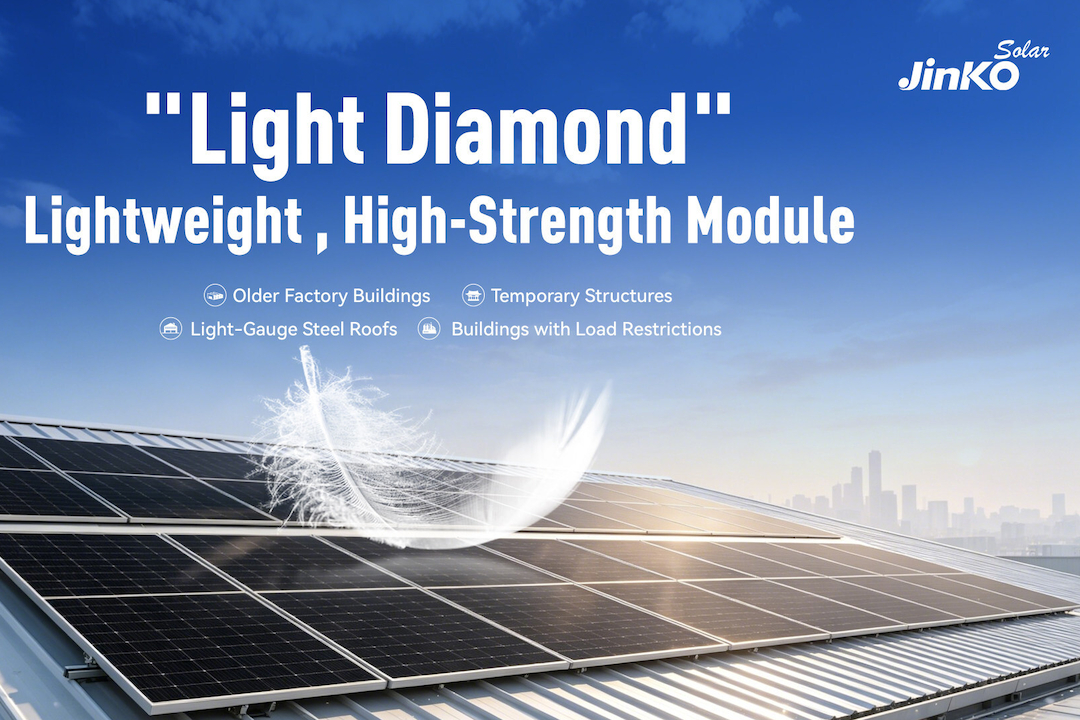
Billions of square meters of rooftop have been off-limits for solar. JinkoSolar just changed that.
The solar industry has a rooftop problem nobody talks about enough.
Not every roof can hold a solar panel. Older factory buildings, light-gauge steel structures, coal sheds, agricultural greenhouses, and buildings with deteriorating frames often cannot support the weight of conventional double-glass modules. They get skipped. The panels go elsewhere. The roof stays bare.
In China alone, over 6 billion square meters of commercial and industrial rooftop space exists. More than 30% of it has load restrictions. That is nearly 2 billion square meters of potential solar capacity that has been sitting untapped because the modules were too heavy.
On April 18, 2026, JinkoSolar launched the Light Diamond, a lightweight high-strength solar module built specifically for those roofs. It weighs 7 kilograms per square meter. Conventional double-glass modules weigh 12.2 kilograms per square meter. That is a 40% reduction. And it delivers 24.94% module efficiency, a figure that most full-weight premium modules have not yet reached.
Weight down. Efficiency up. The trade-off the industry assumed was permanent has been broken.
Why rooftop load capacity has been the invisible barrier to distributed solar
Industrial rooftop solar is not a new idea. The economics of generating electricity at the point of consumption, eliminating transmission losses and reducing grid dependency, have been understood for decades.
The barrier has been structural. A building constructed in the 1970s or 1980s was designed to hold its own weight, its contents, and a snow load. It was not designed to hold an additional 12 kilograms per square meter of solar panels across its entire roof surface. Retrofitting those buildings for solar typically required structural engineering assessments, reinforcement work, production shutdowns during construction, regulatory approvals for structural modifications, and construction timelines exceeding 40 days.
For many building owners, the economics never penciled out. The reinforcement cost, the shutdown cost, and the approval burden consumed the returns that rooftop solar was supposed to generate.
JinkoSolar’s solution to that problem is not subsidies or policy. It is physics. A module that weighs 40% less does not require structural reinforcement on most load-restricted roofs. The approval process is simplified. The construction period drops from over 40 days to 8 to 10 days. Production continues during installation. The cost savings on reinforcement alone run approximately 500,000 yuan per megawatt of installation.
The efficiency figure is the technical achievement that deserves attention
24.94% module efficiency is a meaningful number.
For context, the industry average for commercial solar modules sits around 20 to 22%. Premium products from leading manufacturers have been pushing toward 23 to 24%. Reaching 24.94% while simultaneously cutting module weight by 40% is not an incremental improvement. It represents a genuine engineering advance in the Tiger Neo 3.0 platform that JinkoSolar has built the Light Diamond on.
The commercial consequence is direct. Higher efficiency means more watts from the same roof area. A 560-watt Light Diamond module versus the 450 to 460 watts delivered by flexible or composite lightweight alternatives means over 100 additional watts per module. On a constrained roof where you can only install a fixed number of modules, that difference translates directly into higher total system output, better economics, and a shorter payback period.
According to the International Energy Agency’s Photovoltaic Power Systems Programme, distributed commercial and industrial rooftop solar is one of the fastest-growing segments of global solar deployment, with efficiency improvements and installation cost reductions being the primary drivers of accelerating adoption. A module that improves both simultaneously addresses the core commercial requirement.
The 30-year warranty is the reliability signal that matters most
Lightweight modules have historically carried a reputation risk.
The question any building owner asks is whether lighter means weaker. Whether a module designed to reduce weight has done so by compromising the durability that justifies a 20 to 25-year investment.
JinkoSolar has addressed this directly with the Light Diamond’s structural design. The 1.6mm lightweight glass maintains light transmittance while reducing weight. A reinforced channel frame design and reinforced adhesive film provide mechanical strength and sealing performance. The maximum front-side load certification is 3,600 pascals, equivalent to 3.6 meters of snow accumulation. The module withstands 25mm hailstone impacts. The back-side load capacity handles Category 12 wind forces.
The 30-year power output warranty is 12 to 15 years longer than what flexible or composite lightweight alternatives offer. First-year degradation does not exceed 1%, with annual degradation of 0.35%. These are figures that outperform industry averages on standard modules, not just comparisons within the lightweight category.
The market this unlocks is genuinely large
The numbers Jinko has published for the addressable market are worth taking seriously.
200 gigawatts of theoretical installation capacity across China’s load-restricted commercial and industrial rooftops. A market size surpassing 300 billion yuan. These are not projections built on optimistic assumptions. They are calculations based on the area of existing rooftop that previously could not be used for solar and can now be used for the first time.
Global context reinforces the scale. According to BloombergNEF’s solar market research, commercial and industrial rooftop solar represents one of the most significant underpenetrated segments of the global solar market, with structural and regulatory barriers having historically prevented deployment on a large share of eligible building stock. A lightweight module that removes the primary structural barrier is not entering a crowded market. It is creating access to one.
The renovation of old industrial buildings. Light-gauge steel roofs. Agricultural greenhouses. Coal sheds. Cultural parks. These are not niche edge cases. They are the majority of the load-restricted building stock that global solar deployment has been working around for two decades.
That is the market the Light Diamond is built for.
Sources
- IEA Photovoltaic Power Systems Programme — Distributed Solar Deployment
- BloombergNEF — Commercial and Industrial Solar Market
- JinkoSolar — Official Website
Editorial disclosure
This article is based on a press release issued by JinkoSolar and has been independently rewritten and editorially expanded. It covers the launch of JinkoSolar’s Light Diamond lightweight high-strength solar module. Performance figures including efficiency, warranty terms, and load capacity are as stated by JinkoSolar and have not been independently verified. Market size figures for China’s load-restricted rooftop market are JinkoSolar’s own estimates. Market context is sourced from the IEA Photovoltaic Power Systems Programme and BloombergNEF. Commentary reflects the author’s own assessment. The information provided on this website is for informational and educational purposes only. Our content is derived strictly from verified online sources to ensure accuracy and objectivity. This analysis does not constitute financial, investment, or professional advice. Readers are encouraged to consult with qualified professionals before making decisions based on this information. For more information, please see our full DISCLAIMER.