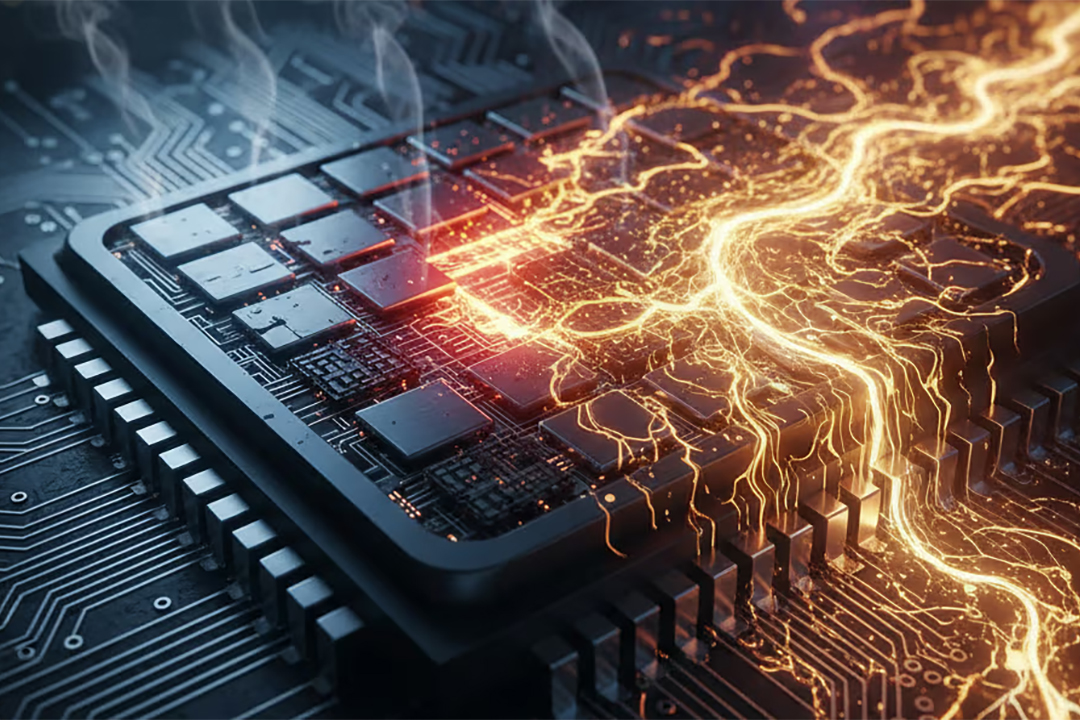
A new line of academic research suggests that a technique known as thermodynamic computing could one day reduce the energy needed for AI image generation by an extraordinary margin. Some researchers estimate potential energy savings of up to ten billion times compared with today’s AI systems.
The idea is still experimental and far from commercial use. However, early prototypes indicate that the concept may be physically possible, even if building practical hardware remains a major challenge.
What Is Thermodynamic Computing in Simple Terms
Unlike conventional computers that rely on precise digital calculations, thermodynamic computing uses physical processes such as noise, randomness, and energy flow to perform calculations. It works more like nature itself, allowing systems to evolve toward stable outcomes rather than forcing exact numerical steps.
Researchers believe this approach could be particularly efficient for certain AI tasks, including image generation, which currently requires enormous amounts of electricity and specialized chips.
Early Research Shows Proof of Concept
Scientists at Lawrence Berkeley National Laboratory recently published studies showing that a simplified neural network can be recreated using thermodynamic principles. In their experiments, the system was able to generate basic images, such as handwritten digits, by allowing information to naturally decay and then mathematically reversing that process.
While the results are extremely basic compared to modern AI tools like Google’s image generators, researchers see this as an early proof that the concept can work.
Commercial Use Still Far Away
The researchers are clear that this technology is not close to replacing today’s AI hardware. Current experiments are small, slow, and limited in capability. Designing real hardware that can match the performance of today’s AI models while maintaining massive energy savings remains an open problem.
In short, the science looks promising, but engineering a usable product could take many years.
Why Investors Are Paying Attention
Energy consumption has become one of the biggest constraints on AI growth. Data centers already consume massive amounts of electricity, and AI demand continues to rise rapidly. Any technology that can significantly reduce power usage could have long-term implications for:
- Data center operators
- Cloud service providers
- AI infrastructure companies
- Energy markets and utilities
If thermodynamic computing ever becomes practical, it could change the cost structure of AI and reduce the pressure on global power grids.
Investor Takeaway
This research is not an investment opportunity today, but it highlights a growing trend. Energy efficiency is becoming a critical factor in AI development. Technologies that reduce power consumption, even at an early research stage, are attracting serious attention.
For now, thermodynamic computing should be viewed as a long-term, high-risk concept with potentially massive upside if the hardware challenges can be solved.