
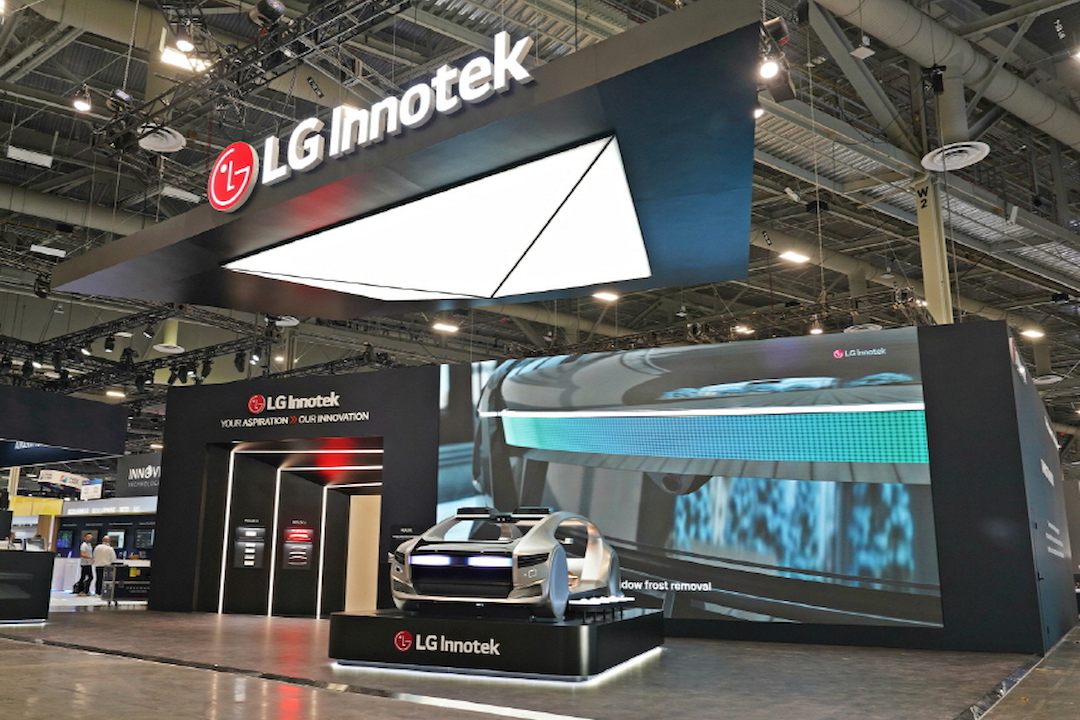
Autonomous vehicles need to see the world. Not just with cameras, but with LiDAR, radar, and sensor fusion systems that process massive amounts of data in real time to make split-second driving decisions. The hardware that does that sensing is built by companies most people have never heard of. LG Innotek is one of them, and on March 29, 2026, it announced a strategic partnership with Applied Intuition, the autonomous driving software company whose customers include 18 of the world’s top 20 automakers. The combination of LG Innotek’s sensing hardware with Applied Intuition’s software and real-world validation infrastructure represents a meaningful step forward for the autonomous vehicle industry.
This partnership is not just about cars. It is explicitly designed to expand into drones and robotics as part of a broader push into what the industry is calling physical AI.
What physical AI actually means and why it changes everything
Most people think of AI as software running in data centers or on phones. Physical AI is different. It is artificial intelligence embedded in machines that interact with the physical world, vehicles that navigate traffic, robots that handle objects, drones that operate in complex airspace. The common thread is sensing: these machines need accurate, reliable, real-time perception of their environment to function safely.
That sensing requirement is where LG Innotek’s business sits. The company produces camera modules, LiDAR systems, and radar components that serve as the perceptual layer for autonomous systems. Getting those sensors to perform consistently across diverse road conditions, weather patterns, and traffic environments around the world is one of the hardest engineering challenges in the automotive industry.
Applied Intuition’s role is equally critical. The company builds the simulation tools and software platforms that allow automakers to test autonomous driving systems virtually before putting them on real roads. Its reference vehicles operate in the US, Europe, and Japan, collecting real-world driving data that feeds back into both software development and hardware validation. When 18 of the world’s top 20 automakers are your customers, your validation infrastructure effectively becomes the industry standard.
Why the virtual sensor breakthrough is the most technically significant part of this deal

Buried in the partnership announcement is a detail that deserves more attention than the headline numbers. LG Innotek has integrated its proprietary virtual sensor technology into Applied Intuition’s simulation tools, becoming the first company to implement a full sensor suite covering cameras, LiDAR, and radar within that platform.
A virtual sensor, called a real sensor in industry terminology, replicates the characteristics of physical sensors in a digital twin environment. In practice, this means automakers can run simulation tests that generate data comparable to actual on-road driving without physically deploying test vehicles. The implications for development timelines are significant. Testing that would previously require thousands of miles of real-world driving across multiple countries can now be partially substituted with simulation runs that are faster, cheaper, and infinitely repeatable.
More importantly for LG Innotek’s commercial strategy, when an automaker uses its virtual sensors during the software development phase, those same sensors become the natural choice for mass production. The virtual sensor creates a pathway from simulation to production order that did not previously exist in such an integrated form. According to McKinsey’s Automotive and Assembly practice, development timeline compression is one of the single most valuable capabilities in the autonomous vehicle supply chain, with every month of acceleration representing hundreds of millions of dollars in competitive advantage for automakers racing to market.
The expansion beyond automotive is where the long-term opportunity lives
LG Innotek and Applied Intuition have both explicitly stated that this partnership will expand beyond autonomous driving into drones and robotics. That framing is strategically significant.
The autonomous vehicle market, while large, is a single application. The physical AI market is an entire category. Industrial robots, delivery drones, agricultural automation, defense robotics, and warehouse logistics systems all require the same fundamental capabilities: reliable sensing, real-time data processing, and software that can make decisions in unstructured environments. A sensing hardware company that has validated its products through the most rigorous test environment in the physical AI space, the public road, is extremely well positioned to supply adjacent markets.
According to MarketsandMarkets research, the global robotics market is projected to reach $218 billion by 2030, with sensing and perception hardware representing a significant portion of total system cost. The overlap between automotive sensing technology and robotics sensing requirements is substantial, which is why companies like LG Innotek are explicitly targeting both simultaneously.
LG Innotek’s pivot from parts supplier to solutions provider
CEO Moon Hyuksoo announced earlier in 2026 that LG Innotek’s strategic direction is to transform from a parts supplier into a solutions provider. That distinction matters commercially. Parts suppliers compete primarily on cost. Solutions providers compete on integration, performance, and the stickiness of combined hardware-software ecosystems.
The Applied Intuition partnership is a direct expression of that strategy. By combining sensing hardware with simulation software, real-world validation data, and an integrated development pathway for automakers, LG Innotek is building the kind of solutions stack that creates customer dependency well beyond the component level. Applied Intuition CEO Qasar Younis captured the commercial logic directly: autonomous vehicles will only scale if the hardware and software ecosystems evolve together.
For a company whose sensing modules are already embedded in the development pipelines of Applied Intuition’s 18 top-20 automaker customers, that statement is a roadmap to a very large addressable market.
Sources
- McKinsey — Autonomous Driving’s Future
- MarketsandMarkets — Robotics Market Research
- Applied Intuition — Company Overview
- LG Innotek — Investor Relations
Editorial disclosure
This article is based on a press release issued by LG Innotek and has been independently rewritten and editorially expanded. It covers a strategic partnership between LG Innotek and Applied Intuition in the autonomous driving and physical AI sensing sector. Market context is sourced from McKinsey and MarketsandMarkets. Commentary reflects the author’s own assessment. The information provided on this website is for informational and educational purposes only. Our content is derived strictly from verified online sources to ensure accuracy and objectivity. This analysis does not constitute financial, investment, or professional advice. Readers are encouraged to consult with qualified professionals before making decisions based on this information. For more information, please see our full DISCLAIMER.

 Watch on YouTube