
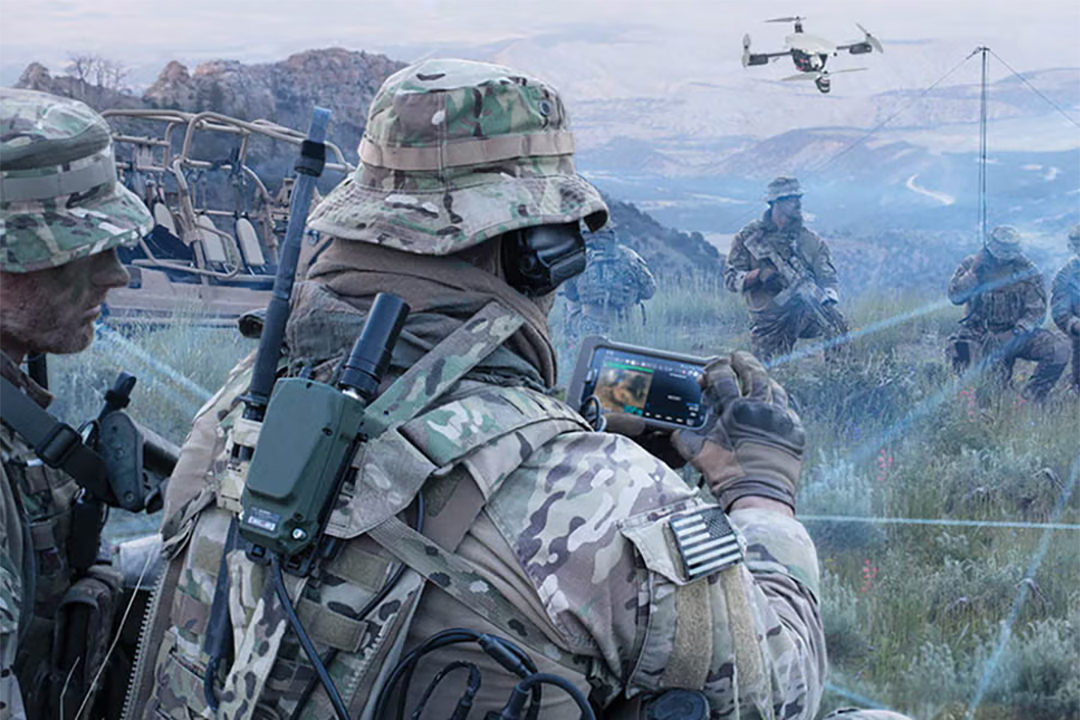
The arithmetic of modern drone warfare is brutal. An FPV drone costs $400. A Coyote interceptor costs $180,000. A Stinger missile costs more than $400,000. Ukraine demonstrated at scale what happens when infantry units face swarms of cheap attritable drones without immediate local protection: losses mount faster than any air defense system can respond, at a cost ratio no military can sustain.
The traditional answer has been more hardware. L3Harris Technologies (NYSE: LHX) and DataShapes AI are proposing a different answer: software.
Wraith Shield, announced by L3Harris on May 13 and now confirmed with DataShapes AI as the AI partner, is a software upgrade that turns the Falcon IV family of tactical radios into a distributed counter-drone detection and disruption network. No new hardware. No additional weight on an already heavy infantry load. Just a software update to radios soldiers are already carrying.
How It Works
The Falcon IV radio already does something relevant to counter-drone operations: it continuously scans the RF spectrum to find friendly Wraith-waveform radios, form ad-hoc local networks, and maintain communications against electronic warfare attacks. That scanning capability is the foundation Wraith Shield builds on. The same antenna that transmits and receives communications also detects and characterizes RF emissions from nearby drones.
DataShapes AI’s GlobalEdge platform processes that RF data at the tactical edge using edge-native AI, with no cloud connectivity required. In a contested electromagnetic environment where cloud links may be jammed or unavailable, that matters. The system identifies enemy drone control signals, shares that intelligence across the local radio network, and coordinates all radios on the net to broadcast jamming simultaneously. The current version coordinates up to 40 radios at once, roughly platoon-scale. L3Harris engineers are targeting 100 in a future update.
The RF-9820S operates in the same frequency bands most attritable FPV drones use for control signals. That alignment is not accidental. It means soldiers carrying the radio most likely to benefit from Wraith Shield are already carrying hardware tuned to the right frequencies.
The Scale Argument
This is where Wraith Shield’s logic becomes compelling. L3Harris has more than 100,000 Falcon IV tactical radios fielded with US forces, NATO members, and allied militaries. Every one of those radios is a potential Wraith Shield node. At a cost Defense Daily described as in the single-digit thousands per unit, deploying counter-drone capability across an entire fielded radio fleet becomes arithmetically feasible in a way that buying dedicated C-UAS systems never could be.
L3Harris’s existing systems like VAMPIRE and Drone Guardian address higher-end threats requiring kinetic or stronger electronic effects. Wraith Shield addresses a different problem: the individual infantry platoon that cannot wait for perfect air defense coverage every time a cheap drone appears overhead. It is layered defense built from hardware already in the fight.
DataShapes AI’s Role
The GlobalEdge platform handles the intelligence layer that makes Wraith Shield work as a system rather than an isolated radio. It converts raw RF data into real-time actionable intelligence, routes that intelligence across the distributed radio network, and enables coordinated response without centralized processing or cloud dependency.
Paul Craft, DataShapes AI’s president and a former US Army Chief of Cyber and Electronic Warfare, described the broader implication clearly: every forward-deployed unit now faces cheap drones capable of penetrating defenses and exhausting countermeasures. The answer cannot scale through hardware. It has to scale through intelligence delivered instantly at the edge.
Initial deployment on the AN/PRC-171 is scheduled for later in 2026. Software upgrade availability across the broader Wraith-capable radio fleet follows. The Wraith waveform was developed in the early 2020s with direct input from Ukraine, where the drone threat was already reshaping ground combat before the wider military world caught up.
The math of drone warfare has not changed. The response to it just got a new variable.
Sources
- L3Harris: The Wraith Shield Advantage
- Breaking Defense: L3Harris Turns Handheld Radios Into Counter-Drone Jammers
- Defence Blog: L3Harris Turns Tactical Radios Into Counter-Drone Sensors
- Defense Daily: Wraith Shield Software Add for Falcon IV Radios
- The Defense Post: L3Harris Adds AI Counter-Drone Capability to Tactical Radios
- ZME Science: Software Update Radio FPV Drones
- ASD News: Wraith Shield Advantage
Editorial Disclosure
This article is based on a press release issued by DataShapes AI and expanded with independent defense industry reporting. L3Harris Technologies, Inc. (NYSE: LHX) is a publicly traded company. DataShapes AI is a privately held company. This article does not constitute investment advice or a recommendation to buy or sell any security. Wraith Shield is a software capability in development; initial deployment on the AN/PRC-171 is scheduled for 2026, with broader Wraith-capable radio upgrade availability to follow. Deployment timelines and capability specifications are subject to change. Performance figures are based on company-disclosed and press-reported specifications. Market prices cited reflect the date of publication and may differ from current prices. The information provided on this website is for informational and educational purposes only. Our content is derived strictly from verified online sources to ensure accuracy and objectivity. This analysis does not constitute financial, investment, or professional advice. Readers are encouraged to consult with qualified professionals before making decisions based on this information. For more information, please see our full DISCLAIMER.

 Watch on YouTube