
The invisible technology that makes electric vehicles actually work just got a major upgrade
Most people buying an electric vehicle think about range, charging speed, and price. Almost nobody thinks about thermal management. That is a mistake, because thermal management is one of the most important factors determining how well an EV actually performs in the real world. Heat the battery too much and it degrades faster. Cool it too aggressively and you waste energy. Manage it poorly during fast charging and you either slow the charge or risk damage. Hanon Systems (KS: 018880), a global automotive thermal management supplier, just announced it is supplying a highly integrated cooling module for electric vehicles that addresses all of these challenges simultaneously, and it is already deployed in BMW’s fully electric iX3 SUV.
The product is called the Highly Integrated Cooling Entity. At 16 kilograms, it fits in the palm of a large hand relative to what it replaces. What it does is far more significant than its size suggests.
Why thermal management is the hidden battleground of electric vehicle performance
A lithium-ion battery pack operates most efficiently within a narrow temperature window, typically between 20 and 40 degrees Celsius. Outside that range, performance degrades. In cold weather, range drops significantly because the battery cannot deliver its rated capacity and energy must be diverted to warm the cells. In hot weather or during fast charging, excess heat builds up that must be actively removed to prevent degradation and maintain safety.
At the same time, the electric motor, power electronics, and cabin climate system all have their own thermal management needs that must be coordinated. In a conventional ICE vehicle, waste heat from the engine could be harvested for cabin heating. In an EV, there is no combustion waste heat, so heating the cabin draws directly from the battery, reducing range.
Managing all of these competing thermal demands efficiently is one of the most technically demanding engineering challenges in EV design. It is also one of the areas where the difference between a well-engineered and poorly-engineered EV is most visible to drivers, particularly in extreme weather.
According to the US Department of Energy’s Vehicle Technologies Office, thermal management improvements represent one of the highest-leverage areas for increasing EV range and battery longevity, with optimized systems potentially extending battery life by 20% or more over the vehicle’s lifetime.
What the HICE module actually integrates and why that matters
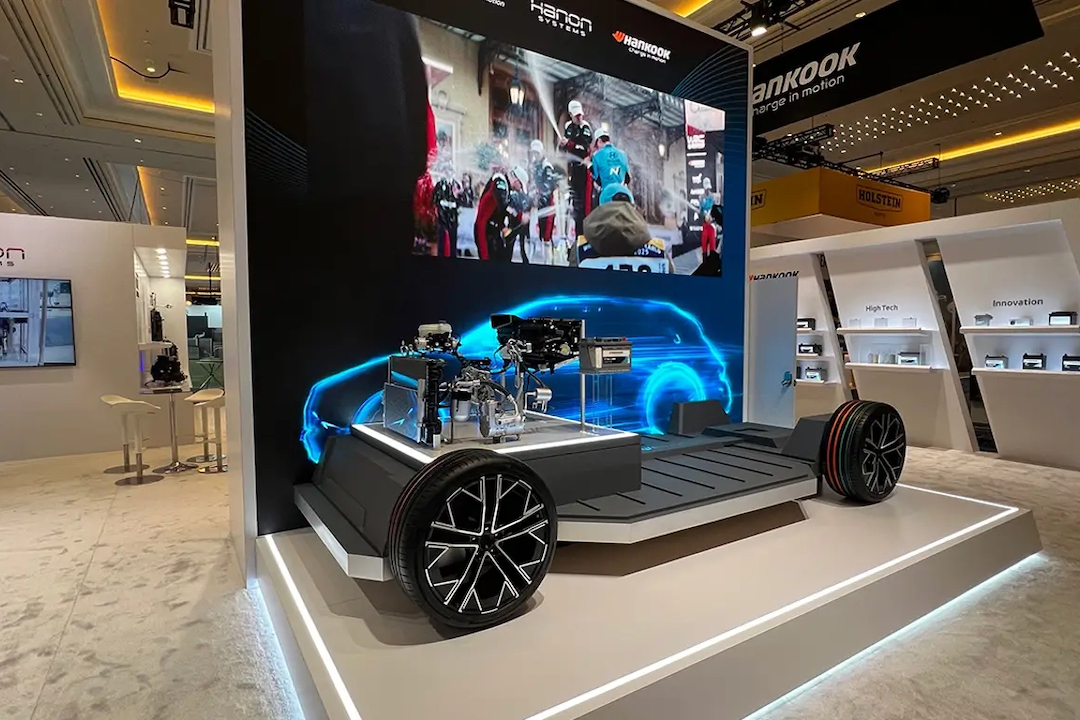
The Hanon Systems HICE module combines an innovative eCompressor, electronic expansion valve block, water-cooled condenser, internal heat exchanger, chiller, air conditioning lines, and pressure and temperature sensors into a single compact unit. Previously, these components would be separate systems connected by lines and fittings, each requiring its own mounting points, seals, and assembly steps.
Consolidating all of that into a 16-kilogram module has several compounding benefits. The packaging savings free up space that can be used for additional battery capacity. The reduction in connecting lines and fittings reduces potential leak points and simplifies assembly. The integrated design allows the system to coordinate all refrigerant functions from a single control point, enabling more intelligent and responsive thermal management than distributed systems can achieve.
The NVH design elements, vibration isolation components and a sound cover, address one of the less-discussed aspects of thermal management hardware: noise. EV cabins are significantly quieter than ICE vehicles, which means component noise that would be masked by engine sound becomes audible. Hanon’s attention to this detail reflects sophisticated understanding of what premium EV customers actually experience inside the vehicle.
The BMW iX3 deployment validates the technology at the highest level
Hanon Systems has confirmed that the HICE module was first deployed in BMW’s fully electric iX3 SUV. That deployment is a meaningful validation signal. BMW’s engineering standards for thermal management in its electric vehicles are among the most demanding in the industry, reflecting both the premium positioning of the brand and the company’s decade-long investment in EV architecture through its i-series and later iX platforms.
Getting a highly integrated thermal management module into a BMW production vehicle requires surviving one of the most rigorous supplier qualification processes in the automotive industry. The fact that Hanon’s solution passed that process and is now in production with one of the world’s most respected automotive brands is the strongest possible real-world endorsement of the technology’s performance and reliability.
According to McKinsey’s Center for Future Mobility, thermal management system suppliers are increasingly being evaluated on their ability to deliver integrated solutions rather than individual components, as automakers seek to reduce the complexity of their EV platforms and accelerate development timelines. Hanon’s HICE module is a direct expression of that industry direction.
Hanon Systems’ position in the global EV supply chain
Hanon Systems is not a startup riding the EV wave. Founded in 1986 and now a subsidiary of Hankook and Company Group following a January 2025 acquisition, the company operates 50 manufacturing sites across 21 countries with more than 20,000 employees. It supplies thermal management systems across heating, ventilation and air conditioning, powertrain cooling, compressors, and fluid management to automakers globally.
That scale matters for EV supply chain security. Automakers building global EV platforms need suppliers capable of delivering components consistently across multiple manufacturing regions simultaneously. A supplier with 50 production sites and three regional innovation centers has the geographic footprint to support global EV platform launches in a way that smaller, more specialized thermal management companies cannot.
The International Energy Agency projects global EV sales to continue growing rapidly through 2030, with thermal management remaining one of the highest-value subsystems per vehicle as battery technology and fast-charging infrastructure advance. Hanon’s integrated module approach positions it to capture increasing value per vehicle as EV architectures become more sophisticated.
Sources
- US Department of Energy — Vehicle Technologies Office
- McKinsey Center for Future Mobility — Future of Mobility
- International Energy Agency — Electric Vehicles
- Hanon Systems — Official Website
Editorial disclosure
This article is based on a press release issued by Hanon Systems and has been independently rewritten and editorially expanded. It covers the announcement of Hanon Systems’ highly integrated cooling entity for electric vehicles, first deployed in BMW’s iX3 SUV. Hanon Systems trades on the Korea Stock Exchange under the ticker 018880. Market context is sourced from the US Department of Energy, McKinsey, and the International Energy Agency. Commentary reflects the author’s own assessment. The information provided on this website is for informational and educational purposes only. Our content is derived strictly from verified online sources to ensure accuracy and objectivity. This analysis does not constitute financial, investment, or professional advice. Readers are encouraged to consult with qualified professionals before making decisions based on this information. For more information, please see our full DISCLAIMER.

 Watch on YouTube