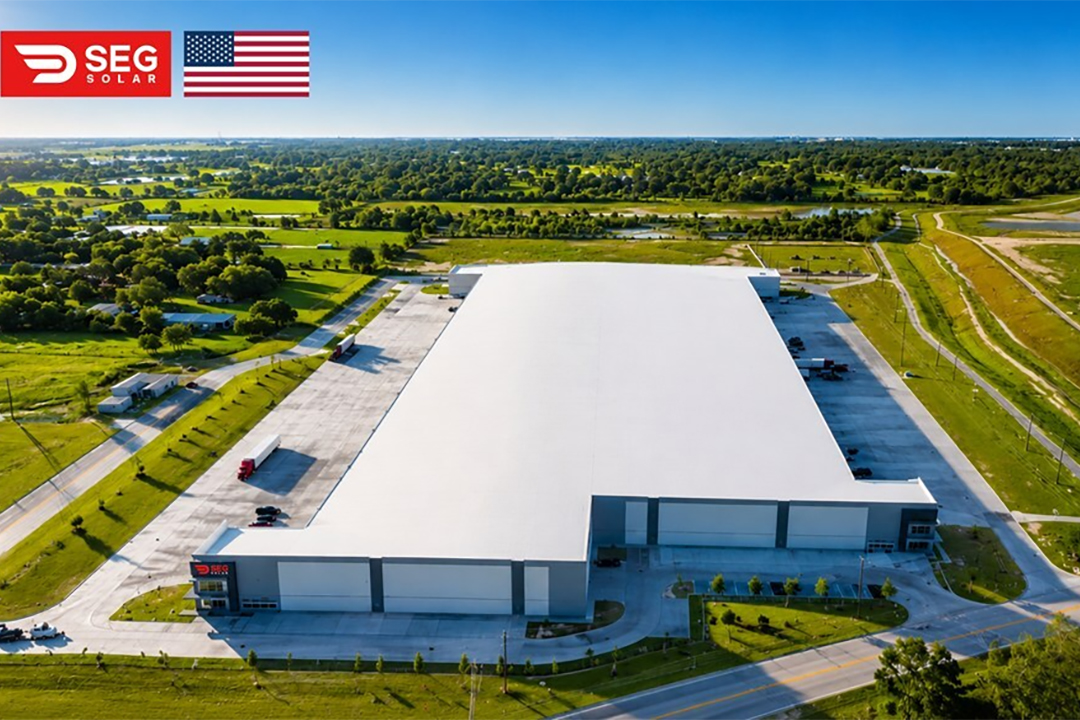
A second US facility brings the company to 6 GW of domestic capacity.
SEG Solar announced Thursday it will build a second solar module manufacturing facility in Houston, Texas — a 4-gigawatt plant representing more than $200 million in investment and up to 800 new jobs. Commercial operations are expected in Q3 2026. Combined with the company’s existing 2 GW Houston factory, the expansion takes SEG’s total US annual module production capacity to 6 GW, positioning it among the largest fully US-owned module manufacturers in the country.
The announcement lands at a moment when domestic solar manufacturing has become a genuinely competitive arena, not just a policy talking point.
The Race to Onshore
In October 2025, US solar manufacturing capacity crossed 60 GW for the first time, a threshold widely viewed as the point where domestic production could theoretically meet total annual demand. That milestone followed years of factory announcements, tariff battles, and IRA incentives reshaping where panels get made. SEG is now accelerating into that momentum.
The company’s existing Houston facility tells the financial story behind this expansion. In June 2025, SEG completed its first sale of Section 45X Advanced Manufacturing Production Tax Credits, with a total value of up to $50 million, priced at $0.94 per $1.00 of credit value and tied directly to production output. That cash flow, generated by manufacturing panels on US soil, is precisely the kind of mechanism the IRA was designed to create. It also signals that SEG’s domestic production model is generating real returns, not just policy benefits on paper.
The new facility covers nearly 500,000 square feet and is designed with flexibility to integrate next-generation technology including heterojunction (HJT) cells as the product mix evolves. That forward-looking architecture matters in a market where module efficiency gains are moving fast.
Building the Full Chain
The Houston expansion is one half of a larger supply strategy. SEG separately disclosed plans for a 5 GW ingot and wafer manufacturing facility in Indonesia, with construction expected to begin in Q2 2026. When both projects are complete, SEG will be able to deliver modules through a supply chain spanning ingots, wafers, cells, and finished modules under coordinated production.
That kind of vertical integration is increasingly the differentiator. US solar manufacturers have made real strides toward reshoring production, but the sector is still navigating significant supply chain complexity, with tariffs on Southeast Asian imports, anti-dumping and countervailing duty investigations, and FEOC compliance requirements all reshaping where buyers source product. A manufacturer that controls more of the chain carries less exposure to those disruptions.
FEOC Is the New Competitive Moat
The compliance angle deserves more attention than press releases typically give it. FEOC restrictions under the One Big Beautiful Bill took effect January 1, 2026, creating new eligibility requirements for Section 45X credits and project tax credits under 45Y and 48E. Manufacturers with too-close a connection to China, Russia, North Korea, or Iran risk losing access to those credits entirely.
SEG has been validated as a non-prohibited foreign entity for FEOC compliance purposes by multiple independent third parties. In a market where that validation is becoming a procurement prerequisite for utility-scale developers, it is a real differentiator. Developers relying on Southeast Asian or Chinese-linked supply chains are actively reassessing sourcing, and FEOC-clean domestic manufacturers are benefiting directly from that shift.
Market Dynamics
Solar PV capacity additions in the US are projected at 53 to 56 GWdc in 2025, with demand potentially extending into 2026 and 2027 as developers accelerate projects ahead of potential tax credit changes. Supply has tightened as tariffs on Southeast Asian imports bite deeper. Domestic capacity that is FEOC-clean, 45X-eligible, and able to deliver at scale is in shorter supply than the aggregate capacity numbers suggest.
SEG shipped over 7.5 GW of solar modules worldwide by the end of 2025. The company is founded in 2021, relatively young, and has moved quickly. The new facility is its largest single investment to date, and the decision to plant a second flag in Houston rather than diversify geographically suggests confidence in Texas infrastructure, workforce, and energy costs as long-term competitive advantages.
One caveat worth noting: commercial operations are expected in Q3 2026. Factory timelines in solar manufacturing have a history of slipping. Permitting, equipment delivery, staffing, and commissioning are all variables. The 45X credit also begins phasing out at 25% per year starting in 2030, narrowing the window for maximum financial benefit from domestic production incentives. Neither risk invalidates the strategy. Both are worth watching.
Sources
- SEG Solar
- SEG Solar 45X Tax Credit Sale Announcement
- Thomas Net: State of US Solar Manufacturing in 2026
- Canary Media: US Solar Manufacturing in 2026
- PV Magazine: FEOC Restrictions and 45X Tax Credits
- Norton Rose Fulbright: New FEOC Guidance Notice 2026-15
- Sunhub: US Solar Policy Shifts 2025
- PV Magazine USA: One Big Beautiful Bill and Tariffs in US Solar
Editorial Disclosure
This article is based on a press release issued by SEG Solar and expanded with independent industry and policy data. SEG Solar is a privately held company headquartered in Houston, Texas. No securities are discussed in this article. Tax credit values and production projections are based on company-disclosed figures and are subject to change based on actual output, regulatory developments, and IRS guidance. Section 45X tax credits begin phasing out starting in 2030. FEOC compliance status is based on company disclosure and independent third-party validation as stated by SEG Solar; readers should conduct their own due diligence on compliance matters. Commercial operations at the new facility are projected for Q3 2026 and have not commenced. The information provided on this website is for informational and educational purposes only. Our content is derived strictly from verified online sources to ensure accuracy and objectivity. This analysis does not constitute financial, investment, or professional advice. Readers are encouraged to consult with qualified professionals before making decisions based on this information. For more information, please see our full DISCLAIMER.