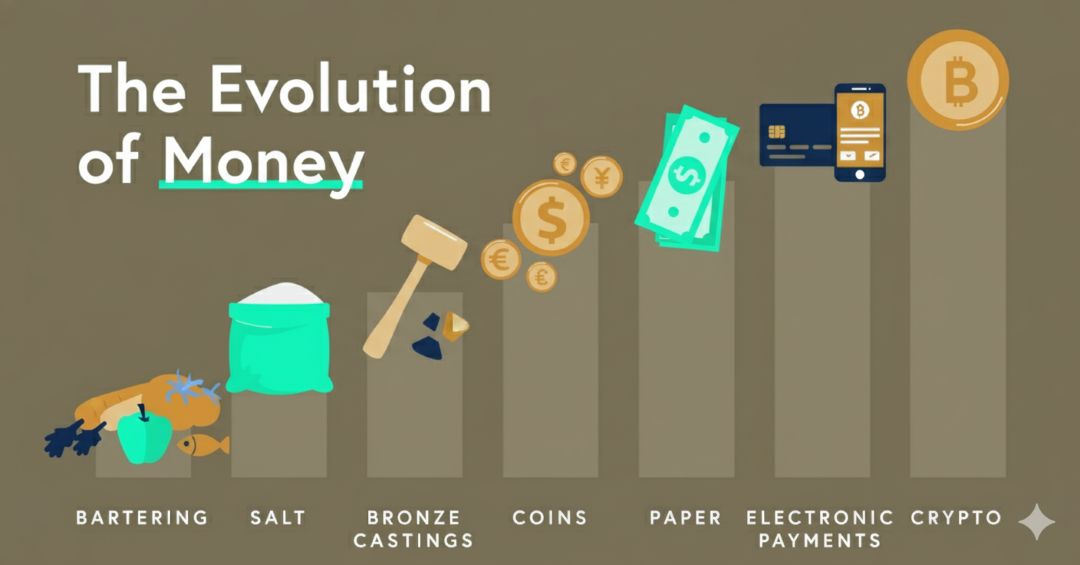
Central banks, financial firms, and technology companies are moving toward a more digital monetary system. Cryptocurrencies, stablecoins, and central bank digital currencies offer alternative mechanisms for payments and value storage. These technologies could reduce frictions in cross-border settlement, expand financial access, and enable new financial services. They also introduce serious tradeoffs in security, privacy, and systemic risk. Whether crypto replaces fiat in whole or in part will depend on a complex mix of technical reliability, regulatory choices, political priorities, and public trust. This article maps the mechanics, benefits, and obstacles of a digital-money future and outlines plausible pathways for transition.

What we mean by fiat and by crypto
Fiat money is currency issued and guaranteed by a sovereign state. It circulates because governments declare it legal tender and because institutions and markets accept it for taxes, wages, and contracts. Cryptocurrency refers to cryptographic tokens that exist on distributed ledgers. Some tokens are native to open networks that anyone can join. Other digital currencies are issued by institutions or central banks and may operate on permissioned ledgers. The term covers a wide range of instruments, from volatile tokens used for speculative trading to stablecoins pegged to national currencies.
The Digital Shift in Money
For more than a century, paper money has defined modern economies. Today, that dominance is fading. Across Europe and parts of Asia, physical cash use has declined by more than half in the past decade. Mobile payments, digital wallets, and online banking have become the norm. This shift raises a larger question: if most money now moves electronically, could national currencies themselves become fully digital?

How Digital Currencies Work
Digital money can take several forms. At one end are central bank digital currencies (CBDCs)—government-issued digital cash that functions as legal tender. China’s digital yuan and the European Central Bank’s digital euro project are leading examples. At the other end are private digital assets such as stablecoins—tokens like USDT or USDC that aim to maintain a one-to-one value with fiat currencies. Both rely on distributed ledgers to record transactions securely and instantly. The key difference lies in who controls them: the state or private networks.
Why Banks Are Paying Attention
Banks are beginning to view digital currencies as more than a passing trend. For institutions that process billions of dollars daily, blockchain-based settlement can cut costs and speed up transfers. Some banks already use tokenized deposits—digital representations of client funds—for faster cross-border payments. JPMorgan’s Onyx platform, for example, has processed billions in tokenized transfers between global clients. For businesses, these rails reduce fees, shorten settlement times, and remove dependence on outdated clearing systems.

Consumers and the End of Cash
For consumers, digital money promises both convenience and access. In countries like Kenya and the Philippines, mobile-based payment systems have already brought millions into the formal economy. A future where digital currencies replace physical cash could make payments faster and traceable while lowering transaction costs for small merchants. However, it also raises concerns over privacy. A fully digital system means every transaction could, in theory, be monitored—making the balance between security and personal freedom a central policy debate.
Risks and Stability
Digital currencies are not without risk. Software vulnerabilities, custodial failures, and cyberattacks pose real threats. A major concern for regulators is financial stability. If depositors can instantly move money from banks into stablecoins or CBDCs, a loss of confidence could trigger faster, more severe bank runs. To counter this, central banks and governments are studying ways to design safeguards into digital systems, ensuring they remain resilient under stress.
The Road Ahead: Coexistence, Not Replacement
The complete replacement of fiat currency is unlikely in the near future. Instead, the world is moving toward a hybrid system. Governments will issue digital cash. Private firms will operate regulated stablecoins. Banks will continue to act as intermediaries, integrating blockchain technology into existing systems. This transition mirrors what happened when online banking first appeared—initial skepticism, followed by gradual adoption as reliability and regulation caught up.
A Controlled Revolution
In the long term, money is likely to become entirely digital, but not necessarily decentralized. Nations will want to retain control over their monetary systems, even as they adopt the efficiencies of blockchain technology. The next decade will determine whether digital money strengthens the global financial system—or fragments it into competing private networks.
What is clear is that the infrastructure of money is changing faster than most people realize. As banks, regulators, and consumers adapt, the question is not if digital currency will reshape banking, but how soon it will happen.
Conclusion
Digital currencies offer a realistic route to reshaping how money moves and how banking services are delivered. They can reduce friction, expand access, and enable new financial products. They can also introduce new vulnerabilities in privacy, stability, and governance. A wholesale replacement of fiat is not imminent. A more likely near-term outcome is a mixed system where central bank digital currencies, regulated stablecoins, and bank-hosted digital services coexist. The overall direction, however, favors digital-native rails. The institutions and regulators that move deliberately, with safeguards and public accountability, will determine whether that future enhances stability and serves broad social goals.