Sulfuric acid prices have risen 600% in under two years in the United States. Most lithium projects use sulfuric acid. Century Lithium does not.
Century Lithium (TSXV: LCE | OTCQX: CYDVF) announced on April 23, 2026 that its Lithium Extraction Demonstration Plant is being relocated to Tonopah, Nevada, with commissioning targeted for the second half of 2026. The more significant news is the context around that relocation: a patent-pending chlor-alkali process that uses salt and electricity rather than sulfur-derived reagents, at precisely the moment global sulfur markets are experiencing an extraordinary price dislocation.
What is happening to sulfur prices and why it matters for lithium
Most lithium extraction from hard rock spodumene and sedimentary claystone deposits uses sulfuric acid as the primary leaching reagent. Sulfuric acid is produced from sulfur. And sulfur prices have moved in ways that are upending project economics across the lithium industry.
China’s spot sulfur price reached US$950 per tonne in April 2026, a 283% increase from approximately US$248 per tonne in January 2025. In the United States, Tampa contract sulfur prices surged from US$69 per long ton at the start of 2024 to a projected US$475 to $520 per long ton under Q1 2026 contracts. That is roughly a 600% increase in under two years. US sulfuric acid prices followed, rising from US$85 per tonne in early 2024 to US$146 per tonne by March 2026.
For a lithium project consuming tens of thousands of tonnes of sulfuric acid annually, those cost increases are not marginal. They restructure the project economics entirely. Operating cost assumptions in feasibility studies filed twelve to eighteen months ago are materially wrong for any project using sulfuric acid as a primary reagent.
Angel Island’s process uses neither sulfur nor sulfuric acid.
How the chlor-alkali process works and why it is structurally different
The patent-pending process Century Lithium has developed generates hydrochloric acid and sodium hydroxide on-site from sodium chloride and electricity. Hydrochloric acid leaches lithium from Angel Island’s claystone deposit. Sodium hydroxide provides pH control throughout leaching, filtration, and direct lithium extraction. Both reagents are continuously regenerated as co-products of the electrolytic cells, closing the loop.
The primary inputs are salt and electricity. Salt is a commodity with stable pricing, abundant domestic supply, and no structural connection to global sulfur markets. Electricity in Nevada draws on a grid with growing renewable generation capacity. Neither input is subject to the supply chain pressures that have driven sulfuric acid costs to record levels.
The process also produces surplus sodium hydroxide, which is a commercially valuable chemical with established industrial markets. The 2026 Feasibility Study, prepared by Mineral Property Development, Global Resource Engineering, and SRK Incorporated under NI 43-101, models that surplus sodium hydroxide as a revenue-generating by-product that further reduces operating costs. The study reports an after-tax NPV of US$4.01 billion and average operating costs of US$4,389 per tonne of lithium carbonate.
The demonstration plant move and what it proves
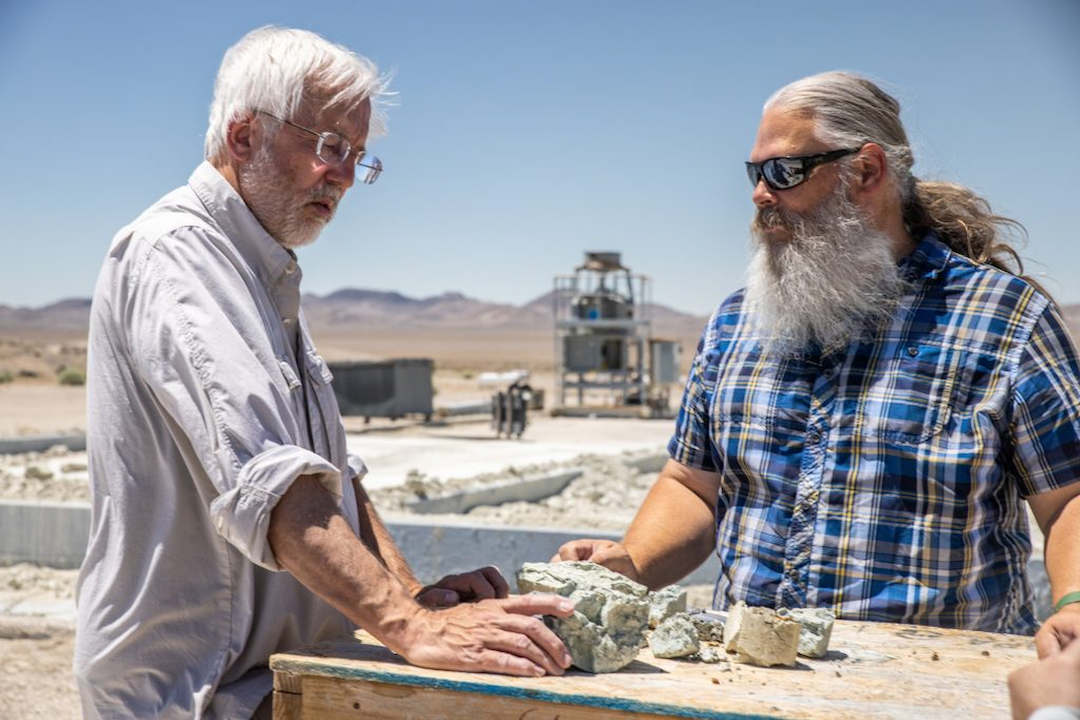
The Demonstration Plant operated at Century Lithium’s Amargosa Valley facility for five years, producing battery-grade lithium carbonate and validating the chlor-alkali flowsheet on actual Angel Island claystone. Moving it to Tonopah, the site of the planned full-scale operation, is the next logical step.
Once commissioned in H2 2026, the plant will run structured metallurgical tests on claystone zones 1 and 2, consistent with the 2026 Feasibility Study recommendations. Bench-scale testing already indicates the deeper claystone zones perform at least as well as the surface material used in earlier runs. The full-scale Demonstration Plant will validate that finding at production-relevant scale.
The Tonopah facility will also serve as a showcase for government agencies, community stakeholders, and potential funding partners evaluating the project. Century Lithium is pursuing federal critical minerals funding, including evaluation of recovering additional critical elements from the Angel Island leach solutions identified in the Feasibility Study.
The supply chain independence argument in the current environment
According to the US Geological Survey’s critical minerals framework, domestic supply chain resilience is now a primary criterion for federal support of critical minerals projects. A lithium project that sources its primary reagents domestically, uses no imported chemicals with volatile pricing, and produces a by-product that offsets operating costs fits that framework precisely.
Most lithium projects cannot make that argument. Angel Island can.
The lithium market itself remains challenged by oversupply from Australian spodumene and Chinese processing capacity, with lithium carbonate prices well below the peaks of 2022 and 2023. But project economics at current prices depend heavily on operating cost assumptions that sulfuric acid price spikes are now invalidating for competitors. A project with operating costs of US$4,389 per tonne using stable salt-based inputs is in a structurally different position than one projecting similar costs using sulfuric acid at three to six times its 2024 price.
Sources
- US Geological Survey — Critical Minerals Framework
- USGS — Sulfur Mineral Commodity Summaries 2025
- Century Lithium — Official Website
Editorial disclosure
This article is based on a press release issued by Century Lithium Corp. and has been independently rewritten and editorially expanded. It covers the relocation of Century Lithium’s Demonstration Plant to Tonopah, Nevada, and provides context on the company’s chlor-alkali lithium extraction process. Century Lithium trades on the TSXV under LCE and on OTCQX under CYDVF. The 2026 Feasibility Study NPV of US$4.01 billion is based on NI 43-101 standards and incorporates assumptions about lithium prices, operating costs, and capital costs that may differ materially from actual outcomes. No mineral resources that are not mineral reserves have demonstrated economic viability. The Angel Island project is in the permitting and development stage and carries significant development, permitting, and commodity price risk. Market context is sourced from the USGS. Commentary reflects the author’s own assessment. The information provided on this website is for informational and educational purposes only. Our content is derived strictly from verified online sources to ensure accuracy and objectivity. This analysis does not constitute financial, investment, or professional advice. Readers are encouraged to consult with qualified professionals before making decisions based on this information. For more information, please see our full DISCLAIMER.