
A premature infant in the NICU and a 70-year-old in the ICU need completely different respiratory support. Different flow rates, different circuit sizes, different setup requirements. Until now, that meant different disposable circuits, different inventory, different workflows for clinical staff managing both populations at once.
One FDA clearance just changed that.
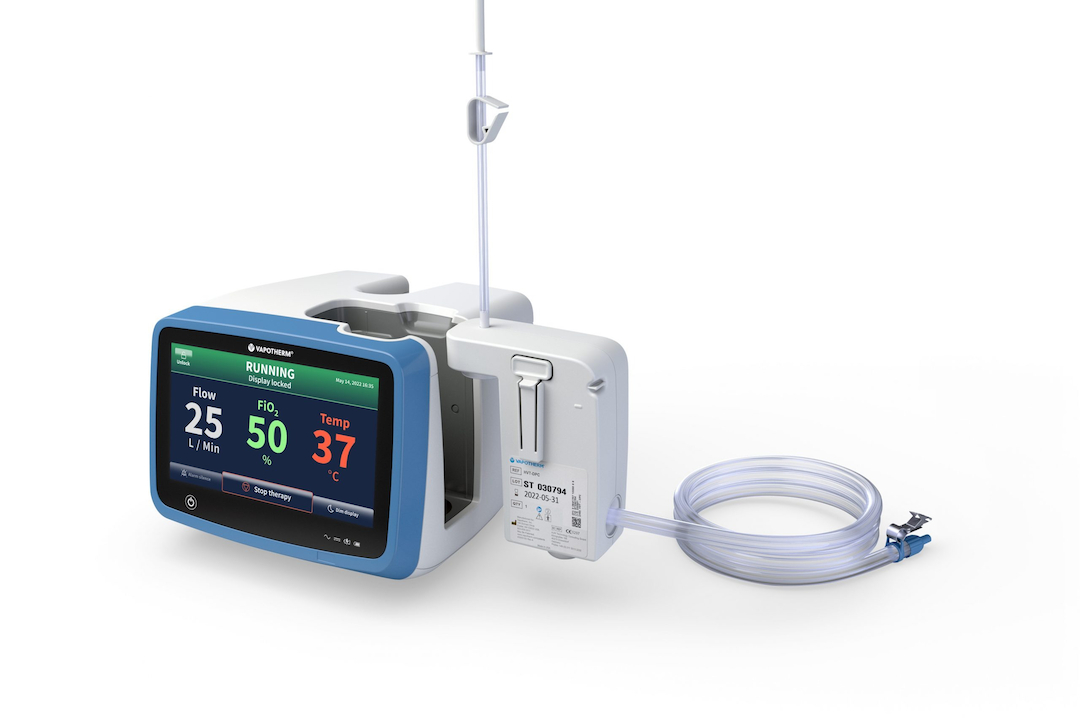
On April 21, 2026, Vapotherm announced 510(k) clearance for its All Patient Circuit, a single disposable patient circuit covering a 2 to 45 liters per minute flow range, from neonatal through adult patients. It pairs with the HVT 2.0 high velocity therapy system and comes in standard and aerosol configurations.
The therapy behind the circuit
High velocity therapy is not new, but its adoption curve has been steep. The approach delivers precisely conditioned, humidified air through nasal cannulas at high flow rates, no mask, no intubation, and it has become a first-line intervention for acute respiratory distress across emergency departments and ICUs. Clinical studies show it reduces intubation rates by around 28% compared to conventional oxygen delivery. High-flow therapy adoption in US ICUs now exceeds 78%, according to industry analysis, and the global high-flow nasal cannula market is projected to grow from $8 billion in 2025 to $13.3 billion by 2030.
In neonatal care the picture is equally established. Research published in Frontiers in Pediatrics covering more than 3,300 premature infants found no significant difference in treatment failure or mechanical ventilation rates between high-flow nasal cannula therapy and CPAP, while also showing lower rates of nasal trauma. Use in NICUs has risen sharply over the past decade, with 95% of infants born under 30 weeks gestation now receiving high-flow therapy at some point during their hospital stay at many leading centers.
The technology works across the age spectrum. What has lagged is the hardware to match.
Why a single circuit across that range is harder than it sounds
A premature infant might need flow rates under 5 liters per minute. A critically ill adult might need 40 or more. Getting the humidity conditioning right across that entire range, without compromising performance at either end, is the hard part. The circuit needs to maintain precise temperature and humidity levels regardless of where in that range the clinician is operating, because the therapeutic benefit of high velocity therapy depends on consistently conditioned gas reaching the airway.
Existing solutions forced hospitals to stock separate circuits for different patient populations, train staff on different products, and swap circuits when a patient’s clinical status changed and their flow requirements moved out of range. For a hospital running a NICU and an ICU simultaneously, that meant two separate supply chains, two training protocols, and a transition point mid-care that introduced both logistical friction and the possibility of error.
The APC solves it with one device.
Fewer SKUs to stock. Simpler staff training. No circuit swap when a patient’s condition evolves.
The operational case is as strong as the clinical one
Hospital supply chain complexity is consistently cited as one of the highest contributors to avoidable clinical cost. A 2024 analysis by Vizient, a healthcare performance improvement company, found that respiratory care product standardization was among the top ten opportunities for cost reduction in acute care settings, with fragmented disposable inventories driving both direct procurement costs and indirect labor costs in setup and training.
The All Patient Circuit addresses both simultaneously. At the bedside, a clinician treating a deteriorating infant who needs escalating flow rates no longer needs to swap hardware. In the supply room, the procurement team orders one SKU instead of several. During a high-volume respiratory season, when beds may shift between patient types and staff may be redeployed across units, a single circuit that works everywhere removes a potential failure point.
The American Thoracic Society’s clinical guidelines on high-flow nasal oxygen link equipment standardization across care settings to reduced clinical errors and improved protocol adherence. A circuit that spans the entire patient population from the smallest premature infant to the largest adult is the most complete expression of that principle any single product has yet achieved.
What this means for Vapotherm’s installed base
Vapotherm’s HVT 2.0 has been used to treat millions of patients worldwide. The All Patient Circuit expands what that installed base can do without requiring hospitals to acquire new hardware. Existing HVT 2.0 users gain neonatal capability through a new disposable, not a capital purchase.
That matters in a procurement environment where hospitals are under sustained pressure to reduce capital expenditure while maintaining or expanding clinical capability. An FDA-cleared expansion of existing equipment’s clinical range, delivered through a consumable, is a more accessible upgrade path than a new platform purchase.
Respiratory illness remains one of the most common drivers of acute hospitalization across every age group. COPD, bronchiolitis, pneumonia, acute respiratory failure, prematurity-related lung disease. These conditions do not concentrate in a single ward. The patients are everywhere in the hospital. Having one circuit that treats all of them is not a marginal convenience.
It is a fundamentally simpler way to run a respiratory therapy program.
Sources
- Frontiers in Pediatrics — HFNC vs CPAP in Preterm Infants
- American Thoracic Society — High-Flow Nasal Oxygen Guidelines
- Mordor Intelligence — High-Flow Nasal Cannula Market
- Vapotherm — Official Website
Editorial disclosure
This article covers FDA 510(k) clearance for Vapotherm’s All Patient Circuit. 510(k) clearance indicates substantial equivalence to a predicate device and is not an approval of specific clinical claims. Does not constitute medical advice. The information provided on this website is for informational and educational purposes only. Our content is derived strictly from verified online sources to ensure accuracy and objectivity. This analysis does not constitute financial, investment, or professional advice. Readers are encouraged to consult with qualified professionals before making decisions based on this information. For more information, please see our full DISCLAIMER.