150,000 new products. 2,000 suppliers. One building in Hong Kong. And humanoid robots are now on the show floor.
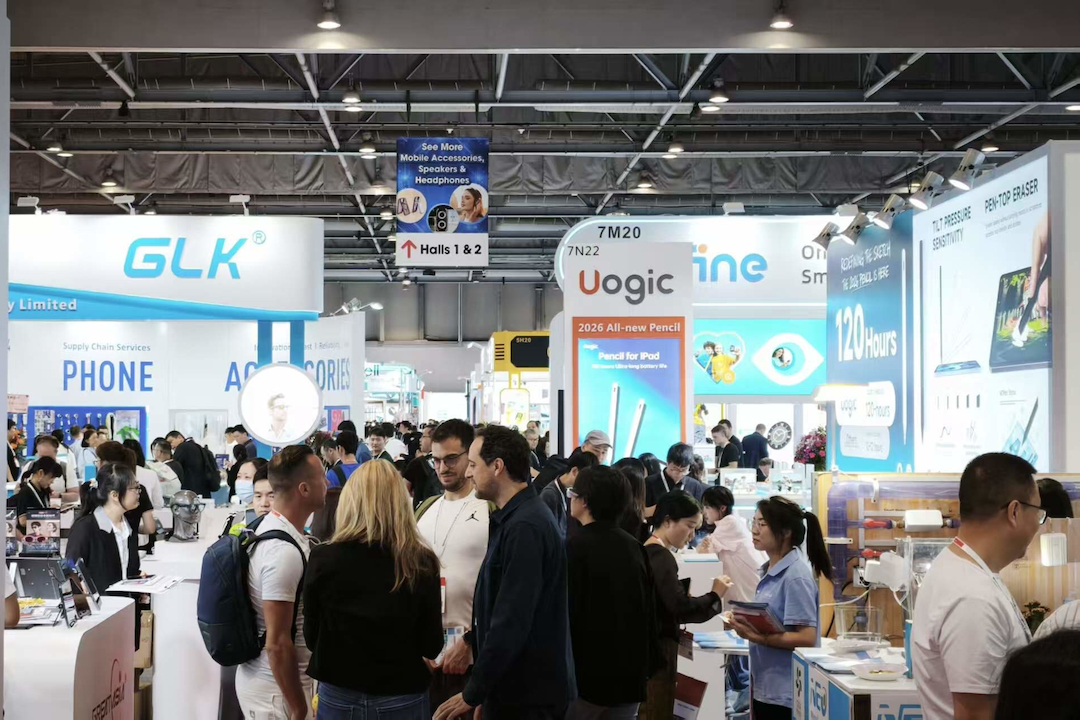
The Global Sources Hong Kong Shows Phase II opened on April 18, 2026 at AsiaWorld-Expo, running through April 21. Over 2,000 suppliers. Nearly 4,000 booths. Approximately 150,000 new products across mobile electronics, smart home, AR/VR, personal healthcare, and consumer lifestyle categories.
Those numbers are large. The more significant number is 1,200.
That is how many booths are dedicated to AI products in a single dedicated pavilion. Not a corner of the show. Not a special interest section. One thousand two hundred booths, organized across seven segments: AI terminal devices, AI wearables, AI glasses, AI toys, AI pet products, AI personal healthcare, and AI convergence products.
AI is not a category at this show anymore.
It is the baseline.
What that shift actually means on a trade show floor
A year ago, AI products at consumer electronics sourcing shows occupied dedicated technology zones that buyers visited to see what was coming. Products with demonstrated mass-production capability were rare. Most exhibits were prototypes, proof-of-concepts, or aspirational designs looking for investment.
That distinction has collapsed.
Global Sources VP John Kao described the change directly: AI is moving from concept to mass production. The wave of technology reshaping products has arrived. The show’s own framing reflects this. AI is described as having permeated virtually every product category, from smart wearables and home security to personal healthcare. The AI pavilion is specifically curated around products with proven mass-production capabilities, not future concepts.
That curation matters for global buyers. A buyer sourcing smart home products does not want to know what is theoretically possible. They want to know what they can actually order, in volume, for delivery within a viable commercial window. The shift from prototype to production-ready at this scale signals that AI hardware has crossed the threshold from innovation showcase to mainstream supply chain.
The humanoid robot zone is the detail that stops you in your tracks
The Physical.ai Lab is new this year.
China has designated humanoid robots as a strategic emerging industry. The lab at this show is not a preview of what might be available someday. It showcases robot products that have already entered the commercialization stage. Humanoid robots. Embodied intelligent robots. Robotic lawn mowers. Educational robots.
Unitree Robotics, whose humanoid and quadrupedal robots have become reference points for the global robotics industry, is on the floor with live demonstrations including dance and kung fu performances designed to showcase motion planning and real-time control capabilities. Linkerbot’s robot band is performing. These are not demonstrations of laboratory capability. They are commercial showcases by companies that are manufacturing and selling these products.
According to Goldman Sachs Research on humanoid robotics, the humanoid robot market could reach $38 billion by 2035, with manufacturing, logistics, and consumer applications as the primary growth sectors. The presence of commercially viable humanoid robots at a sourcing show, rather than an industry conference or research exhibition, marks a specific transition point. These are products with buyers, supply chains, and delivery timelines.
The buyer attendance data tells the other half of the story
Pre-registered buyers grew 35% year on year as of March 2026.
That growth is not uniform. The strongest increases are coming from Eastern Europe, Western Europe, the United States, and ASEAN. Those are markets where sourcing professionals are actively looking for the supply chain access that the Global Sources platform provides, and the growth rates suggest urgency rather than routine attendance.
Mobile accessories exhibitors have grown 50% compared with the same period in 2025. That growth reflects the intensity of product development around new form factors including AI glasses, wearable computing, and accessories for the expanding universe of AI-enabled mobile devices.
The show has also introduced new matching infrastructure. The upgraded Business Matching service is expected to arrange over 3,000 buyer-supplier sessions across all three phases. A Sourcing Connection Desk provides real-time walk-in matching for buyers who did not book appointments in advance. These are operational improvements that reflect the pressure of matching high buyer demand with the right suppliers across 150,000 products.
Why Hong Kong specifically matters for this kind of show
Hong Kong’s position as the gateway between Chinese manufacturing and global buyers has been challenged by geopolitical tensions, COVID-era disruptions, and the rise of competing sourcing platforms and events. The buyer growth data suggests the city’s role as a physical sourcing hub is resilient in ways that pure digital platforms have not replicated.
Physical sourcing at this scale, where a buyer can see and touch 150,000 products across four days, evaluate manufacturing quality in person, negotiate directly with factory principals, and attend sessions that decode what AI is doing to the consumer electronics value chain, provides a different class of market intelligence than any digital platform currently offers.
According to the World Trade Organization’s global trade statistics, China remains the world’s largest exporter of consumer electronics by substantial margin, and Hong Kong maintains its role as the primary commercial interface between that manufacturing base and global buyers. A show that grew buyer registration by 35% year on year in that context is doing something right.
The summit program running alongside the show includes sessions on AI-driven retail markets, smart sourcing strategies, and consumer tech futures. The content reflects what buyers actually need right now: not just product access but the analytical framework to understand which of the 150,000 products on the floor represent genuine commercial opportunities versus incremental iterations.
The AI Gold Rush session on April 19 and the Consumer Tech Futures session on April 20 are the right sessions at the right moment.
Sources
- Goldman Sachs — Humanoid Robots Market Research
- World Trade Organization — Global Trade Statistics
- Global Sources — Official Website
Editorial disclosure
This article is based on a press release issued by Global Sources and has been independently rewritten and editorially expanded. It covers Phase II of the Global Sources Hong Kong Shows at AsiaWorld-Expo, April 18 to 21, 2026. Market context is sourced from Goldman Sachs Research and the World Trade Organization. Commentary reflects the author’s own assessment. The information provided on this website is for informational and educational purposes only. Our content is derived strictly from verified online sources to ensure accuracy and objectivity. This analysis does not constitute financial, investment, or professional advice. Readers are encouraged to consult with qualified professionals before making decisions based on this information. For more information, please see our full DISCLAIMER.