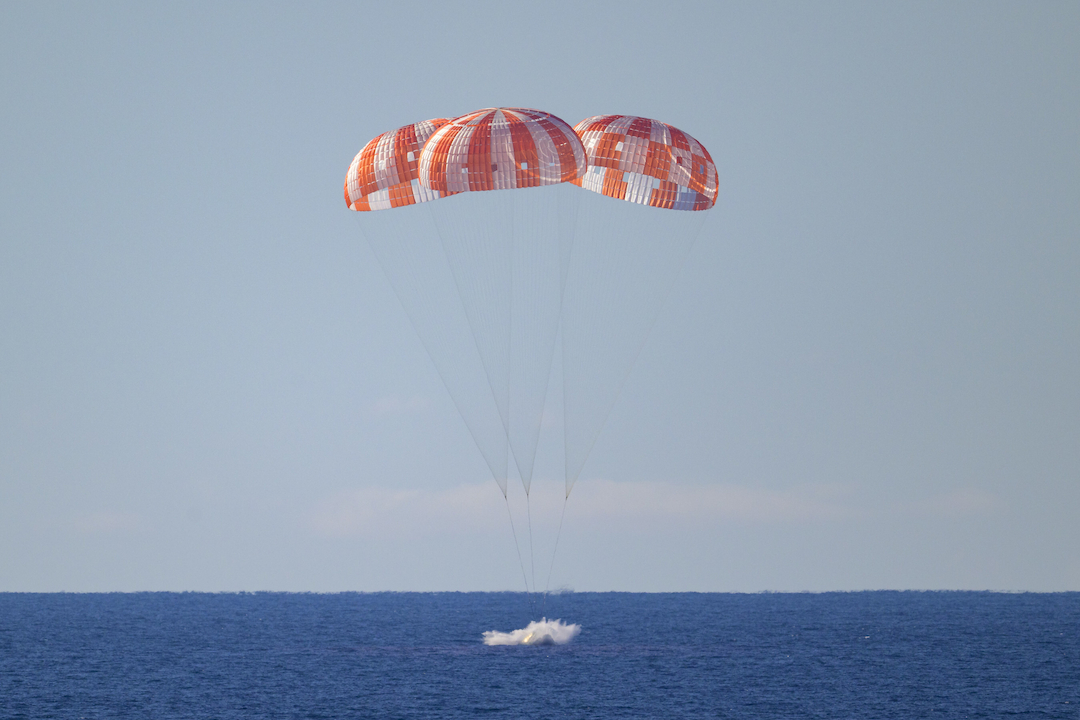
They went around the Moon and came home. The first humans in deep space in 53 years just splashed down in the Pacific.
On April 10, 2026, four astronauts returned to Earth.
Reid Wiseman. Victor Glover. Christina Koch. Jeremy Hansen.
They traveled 694,481 miles. They flew farther from Earth than any human being in history, reaching 252,756 miles at their furthest point. They went around the far side of the Moon. They came back.
The last time humans went this far was December 1972. Apollo 17. Eugene Cernan was the last person to stand on the lunar surface. When he climbed back into the lunar module, nobody knew it would be 53 years before humans returned to deep space.
Now someone has.
What Artemis II actually demonstrated
This was not a landing mission. That comes next.
Artemis II was a validation mission. NASA needed to know that Orion could carry humans beyond low-Earth orbit, sustain them in deep space, and bring them home safely. Everything that happens after depends on that answer.
The crew conducted critical system evaluations across life support, navigation, communications, propulsion, and manual piloting. They tested the fully integrated environmental control systems. They captured science imagery of the far side lunar surface. They pushed every system in Orion to its limit in the one environment where failure is not recoverable.
The most demanding moment was re-entry.
Orion hit Earth’s atmosphere at speeds approaching 24,000 miles per hour. The heat shield faced temperatures nearing 5,000 degrees Fahrenheit. That is roughly half the temperature of the Sun’s surface. The parachute system then executed a precise descent sequence from that extreme deceleration to a controlled splashdown off the coast of southern California.
It worked.
All of it worked.
The heat shield is the critical detail most coverage will miss
Orion uses a thermal protection system built around Avcoat, an ablative heat shield material that burns away deliberately during re-entry, carrying heat away from the spacecraft. The Artemis II entry profile is more demanding than Apollo because Orion is a larger spacecraft returning from a longer trajectory.
According to NASA’s Orion program documentation, the heat shield on Orion is the largest of its kind ever built for a crewed spacecraft, measuring approximately 16.5 feet in diameter. Its performance during Artemis II is not just a box-ticking exercise for this mission. It is the data that informs every future crewed deep space mission. Including the one that lands on the Moon.
What comes next and why the sequence matters
Artemis III will demonstrate docking with NASA’s Human Landing System. That is the mission that puts humans back on the lunar surface for the first time since 1972. Artemis IV will land astronauts on the Moon.
None of that happens without what just succeeded.
Lockheed Martin (NYSE: LMT) is the prime contractor for Orion, leading its design, development, and production. The splashdown validates the program’s readiness to move forward. It also validates Lockheed Martin’s positioning in the deep space exploration supply chain at a moment when both NASA’s budget priorities and the broader geopolitical competition in space are pushing lunar exploration up every government’s priority list.
China has stated publicly that it intends to land taikonauts on the Moon before 2030. The Secure World Foundation’s Space Sustainability Report has documented the accelerating pace of Chinese lunar and deep space program development. Artemis II does not exist in a vacuum. It is part of a competition that extends well beyond science.
The numbers that define this mission
694,481 miles traveled total. 252,756 miles at maximum distance from Earth. 10 days in deep space. Re-entry at 24,000 miles per hour. Heat shield temperatures of 5,000 degrees Fahrenheit. Four crew members. One recovery ship. Zero casualties.
The last number is the one that matters most.
Fifty-three years between the last humans in deep space and the next ones. The gap is closed. What comes after is a question of execution, funding, and political will. The engineering question, can we do this, has just been answered.
We can.
Sources
- NASA — Orion Spacecraft Program
- Secure World Foundation — Space Sustainability Report 2025
- Lockheed Martin — Investor Relations
Editorial disclosure
This article is based on a press release issued by Lockheed Martin and has been independently rewritten and editorially expanded. It covers the successful splashdown of NASA’s Orion spacecraft following the Artemis II crewed lunar mission. Lockheed Martin trades on the NYSE under the ticker LMT. Market context is sourced from NASA and the Secure World Foundation. Commentary reflects the author’s own assessment. The information provided on this website is for informational and educational purposes only. Our content is derived strictly from verified online sources to ensure accuracy and objectivity. This analysis does not constitute financial, investment, or professional advice. Readers are encouraged to consult with qualified professionals before making decisions based on this information. For more information, please see our full DISCLAIMER.