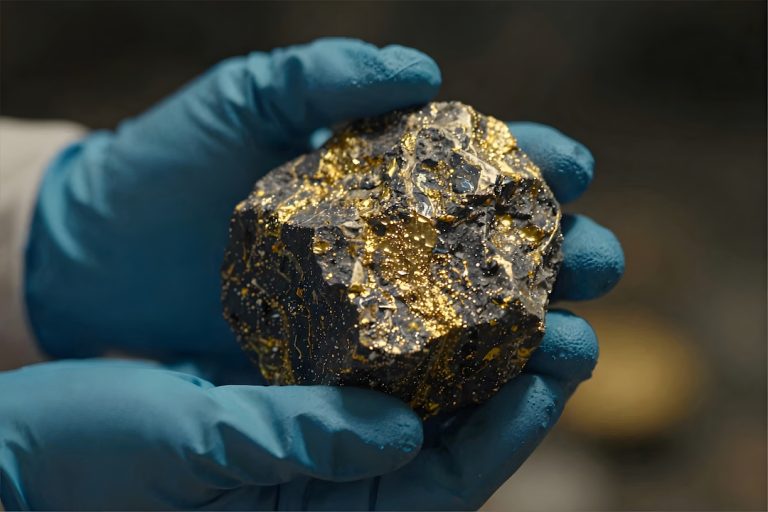
Gold royalty companies are one of the most misunderstood investment vehicles in the mining sector. They do not dig holes or run machinery. They provide financing to mine developers in exchange for the right to receive a percentage of future production revenue. The appeal is straightforward: royalty companies get commodity price upside with far less operational risk than actual miners. When gold rises, their revenue rises. When a mine has a bad quarter, the royalty company does not pay the repair bill.
Gold Royalty Corp. (NYSE American: GROY) just reported its strongest annual results since the company was founded, and the outlook it is projecting through 2030 is ambitious enough to demand serious attention.
What the 2025 numbers actually show
Full year 2025 revenue hit a record $15.6 million, up from $10.1 million in 2024. That is a 54% increase in a single year, driven by rising gold prices and the continued ramp-up of producing assets across the portfolio. The company generated $6.2 million in positive operating cash flow for the full year, a milestone that matters enormously for a royalty company that spent its early years burning cash to build its portfolio.
Adjusted EBITDA reached $9.8 million for the year, compared with $4.8 million in 2024. The company exited 2025 with over $12 million in cash, no debt, and a fully undrawn $150 million credit facility. That balance sheet gives Gold Royalty significant firepower to add new royalties at a moment when gold is trading at historically elevated levels and mining companies are actively seeking creative financing.
The fourth quarter alone delivered $4.5 million in revenue and $5.2 million in total revenue including land agreement proceeds and interest. That quarterly run rate, if sustained, implies an annual revenue trajectory well above 2025’s full year figure even before the new royalties acquired in late 2025 and early 2026 fully contribute.
The 60% growth forecast for 2026 is the number that stands out
Gold Royalty is guiding for 7,500 to 9,300 gold equivalent ounces in 2026, compared with 5,173 in 2025. The midpoint of that range represents more than 60% year-over-year growth. Two specific acquisitions are driving that step change.
The Pedra Branca royalty, added in late 2025 on BHP’s cash-flowing mine in Brazil, provides immediate royalty revenue from an already-producing operation. The Borborema royalty, added in early 2026, comes with a freshly updated feasibility study from operator Aura Minerals that extended the mine life to over 20 years and increased probable reserves to 40.7 million tonnes containing approximately 1.5 million ounces of gold. A royalty on a mine with a 20-year life is a fundamentally different asset from one with five years remaining.
According to the World Gold Council, gold prices have been trading near record highs in 2025 and 2026, providing a powerful tailwind for royalty revenue calculations across the entire portfolio. Gold Royalty’s 2026 guidance assumes a gold price of $5,150 per ounce, which is broadly consistent with current market levels.
The five-year outlook is where the real story lives
The 2030 target of 28,000 to 34,000 gold equivalent ounces represents a 490% increase from 2025 results at the midpoint. That projection comes entirely from assets already in the portfolio, not future acquisitions. Understanding which assets are driving that growth matters.
The Côté Gold mine, where Gold Royalty holds a 0.75% net smelter return royalty, produced nearly 400,000 ounces in 2025 and is guiding for up to 440,000 ounces in 2026. Operator IAMGOLD is focused on optimisation and potential expansion. The Canadian Malartic and Odyssey mine complex, where Gold Royalty holds a 3% NSR on partial coverage, is one of the most significant underground gold developments in Canada, with Agnico Eagle progressing shaft development and evaluating an expansion to 8,000 to 10,000 tonnes per day that could produce initial output by 2033.
The South Railroad project, with a 0.44% NSR, received an updated feasibility study from operator Orla Mining projecting 1.07 million ounces of payable gold over a 10-year mine life, with construction expected in mid-2026 pending final permits. The Whistler project, where Gold Royalty holds a 1% NSR with an option to acquire an additional 0.75%, posted a preliminary economic assessment with an after-tax NPV of $2.04 billion and internal rate of return of 33% at base case metal prices.
These are not speculative exploration assets. They are advanced development and producing projects operated by companies including Agnico Eagle, IAMGOLD, Barrick Mining, Capstone Copper, and BHP.
Why the royalty model works particularly well in the current gold market
The World Gold Council has documented sustained central bank buying, geopolitical uncertainty, and inflation hedging as the primary drivers of elevated gold prices in 2025 and into 2026. When gold prices are high, royalty companies benefit from every ounce produced across their entire portfolio without bearing any additional operating cost. Their revenue scales with the gold price while their cost structure remains largely fixed.
Gold Royalty’s royalty generator model adds another layer of value creation that most investors overlook. The company has generated 56 royalties since acquiring Ely Gold Royalties in 2021, with eight new royalties added in 2025 alone. Many of these are small early-stage royalties acquired at low cost that could become meaningful revenue contributors if the underlying properties develop into mines. The cost of maintaining 38 properties under land agreements was just $0.1 million in 2025, meaning the optionality in the royalty generator portfolio comes at minimal expense.
For investors seeking gold price exposure with less operational risk than owning mining stocks and more upside than holding physical gold, a diversified royalty portfolio at an inflection point in its revenue growth trajectory represents a genuinely interesting proposition. As with all mining investments, results depend on operator performance and commodity prices, and past revenue growth does not guarantee future results.
Sources
- World Gold Council — Gold Prices
- World Gold Council — Gold Demand Trends
- Gold Royalty Corp. — Official Press Release via PRNewswire
Editorial disclosure
This article is based on a press release issued by Gold Royalty Corp. and has been independently rewritten and editorially expanded. It covers the annual financial results and five-year outlook for Gold Royalty Corp., a gold-focused royalty company trading on the NYSE American under the ticker GROY. This article discusses forward-looking financial projections and commodity price assumptions that are subject to significant uncertainty. Past performance does not guarantee future results. Market context is sourced from the World Gold Council. Commentary reflects the author’s own assessment. The information provided on this website is for informational and educational purposes only. Our content is derived strictly from verified online sources to ensure accuracy and objectivity. This analysis does not constitute financial, investment, or professional advice. Readers are encouraged to consult with qualified professionals before making decisions based on this information. For more information, please see our full DISCLAIMER.