
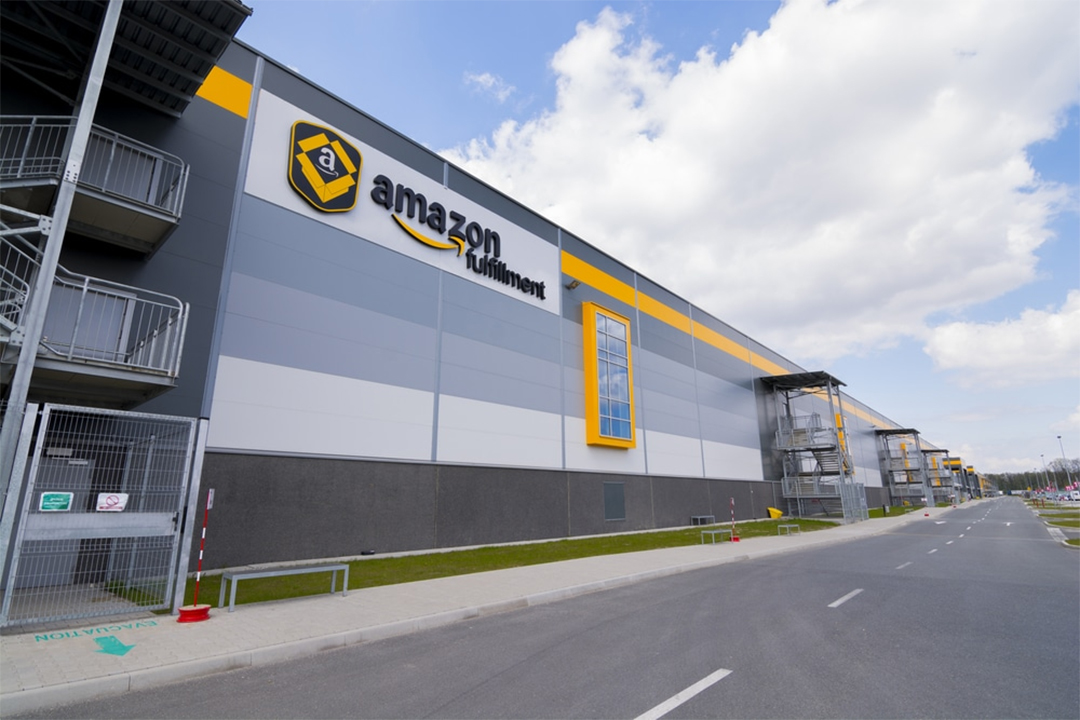
Amazon is betting that concrete — yes, concrete — holds the key to its net-zero future
The construction industry produces more than 35% of global greenhouse gas emissions. Concrete alone accounts for around 8% of global CO2 output, making it one of the single largest contributors to climate change on earth. And yet it is also one of the most overlooked targets for decarbonisation. That is starting to change. On March 19, 2026, Greentown Labs announced the five startups selected for its Go Build 2026 programme, a direct collaboration with Amazon and the Global CO2 Initiative at the University of Michigan focused on one specific and genuinely exciting idea: turning CO2 into construction materials.
Amazon is not doing this out of altruism. It has warehouses, data centres, offices, and grocery stores across the planet, and reaching net-zero carbon by 2040 means decarbonising everything it builds. Lower-carbon concrete is not optional for that goal. It is essential.
What CO2 mineralisation actually means in plain terms
The technology these five startups are developing sounds technical but the core idea is straightforward. Instead of releasing CO2 into the atmosphere as waste, you capture it and chemically bind it into solid building materials. The CO2 becomes part of the concrete or aggregate itself, locked away permanently rather than warming the planet.
This process is called CO2 mineralisation, and it solves two problems simultaneously. It removes carbon from the atmosphere or from industrial emissions. And it produces construction materials that are often cheaper, stronger, or more durable than conventional alternatives. Done at scale, it could transform one of the world’s most polluting industries into one that actively sequesters carbon.
The five startups selected from 62 applicants across 25 countries each approach this differently. Carbon Infuse, based in Brooklyn, New York, upcycles industrial waste and flue gas into construction and manufacturing materials. Carbon Negative Solutions in Portland, Oregon, converts industrial wastes and minerals into carbon-negative cement supplements. Carbon To Stone in Tappan, New York, turns industrial residues and CO2 into lower-carbon construction materials for cement and concrete. Low Carbon Materials in Durham, United Kingdom, develops carbon-sequestering aggregate additives for concrete and asphalt. Neocrete in Auckland, New Zealand, makes low-carbon supplementary cementitious materials behave like cement, reducing both the carbon content and cost of concrete while improving durability.
Each of these approaches targets a different part of the concrete and aggregate supply chain. Together they represent a comprehensive attack on the problem.
Why Amazon’s involvement changes the stakes entirely
Startups developing breakthrough materials face a brutal commercial challenge. The construction industry is deeply conservative. Builders and developers specify materials based on track record, not innovation. Getting a new concrete additive or aggregate substitute into widespread use requires not just technical proof but supply chain integration, procurement relationships, and the kind of validation that only comes from large-scale deployment.
Amazon removes that barrier directly. The company has committed $2 billion to more than 20 sustainability-focused startups and is actively working to decarbonise its global network of buildings as part of its Climate Pledge commitment to net-zero by 2040. When Amazon’s global team works directly with these five startups on technology validation and supply chain strategy, it is not just mentorship. It is a potential commercial pathway that most startups in this space would wait years to access.
According to the Global CO2 Initiative, CO2 utilisation technologies have the potential to generate significant economic value while addressing climate targets, but scaling them requires exactly the kind of corporate partnership this programme is designed to create. Amazon’s procurement scale gives these startups a credible route to the kind of volume that makes the economics work.
The market opportunity behind decarbonising concrete is enormous
The International Energy Agency has identified cement and concrete production as one of the hardest industries to decarbonise, precisely because the CO2 emissions are largely a byproduct of the chemical process of making cement, not just the energy used to power the kilns. Switching to renewable energy alone does not solve the problem. New materials and processes are required.
That challenge creates a genuinely large market opportunity. The global cement market is worth hundreds of billions of dollars annually. Even a modest shift toward lower-carbon alternatives represents an enormous commercial prize. Startups that can demonstrate credible, scalable CO2 mineralisation technologies with major corporate validation behind them are well positioned to capture a share of that market.
Greentown Labs itself has a strong track record with exactly this kind of climatetech innovation. The incubator has supported more than 675 startups since 2011, with a survival rate of 88% and more than $12.5 billion raised collectively by its portfolio companies. That network is not background noise. It is active support that materially improves the odds for the companies in its programmes.
The cohort kicks off on April 1 in Boston — and the global implications go well beyond Amazon
The Go Build 2026 cohort will gather for its kickoff event at Greentown Boston on April 1. The programme gives these five startups direct access to Amazon’s decarbonisation and materials teams, technical support from the Global CO2 Initiative’s researchers at the University of Michigan, and Greentown’s full network of mentors, investors, and corporate partners.
If even one of these five companies scales successfully, the impact extends well beyond Amazon’s buildings. Every construction project that adopts lower-carbon concrete or carbon-sequestering aggregates reduces emissions at a scale that individual consumer choices simply cannot match. Decarbonising concrete is not a niche climate story. It is one of the most important industrial transitions of the next two decades.
Sources
- International Energy Agency — Cement
- Global CO2 Initiative — University of Michigan
- Greentown Labs — Official Press Release via PRNewswire
Editorial disclosure
This article is based on a press release issued by Greentown Labs and has been independently rewritten and editorially expanded. It covers the announcement of the Go Build 2026 startup cohort, a programme involving Greentown Labs, Amazon, and the Global CO2 Initiative focused on CO2 mineralisation technologies for the construction sector. Market context is sourced from the International Energy Agency and the Global CO2 Initiative at the University of Michigan. Commentary reflects the author’s own assessment. The information provided on this website is for informational and educational purposes only. Our content is derived strictly from verified online sources to ensure accuracy and objectivity. This analysis does not constitute financial, investment, or professional advice. Readers are encouraged to consult with qualified professionals before making decisions based on this information. For more information, please see our full DISCLAIMER.