
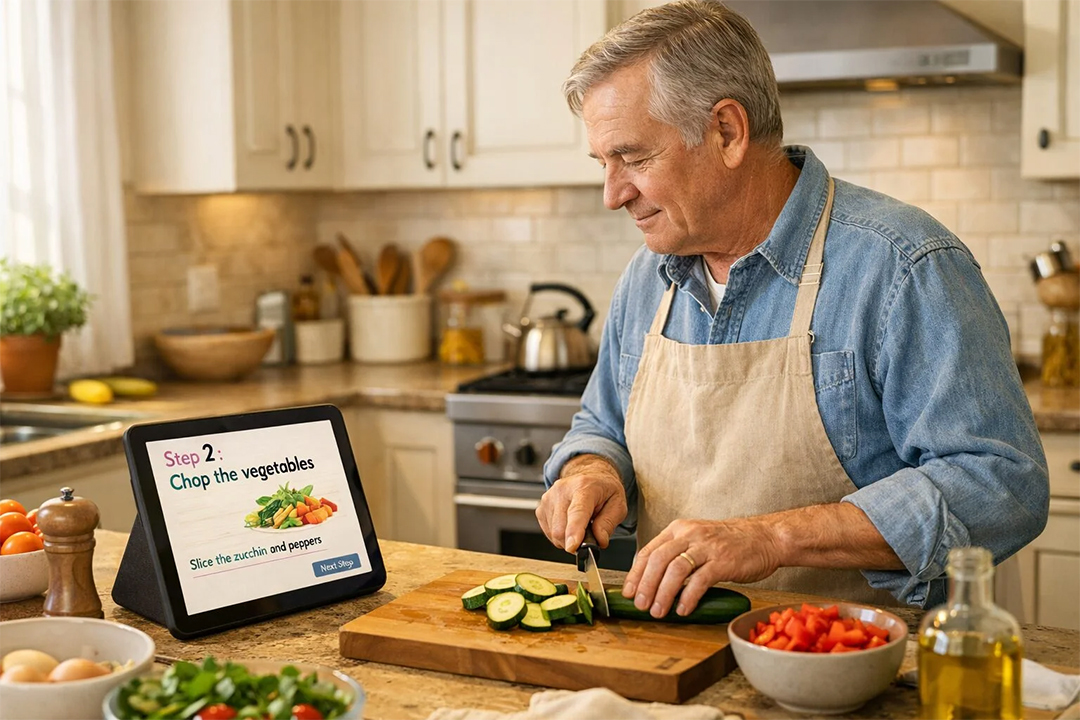
Here’s an interesting problem: millions of older adults experience mild cognitive decline, and that can make even simple tasks, like cooking breakfast or paying bills, tricky. A team at Washington University in St. Louis is experimenting with AI to tackle this. The idea is not to replace caregivers but to create a system that quietly observes and guides when needed.
Watching People Cook, Literally
The researchers focused on cooking first, partly because it is a familiar, everyday task and partly because it is surprisingly difficult to get right when memory or planning skills are slipping. They set up a “smart kitchen” with cameras overhead. Participants were asked to make oatmeal while the AI monitored their actions. Occupational therapy students were also observing, noting mistakes or safety issues.
Now here is the clever part: the AI system, called CHEF-VL, does more than just watch. It tries to understand the sequence of actions, check if steps are skipped, repeated, or done out of order, and flag errors. Because it is based on the latest vision-language models, it can handle a surprising amount of variability. People cook in different ways, and the AI can still make sense of it.
Beyond Paper Tests
Traditional cognitive assessments provide some insight into memory or planning but they cannot fully capture real-world abilities. This system aims to change that. The team reports that it can spot small errors that might signal early cognitive decline, all while observing actual tasks rather than artificial tests on paper.
Why It Matters
For investors thinking about health technology, there is a clear angle: AI tools like this could reduce the need for constant human supervision, potentially lowering care costs and supporting independence for longer periods. There is also a broader public health benefit if older adults remain active and confident in their homes.
The work is still early, and the team is refining the system for everyday environments, but it provides a glimpse into a world where AI does more than automate; it helps people live independently. As Ruiqi Wang, the doctoral student leading much of the AI work, says, “We want people to stay in their homes, feel confident, and be supported when they need it, without being watched all the time.”