Japanese researchers might have found a new way to track health continuously. Instead of a smartwatch or a patch, they made skin that actually glows when certain internal molecules appear. You could say it’s like a living health monitor.
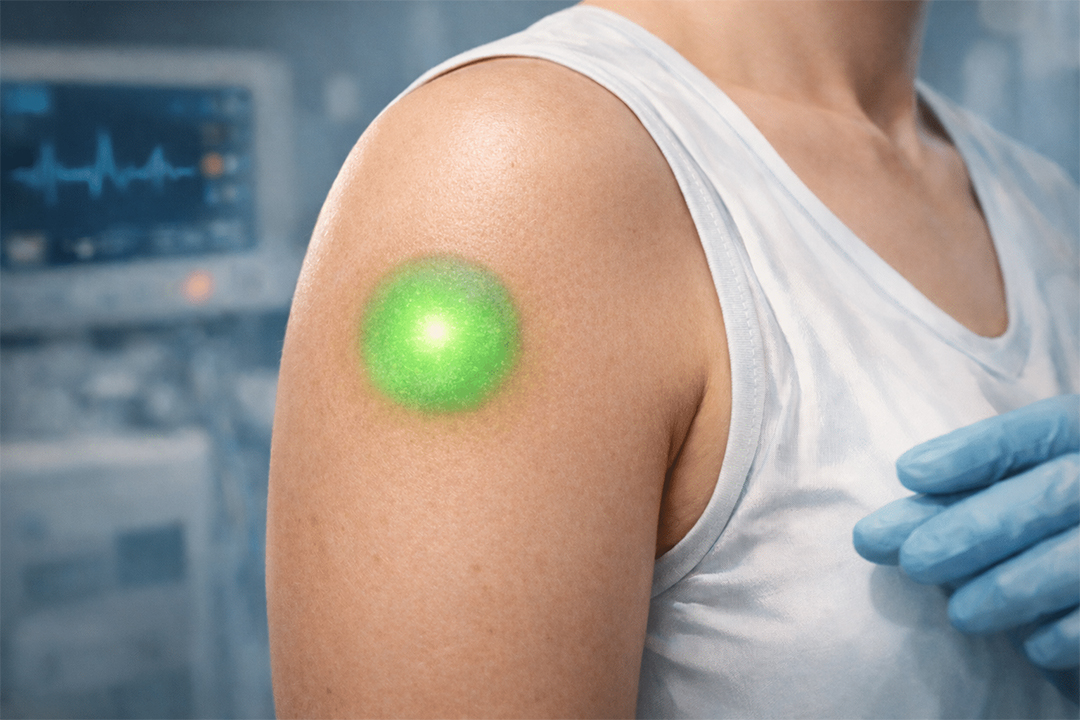
The team, from Tokyo City University and The University of Tokyo, along with RIKEN and Canon Medical Systems, tested the system in mice. They used skin stem cells that naturally regenerate. These cells were modified to glow green when they detect TNF-α, an inflammatory molecule. The glow lasted more than 200 days, because the skin keeps renewing itself. It is interesting that the body itself maintains the sensor. No batteries, no wires, no replacements.
How It Works
Basically, the stem cells are genetically engineered. When inflammation happens, the cells light up. It is visible from the outside, which makes monitoring simple. You do not need blood samples. The grafted skin integrates with the host tissue. Even as the skin cells move and differentiate naturally, the glowing signal stays.
This is different from regular monitoring. Usually, you get snapshots from blood tests or temporary wearables. Sweat, tears, saliva—they all give some info but cannot track internal signals continuously. This living skin does it all the time.
Applications and Potential
The researchers say it could also work for animals. Pets or livestock could show visual signs of illness. In humans, it could help with long-term monitoring of inflammation and other health markers. It is still early, and for now it works in mice. But the idea shows a path toward continuous, biologically integrated monitoring.
The system could be adapted for other molecules, not just inflammation. You change the receptors, you could track glucose or stress markers. It is a proof of concept that living tissue can act as a sensor. And it is biologically self-maintaining.