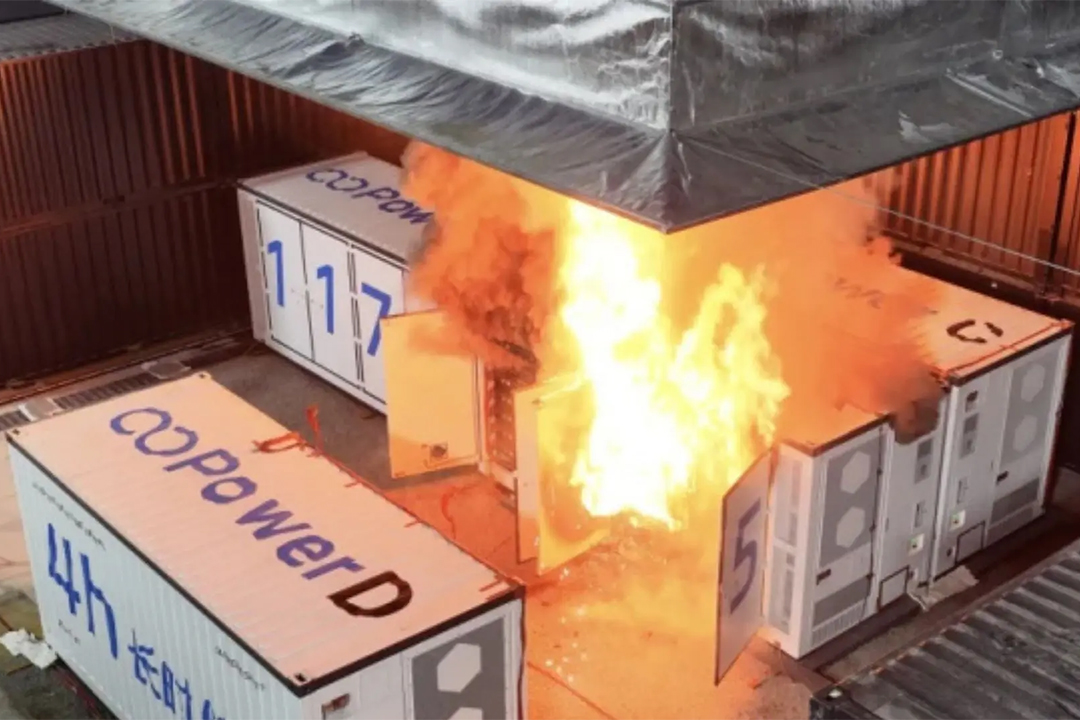
HiTHIUM has completed the world’s first open-door, large-scale fire test of a 6.25MWh battery energy storage system (BESS) using kiloampere-hour (kAh) battery cells, marking a major milestone in long-duration energy storage (LDES) safety validation.
The test was conducted on HiTHIUM’s ∞Power 6.25MWh four-hour system under full supervision from UL Solutions, U.S. authorities having jurisdiction, and fire protection engineers. Testing complied with the latest UL 9540A (2025) and NFPA 855 (2026) standards.
Pushing Energy Storage Safety to Higher Capacity Levels
The fire test builds on HiTHIUM’s earlier open-door validation of a 5MWh system and extends safety verification to significantly higher energy density. The system tested incorporated HiTHIUM’s ∞Cell 1175Ah battery cells, validating safety performance at both the cell and system levels.
Results showed that the 6.25MWh system maintained stable, controllable behavior under extreme thermal conditions, demonstrating that higher-capacity LDES systems can be deployed without compromising safety.
Extreme Test Conditions Designed to Exceed Real-World Scenarios
To stress the system beyond typical operating environments, the test was conducted under the most severe conditions allowed by safety standards:
- Container doors remained fully open to maximize oxygen flow and flame exposure
- Adjacent containers were positioned back-to-back and side-by-side with only 15 cm of spacing
- The system was charged to 100% state of charge
- All active fire suppression systems were disabled
Under these conditions, the system relied entirely on intrinsic safety design rather than external mitigation.
Three Safety Challenges Validated Across Cell, Module, and System Levels
HiTHIUM’s safety architecture follows a multi-layer design philosophy spanning the cell, module, and container levels. The test focused on three core challenges associated with ultra-large-capacity battery systems.
Controlled Energy Release Without Explosion
To manage thermal runaway in 1175Ah cells, HiTHIUM engineered directional airflow channels and dual pressure relief valves at the module level. This allowed rapid, controlled venting of gases without pressure buildup. No explosions or debris ejection occurred during the test.
Fire Containment Without Thermal Propagation
Despite direct flame exposure and minimal spacing between containers, fire-resistant module covers, reinforced steel enclosures, and insulated container structures confined the fire to a single unit. Temperatures in adjacent containers remained below safety thresholds, with no thermal propagation observed.
Structural Integrity Under Prolonged Heat Exposure
The ∞Power 6.25MWh system incorporates a reinforced steel frame, structural stiffeners, and dual-layer partitions. After extended high-temperature exposure, the affected container remained structurally intact, showing no collapse or significant deformation.
A New Benchmark for Long-Duration Energy Storage Safety
The successful open-door fire test represents a major advancement in safety validation for high-capacity energy storage systems. As industry deployments move from 5MWh toward 6MWh and beyond, this test establishes a reference point for intrinsic safety at higher energy levels.
HiTHIUM stated that it will continue prioritizing long-duration energy storage as a core strategic focus, advancing safety through extreme-condition testing and participation in the development of global energy storage safety standards.
The company aims to support broader adoption of large-scale energy storage by improving reliability, scalability, and safety; key requirements for a stable and sustainable global energy transition.
Forward-looking information is subject to risks and uncertainties. Please read our full DISCLAIMER.